Works on My Machine Is Not Just an Excuse (Book I)
"Works on My Machine" is Book I of my series, "Works Left Undone".
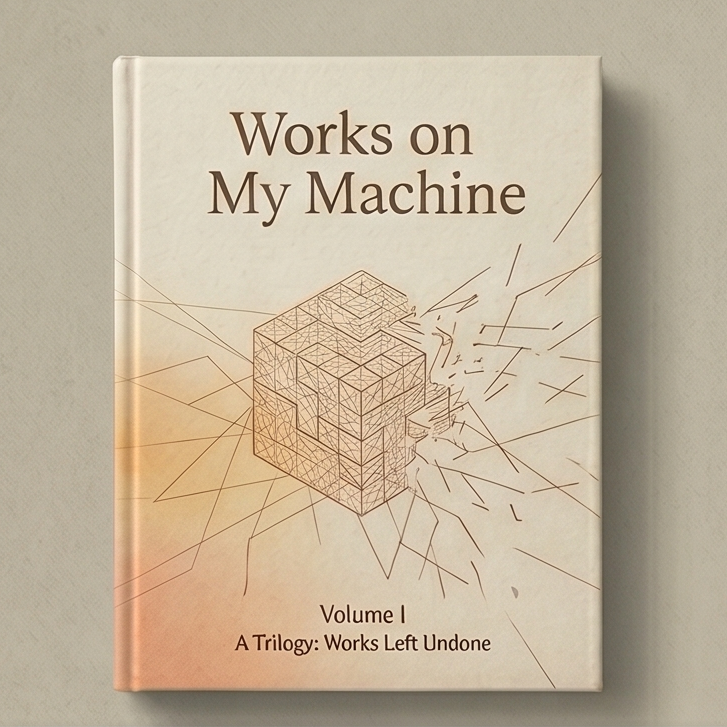
As I explain in my introduction to Open Book:
Open Book is an event series that provides an environment where people can contribute a piece to the series: a passage, a personal narrative that matches the theme, a chapter edit, etc. Below, I have detailed a sketch of an outline for Book I.
| "Open Book provides a rough scaffold"
- Introducing Open Book, a pilot event series by Open for Product➾
Inevitably, this is bound to change if participants take things in another direction. Necessarily, I want to keep this open to changes—not just the prose in the chapter, or vignettes that support the other chapter content, but the structure and strategy of the story itself.
This is entirely "safe", even from the perspective of any one person (me, for instance!) wanting things to go a certain way because the approach that undergirds the whole thing is a mechanism that software programmers use to collectively build things, and that mechanism retains a history of changes as well as producing a final result.
| "keep this open to changes"
The technology involved in setting up that procedure is known as a repository with versioning. I'll talk about what that is, and how it works for Open Book in a future post.
Now, enough about that; let's get to the content of this post!
Book I
Works on My Machine
Overview -
This volume examines the fracture and compression of meaning through language evolution.
A world in which systems function perfectly at the local level—but fail catastrophically when scaled—reveals the limits of broadcast communication and optimized discourse. Dialogue collapses into performance. Truth becomes positional rather than relational. People still speak, but shared understanding erodes.
The central tension:
Language still works—but no longer connects.
Chapter by chapter themes:
    • Context → how meaning fails
    • Compression → why it fails
    • Power → who carries the cost
    • Scale → how systems enforce it
    • Experience → how it feels
    • Slowness (human) → what might restore capacity
    • Pause → consent to proceed
    • Slowness (machine) → how tools can align or distort
    • Collective systems → how we build together
    • Living knowledge → how it continues
PART I — Context Failure
Chapter 1 — Works on My Machine
Context mismatch as diagnostic, not blame.
Chapter 2 — Conservation of Meaning
Compression, lossiness, and what survives.
Chapter 3 — Silent Context Switching
How shared context became compulsory; invisible labor and enforcement.
Interlude I — Orientation
A threshold marker.
Recaps the terrain: context → compression → lopsided repair.
Invites nonlinear entry and reflection.
PART II — Structural Acceleration
Chapter 4 — Enforced Context
Systemic examples of compression and clarity enforcement.
Chapter 5 — From Dialogue to Broadcast
Architectural shift; scale requires compression.
Chapter 6 — Acceleration and Lived Experience
Temporal compression, attention capture, loss of narrative depth.
Interlude II — Orientation
Summarizes: architectural shift → experiential thinning.
Signals the turn toward possibility.
PART III — Slowness and Reconstruction
Chapter 7 — Slow Meaning
Human principles of slowness: attention, care, deliberation, repair, design posture.
Interlude III — Cognitive Consent
Not informational. Existential.
Encourages noticing.
Invites readers to decide whether they are willing to carry slowness forward before tools enter the picture.
Chapter 8 — Slow Machines
Designing AI and sociotechnical systems that expand context rather than collapse it.
PART IV — Collective Design
Chapter 9 — Designing Together
Collective governance, cooperative participation, OfP-style scaffolding.
Chapter 10 — This Book Is Not Finished
How it was written; how it evolves; how readers enter the process.
what do you think?
- Is Open Book something you would participate in?
- What do you see in the progression of human language over time?
- What benefits do you recognize about how fast and far information can travel today?
- What concerns does that raise for you?
Thank you for sharing on steem! I'm witness fuli, and I've given you a free upvote. If you'd like to support me, please consider voting at https://steemitwallet.com/~witnesses 🌟
Thank you for engaging!
Upvoted! Thank you for supporting witness @jswit.