The Man Who Tried to Measure the Earth with His Feet and His Mind
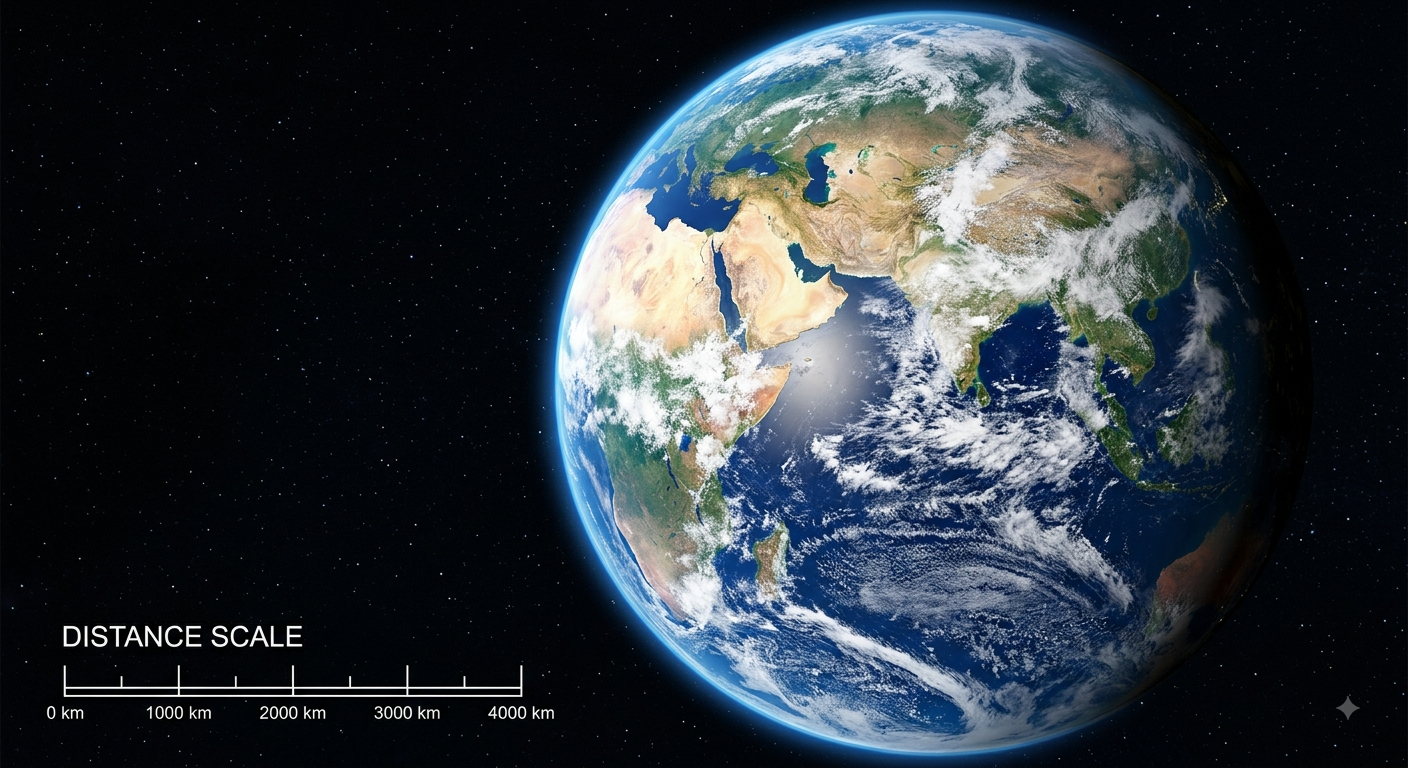
The Man Who Tried to Measure the Earth with His Feet and His Mind
At around seventeen years old, most young people his age were occupied with the beginning of their lives...
But he was standing and observing the sun, then turning what he saw into numbers and calculations.
He was not searching for fame.
He wanted to know one thing:
How can a human being measure the world around him accurately?
He was born in Khwarazm in the tenth century CE and grew up in a scholarly environment. He began studying mathematics and astronomy at an early age. By the age of seventeen, he had already begun carrying out serious scientific work, including calculating the latitude of his birthplace by observing the height of the sun.
But his life was not peaceful.
Political conditions in Khwarazm changed, forcing him to move between different regions, and he spent periods without a stable home or consistent patronage.
Yet he did not stop researching.
He carried his curiosity with him wherever he went.
He studied mathematics, astronomy, medicine, and geography, and learned several languages, allowing him to access scientific sources from different civilizations.
Then came a period that completely transformed his scientific life.
He reached India, and there he did not simply observe the country from the outside.
He learned Sanskrit, read Indian texts, studied mathematics, astronomy, philosophy, customs, and social systems, and attempted to understand the society in which he lived through its own original sources.
He then wrote a major work about India. It was not merely a description of a foreign land, but an extensive study of Indian knowledge, culture, and sciences.
But what makes his story truly remarkable came when he attempted to answer a seemingly simple question:
How large is the Earth?
Of course, he could not travel around the Earth and measure it.
So he developed a mathematical method based on measuring the height of a mountain and the angle of depression of the horizon from its summit. He then used geometry and trigonometry to determine the Earth's radius.
He applied his method in the region of Nandana in India.
The result was remarkably close to the value we know today. Historical sources state that he estimated the Earth's radius at approximately 6,339.6 kilometers.
Imagine the scene...
A man living nearly a thousand years ago, with no satellites, GPS devices, aircraft, or modern measuring instruments.
And yet he climbed to a high place, measured the angle of the horizon, used mathematics, and attempted to determine the size of an entire planet from those measurements alone.
And that was only one of his achievements.
He developed mathematical methods for calculating locations and distances, calculated differences in longitude between cities, produced tables of coordinates for hundreds of locations, and paid attention to measurement errors in scientific observations rather than simply ignoring them.
This particular quality was one of the things that distinguished him most.
He did not accept a result simply because it agreed with an idea he already believed.
He valued observation, compared measurements, discussed possible sources of error, and tried to reach conclusions with as few assumptions as possible.
He combined mathematics, observation, and experimentation in a way that made him one of the most remarkable scholars of his era.
Even more remarkably, this man did not leave his mark on only one field.
He wrote about astronomy, mathematics, geography, medicine, pharmacology, minerals, history, and cultures, and he is credited with a remarkably large body of scientific works.
He lived in an age when a scientific journey could mean crossing deserts, facing political instability, and relying on tools that were primitive compared with what we have today.
Yet he continued to ask:
How do I know that this information is correct?
Then he searched for a way to measure it.
That is why he was not merely a scholar who collected information...
He was a scholar who wanted to test the world through numbers.
Centuries later, his calculations and mathematical methods remain evidence of a mind capable of extracting remarkable knowledge from simple observations.
And now, a question for you:
Did you figure out who this person was?
Write his name in the comments before you look him up. 👇