My Plan for the Billion Dollar Build
The Billion Dollar Unicorn
Perplexity has a contest running: Create a one billion dollar unicorn in 8 weeks. You're up for consideration as a finalist against other builds for a share of $1 million, and $1 million Perplexity Computer (an agentic AI environment) credits for your product.
I've been accepted into the contest with Open for Product, although I think I'll shift that (if I'm allowed; more on that later in the post) to a product I call Session Queen.
A Prompt to Prepare
Here's what I submitted to the Perplexity app in a prompt to generate my next best actionable steps for the next several weeks in order to possibly pull this off. (I'm doubtful, but I'll show you part of what I got back, and you can let me know if this could work):
- A summary of Open for Product (OfP) and the core principles
- An explanation of what Session Queen was as it was initially designed, and how it can evolve to support OfP
- A description of Jester - a Queen companion so some of the work can be split by purpose
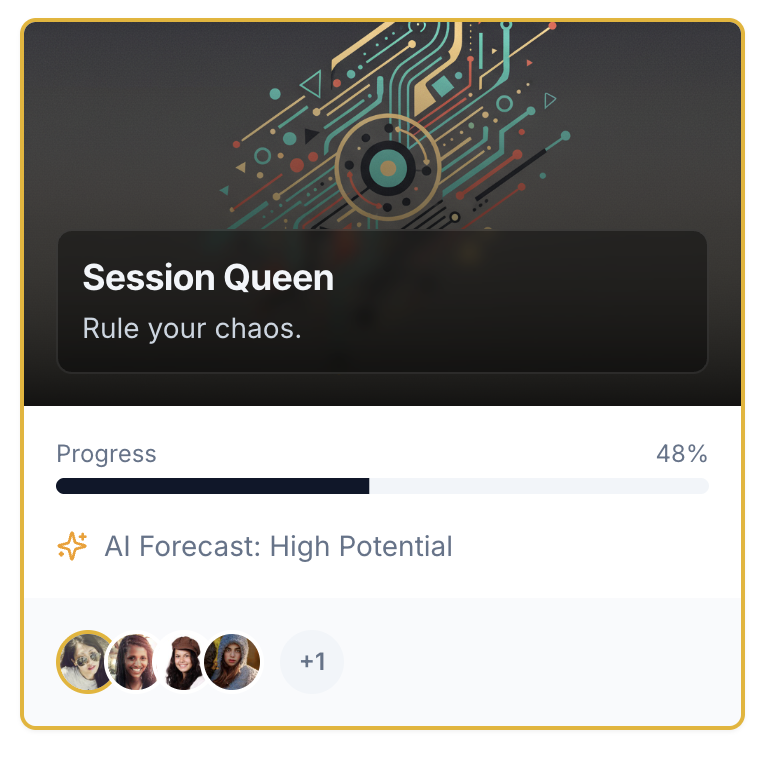
Session Queen is an AI orchestration concept originally designed to manage cross-platform AI sessions, chats, research threads, and project contexts. The evolved version is broader: Session Queen should help manage an entire project, not merely a chat session.
Session Queen is the execution continuity layer for projects.
The central idea:
Most tools help people plan work. Some tools help people do work. Session Queen helps work keep moving between moments of human attention.
Session Queen should coordinate project context, contributor onboarding, daily planning, task recommendations, agent-supported execution, and project momentum.
It should feel less like a chatbot manager and more like a persistent project steward.
The product architecture includes two main personalities/systems:
- Queen
Queen is the actor/operator.- Jester
Jester is the observer/sensemaker.
Queen:
- welcomes and onboards contributors with task suggestions
- helps project leads identify next steps
- drafts outreach, messages, summaries, and briefs
- executes using Perplexity Computer where appropriate
- keeps the project moving when humans are not actively present
Jester:
- watches project activity, particularly momentum
- identifies patterns across projects
- compares needs across projects
- recommends when an agent can assist as workflows become reliable enough to automate
- warns when something should remain human-weighted
- surfaces insights with a slightly irreverent but useful tone
Queen acts. Jester interprets.
The central loop:
Signal → Interpretation → Action → Continuity
NOTE to my reader: I think of this a little like finding the predictable patterns within a double pendulum system.
Examples:
- Signal: a new person joins a project.
- Jester interprets the project’s current needs and the contributor’s profile.
- Queen reaches out, asks onboarding questions, and recommends 1–3 specific scoped contribution paths.
- The project gains momentum without the project lead manually handling everything.
Another example:
- Signal: several projects need a similar onboarding checklist.
- Jester recognizes that a hybrid human-agent onboarding flow has worked repeatedly.
- Queen recommends applying that proven pathway to a new project.
- A human lead can approve the reuse or allow Queen to run it with agent assistance.
Queen, Essentially
Essentially, I initially designed Session Queen as a cross-model context assistant:
"Was I chatting with ChatGPT, Gemini or Claude when I had that conversation about how Tesla conceptualized everything in the universe as a manifestation of some sort of vibration?"
Session Queen knows, so I don't have to keep track! Later I realized Queen could be valuable as a component of Open for Product by keeping project momentum going.
"Session Queen knows."
One of the core design patterns of Open for Product I'd like to keep as things evolve is the idea of partial contribution and incompleteness. Queen can help keep things moving even if the human who initiates something shifts to another human who carries it forward, or it can fill the gaps autonomously (with guardrails) when there's a gap in human ownership. So I redesigned Queen—conceptually; it doesn't exist in the real world yet—to operate more broadly than across chat interfaces. And I directed the design so that it works specifically within Open for Product.
It seems like a good match since Session Queen needs an interface and a real world testing ground, and Open for Product needs a feature that fosters project momentum with flexibility. And so, the submission continues:
The plan
My entire prompt was much larger, and I received a full document as a response.
But below is a bird's eye view of what the math (that's what's happening in the background) says I should focus on over the next few weeks. We're already a few weeks in, so this isn't an 8-week plan, despite how long the contest is.
The full plan is in the file I just shared. Three things up top so you can act today:
MVP scope (4 weeks)
Project page → public join link → Queen onboarding (4 questions, magic-link) → Queen welcome + 1–3 first tasks via Computer → Jester daily brief → sign-off queue (approve/edit/reject) → workflow pattern panel → public Computer audit log. Cut everything else.
4-week plan (skim)
- Week 1 — Spine: Next.js + Supabase + Vercel up; schema migrated; Computer wrapper with logging; contributor join → Queen output works end-to-end; market + beachhead sweep; coming-soon page.
- Week 2 — Loop: Jester brief + sign-off queue + stalled-task scan + landing page; soft launch; 3+ projects with at least one approved Queen action.
- Week 3 — Traction: 10–20 testers, 5+ live projects, 3 testimonial quotes, 200+ waitlist, pattern panel showing real stabilizing patterns.
- Week 4 — Pitch: polish, 5-min demo recording, 2-min hero video, 60-sec cut, launch thread, finalist application.
I'll also give you this context:
Under consideration are four signals — market size, working product, traction, and Computer being genuinely core.
Here's what I told Perplexity about my Total Addressable Market:
Open for Product plays in a converging TAM of roughly 8–15 billion dollars annually, sitting at the intersection of virtual assistant services, virtual event/facilitation, community platforms, collaboration tools, and digital content creation for a core audience of about 29.8 million U.S. solopreneurs (plus broader freelancers and alternative work organizations). The strongest positioning in that market is as: (1) a governed collaboration and project-hub layer that reduces tool sprawl and turns fragmented solo work into sustained project momentum by encoding roles, onboarding, and shared decision‑making for small, ad hoc teams; and (2) a facilitation‑plus‑assets engine (live experiences, digital guides, AI‑assisted templates) that helps “unique professionals” translate loosely held ideas into concrete, reusable systems and outcomes—effectively the operating system for a new, cooperative‑leaning paradigm of work rather than just another app in the stack.
Why shift from Open for Product to Session Queen?
First, at the moment Open for Product doesn't have a lot of substance; it depends a lot on the community that might evolve around it and specific projects to make it real. It's going to scale and evolve with the crowd that uses it—otherwise, it's just a repository of ideas.
Second, I re-read the rules in greater detail, and found that a winner must relinquish some portion of the business to the Perplexity Foundation who are granting the cash injection. Oops! Open for Product is designed as a cooperative business.
Now, while it's entirely possible that the cooperative might vote to allow the equity trade for a cash foundation, we're not formalized:
- In my state, a cooperative needs 5 members to incorporate; and it's just me right now and
- That means no bylaws (and so no way to formally recognize our declare any desire to trade equity for cash)
And so, if I win (again doubtful):
I'm left with the option to simply walk away without cash—and honestly, that's not a bad option as far as I'm concerned; I will have created a presumably viable product with potential, at least by some measure, and Open for Product would enjoy whatever publicity and network effect comes out of the whole effort.
Or I can sell a portion of Session Queen instead if I can make the case for that being the unicorn instead of Open for Product.
Upvoted! Thank you for supporting witness @jswit.