Artificial Rain: Can Humans Really Influence the Weather?
For thousands of years, rainfall has been completely controlled by nature. People could only wait and hope for rain during dry seasons. Today, however, science has introduced an incredible technology called cloud seeding, commonly known as artificial rain. While this technology cannot create clouds from a clear sky, it can encourage existing clouds to produce more rainfall under suitable weather conditions. As climate change continues to increase droughts and water shortages around the world, many countries are investing in this technology to protect agriculture, improve water supplies, and reduce the impact of extreme weather. It is one of the most fascinating examples of how science is working alongside nature to solve real-world problems.
Cloud seeding works by releasing tiny particles, such as silver iodide or natural salts, into moisture-filled clouds using specially equipped aircraft or ground-based generators. These particles provide a surface for water droplets to gather together, eventually becoming heavy enough to fall as rain. Countries like the United Arab Emirates, China, the United States, and Australia have already used this technology in different weather conditions. Although results are not always guaranteed, many successful experiments have shown that cloud seeding can increase rainfall when the atmosphere is suitable. Scientists continue improving the process to make it more efficient, environmentally safe, and reliable for future use.
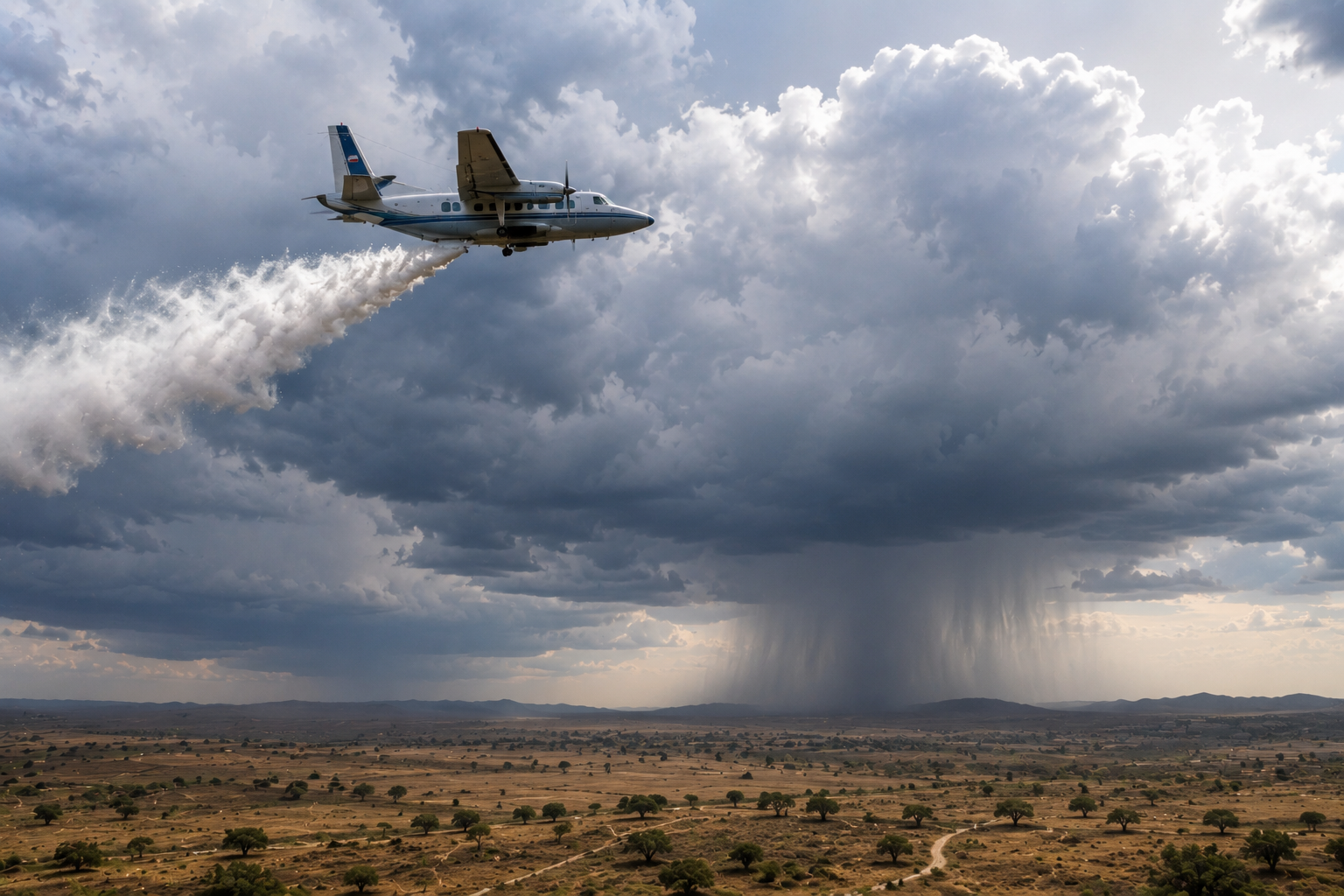
Artificial rain could become an important tool for solving future water problems. It may help farmers during long dry seasons, increase water levels in reservoirs, reduce the risk of drought, and improve food production. Some researchers are even exploring whether cloud seeding can reduce the intensity of certain weather conditions in specific situations. However, this technology still has limitations because it depends entirely on existing clouds and favorable atmospheric conditions. It cannot completely control nature, and researchers continue studying its long-term environmental impact before expanding its use worldwide.
Personally, I think artificial rain is one of the most impressive examples of modern science supporting human life without replacing nature itself. It proves that technology can provide practical solutions to global challenges while respecting the natural environment. Although cloud seeding is still developing, its future looks promising, and it may become an important part of water management for many countries in the coming decades.
What Are Your Thoughts?
Thank you for reading! I'd love to hear your opinion in the comments. If you enjoyed this article, your support and feedback would be greatly appreciated.