Autonomous rescue drone capable of locating more than 80% of people who fall into the sea in minutes/Dron autónomo de rescate capaz de localizar más del 80% de las personas que caen al mar en minutos
Source
In my younger years I have had the luck or misfortune to serve in the Spanish navy. One of the drills we did most frequently was the "man overboard" drill, which implied that one of the crew members had fallen overboard. The rescue (in this case of a normal doll) involved quite complex maneuvers to avoid losing sight of the doll because, if you lost sight of it, it was practically impossible to recover it. That's why I understand that for all professionals who work at sea this is very hopeful news.
En mis años mozos he tenido la suerte o la desgracia de servir en la marina de guerra española. Uno de los simulacros que hacíamos más frecuentemente era el de "hombre al agua", que implicaba que alguno de los tripulantes se había caído por la borda. El rescate (en este caso de un muñeco al uso) implicaba maniobras bastante complejas para evitar perder de vista al muñeco porque, si lo perdías de vista, era prácticamente imposible recuperarlo. Por eso entiendo que para todos los profesionales que trabajan en el mar esta sea un noticia muy esperanzadora.
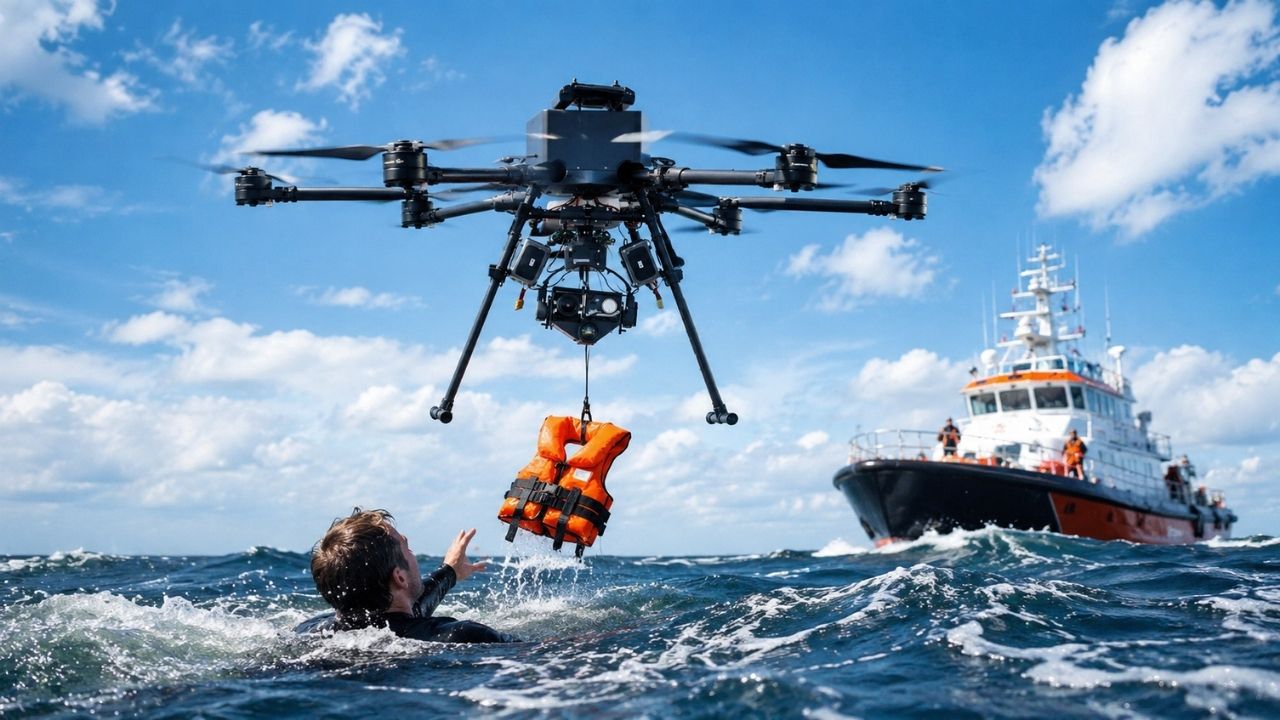
It is an autonomous drone designed by researchers at the Technical University of Denmark (DTU) to revolutionize rescues of people who fall into the sea. This drone uses artificial intelligence and advanced sensors to locate victims quickly and efficiently, even in adverse maritime conditions. The system is deployed from a moving boat to search for people in the water completely automatically. Its artificial intelligence software does not search at random. It analyzes real-time data such as wind speed, ocean currents and time since the fall to predict the most likely area where the victim is located. This avoids inefficient search patterns and saves time.
Se trata de un dron autónomo diseñado por investigadores de la Universidad Técnica de Dinamarca (DTU) para revolucionar los rescates de personas que caen al mar. Este dron utiliza inteligencia artificial y avanzados sensores para localizar víctimas de manera rápida y eficiente, incluso en condiciones marítimas adversas. El sistema se despliega desde un barco en movimiento para buscar personas en el agua de forma completamente automática. Su software de inteligencia artificial no busca al azar. Analiza datos en tiempo real como la velocidad del viento, las corrientes oceánicas y el tiempo transcurrido desde la caída para predecir la zona más probable donde se encuentra la víctima. Esto evita patrones de búsqueda ineficientes y ahorra tiempo.

Source
To detect a person, the drone combines RGB cameras (normal vision), thermal and infrared cameras. This allows body heat to be seen, making it easier to locate even at night, in fog or between waves. The system also includes LiDAR sensors to improve accuracy. Once the person is located, the drone has the ability to automatically launch an inflatable life jacket equipped with a GPS marker. This provides immediate flotation, increasing survival time and giving rescuers the exact location of the victim.
Para detectar a una persona, el dron combina cámaras RGB (visión normal), cámaras térmicas e infrarrojas. Esto permite ver el calor corporal, lo que facilita la localización incluso de noche, con niebla o entre olas. El sistema también incluye sensores LiDAR para mejorar la precisión. Una vez localizada la persona, el dron tiene la capacidad de lanzar automáticamente un chaleco salvavidas inflable equipado con un marcador GPS. Esto proporciona flotación inmediata, aumentando el tiempo de supervivencia y dando a los equipos de rescate la ubicación exacta de la víctima .
The drone, which weighs 24.8 kg and measures 2.4 meters in diameter, can cover an area of up to 1 square kilometer with a flight range of 30 minutes. The main impact of this technology is to save lives. The statistics are harsh: more than 85% of people who fall overboard from a ship die at sea. Traditional search methods are slow and less accurate. According to initial tests, this autonomous drone has a success rate of over 80% in locating people in the water, all in a matter of minutes.
El dron, que pesa 24.8 kg y mide 2.4 metros de diámetro, puede cubrir un área de hasta 1 kilómetro cuadrado con una autonomía de vuelo de 30 minutos. El principal impacto de esta tecnología es salvar vidas. Las estadísticas son duras: más del 85% de las personas que caen por la borda de un barco fallecen en el mar. Los métodos de búsqueda tradicionales son lentos y menos precisos. Según las pruebas iniciales, este dron autónomo tiene una tasa de éxito superior al 80% en la localización de personas en el agua, y todo en cuestión de minutos.

Source
By dramatically reducing search time and providing a flotation device immediately, you combat the leading cause of death: hypothermia. Ultimately, this technology represents a crucial advance for maritime security. As usually happens with these things, at the moment the drone is only a prototype in the development and testing phase and is not yet commercialized. The latest tests have been carried out in the Kattegat Sea, between Denmark and Sweden, where a mannequin with a heated vest has been used to simulate a person in the water and verify the accuracy of the system.
Al reducir drásticamente el tiempo de búsqueda y proporcionar un dispositivo de flotación de inmediato, se combate la principal causa de muerte: la hipotermia . En definitiva, esta tecnología representa un avance crucial para la seguridad marítima. Como suele pasar con estas cosas, de momento el dron es solo un prototipo en fase de desarrollo y pruebas y aún no está comercializado. Las últimas pruebas se han realizado en el mar Kattegat, entre Dinamarca y Suecia, donde se ha utilizado un maniquí con un chaleco calefactado para simular a una persona en el agua y verificar la precisión del sistema.
The long-term goal is for these drones to be installed as standard safety equipment on all types of ships, but the path is complex. The maritime sector is heavily regulated, so the introduction of a new product requires a very extensive testing and certification phase. While these regulatory barriers are overcome, the researchers' vision is more realistic in the short term. Their idea is that the drone can initially be adopted by public services such as the coast guard so that, in the event of an emergency, they can quickly send it to deliver a life jacket to the victim and thus gain vital time.
El objetivo a largo plazo es que estos drones se instalen como equipo de seguridad estándar en todo tipo de barcos, pero el camino es complejo. El sector marítimo está fuertemente regulado, por lo que la introducción de un nuevo producto requiere una fase muy extensa de pruebas y certificaciones. Mientras se superan esas barreras regulatorias, la visión de los investigadores es más realista a corto plazo. Su idea es que el dron pueda ser adoptado inicialmente por servicios públicos como la guardia costera para que, en caso de emergencia, puedan enviarlo rápidamente para entregar un chaleco salvavidas a la víctima y así ganar tiempo vital.
More information/Más información
https://en.clickpetroleoegas.com.br/a-24-meter-drone-created-in-denmark-could-change-sea-rescues-by-locating-castaways-with-more-than-80-success-landing-on-ships-in-seconds-and-ctl01/
The autonomous rescue drone represents a monumental advancement in maritime safety. Using artificial intelligence (AI), thermal imaging, infrared camera technology, laser-based 3D mapping (LiDAR), and real-time information about surrounding conditions, this drone can rapidly locate victims in the water compared to conventional search methods. The drone’s capacity to deploy a GPS-enabled inflatable lifejacket immediately when it identifies a person will help save lives lost to hypothermia. The autonomous rescue drone has achieved an impressive testing success rate of greater than 80% and demonstrates significant potential for use as a life-saving device. As the drone continues to advance beyond the prototype phase, it will be instrumental to search-and-rescue operations throughout the world and will definitely benefit coast guard agencies and commercial vessels globally.