Cryogenic robots, the new alternative for extinguishing fires with liquid nitrogen/Robots criogénicos, la nueva alternativa para apagar incendios con nitrógeno líquido

Source
I imagine most of you aren't aware, but this year in Spain, more than 150,000 hectares of vegetation have already burned this summer. The saddest part is that this situation repeats itself, to a greater or lesser extent, every year. Despite the dedication and skill of the firefighting teams, these fires always have catastrophic consequences. Furthermore, firefighting techniques seem to have evolved considerably, which is why any innovation in this field is so welcome.
Supongo que la mayoría de vosotros no estáis al tanto pero este año en España, en lo que va de verano, ya se han quemado más de 150.000 hectáreas de vegetación. Lo más triste de todo es que esta situación se repite, en mayor o menor medida, todos los años. A pesar del empeño y la pericia de los equipos de extinción, estos incendios siempre tienen consecuencias catastróficas. Además, curiosamente la extinción de incendios parece haber evolucionado especialmente, por eso cualquier innovación es este terreno.
Along these lines, a team from Northeastern University, led by Professor Yiannis Levendis, has developed a prototype robot that uses liquid nitrogen to extinguish fires quickly and without harming the environment. The robot is designed to access dangerous or difficult-to-reach areas for firefighters. Its operation is based on two main actions. First, when liquid nitrogen (at -196°C) is sprayed onto the fire, it evaporates and expands almost 1,000 times its volume. This massive expansion displaces oxygen from the area, effectively suffocating the flames.
En esta línea, un equipo de la Universidad de Northeastern, liderado por el profesor Yiannis Levendis, ha desarrollado un prototipo de robot que usa nitrógeno líquido para apagar incendios de forma rápida y sin dañar el medio ambiente. El robot está diseñado para acceder a zonas peligrosas o de difícil acceso para los bomberos. Su funcionamiento se basa en dos acciones principales. Por un lado, al rociar nitrógeno líquido (a -196°C) sobre el fuego, este se evapora y se expande casi 1.000 veces su volumen . Esta expansión masiva desplaza el oxígeno de la zona, "asfixiando" las llamas.

Source
On the other hand, nitrogen's extremely low temperature rapidly cools the fuel and surrounding area, removing the heat necessary for the fire to continue. The main appeal of this technology is its environmental profile and its potential to improve fire safety. But the greatest advantage is that it leaves no chemical residue. Nitrogen is a gas that already makes up 78% of the atmosphere, so when it evaporates, it simply returns to the air without contaminating the soil or water, unlike traditional chemical fire retardants.
Por otro lado, la extrema baja temperatura del nitrógeno enfría rápidamente el combustible y el área circundante, eliminando el calor necesario para que el fuego continúe. El principal atractivo de esta tecnología es su perfil ambiental y su potencial para mejorar la seguridad en la extinción de incendios. Pero la mayor ventaja es que no deja ningún residuo químico. El nitrógeno es un gas que ya compone el 78% de la atmósfera, por lo que al evaporarse simplemente regresa al aire sin contaminar el suelo ni el agua, a diferencia de los retardantes químicos tradicionales .
As a remotely operated robot with the potential for future autonomy, it allows firefighters to tackle fires in high-risk areas without endangering the lives of emergency crews. Tests have shown it to be effective on a variety of fires, including dry vegetation and flammable liquids such as alcohol and kerosene, as well as lithium battery fires, where water can be counterproductive. Researchers see it as an ideal tool for tackling small fires and hotspots before they become large, uncontrollable blazes, rather than using it to fight large, already raging fires.
Al ser un robot teledirigido y con potencial para ser autónomo en el futuro, permite atacar incendios en zonas de alto riesgo sin exponer la vida de los equipos de emergencia. Las pruebas han demostrado que es eficaz en una variedad de fuegos, incluyendo vegetación seca y líquidos inflamables como alcohol y queroseno, así como en incendios de baterías de litio, donde el agua puede ser contraproducente. Los investigadores lo ven como una herramienta ideal para atajar incendios pequeños y puntos calientes antes de que se conviertan en grandes incendios incontrolables, en lugar de usarlo para combatir grandes fuegos ya desatados.
Source
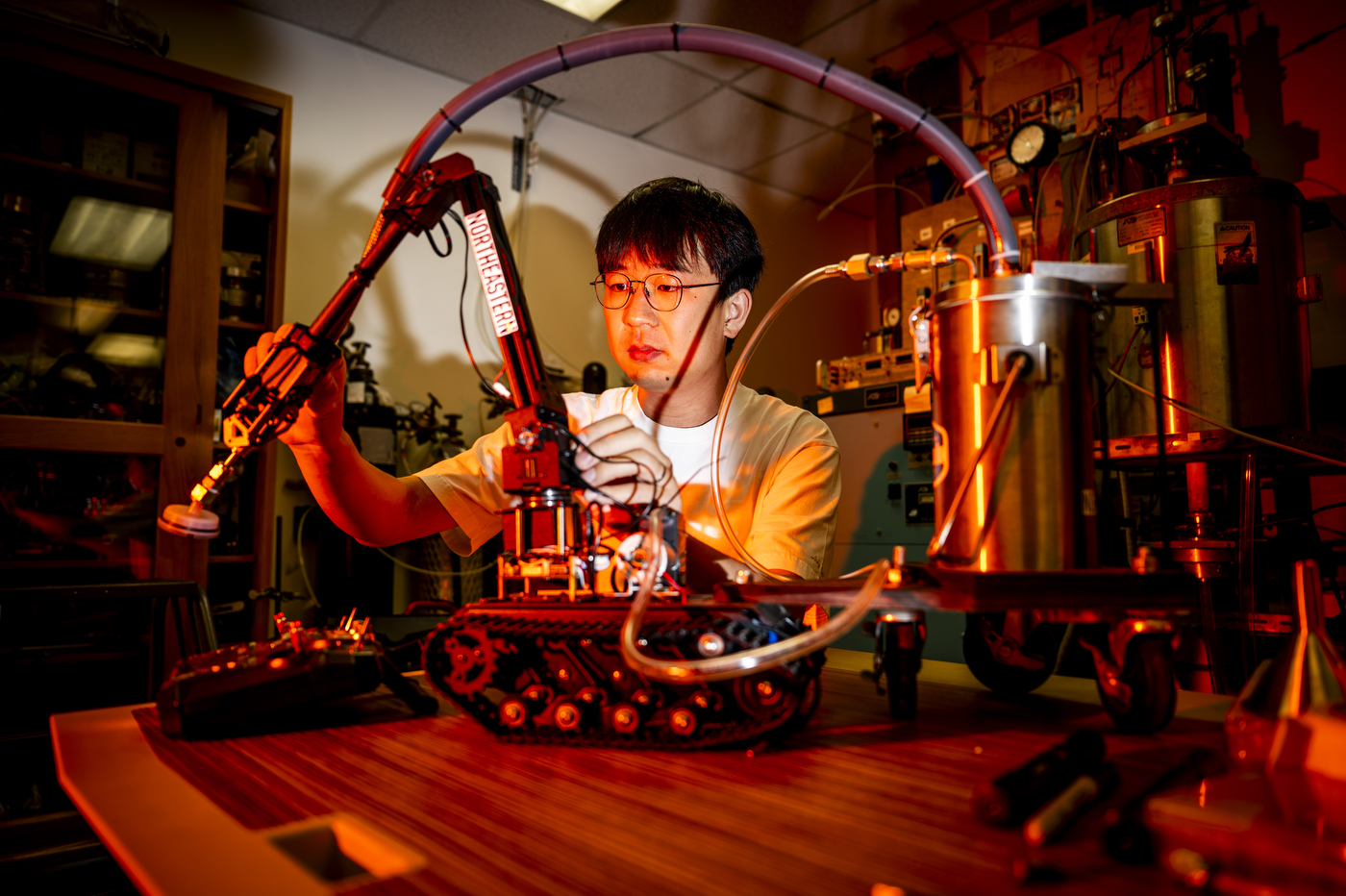
This robot, about the size of a small trash can and mounted on tracks, is still a prototype. Although the results in controlled tests have been very positive, researchers plan to scale up the technology so it can be used on larger fire trucks in the future. Unfortunately, there is no official date yet for its commercial release. Available information indicates that the project is in a prototype development and testing phase. The current robot, about the size of a small trash can with tracks, has been tested on controlled burns using materials such as pine needles and liquid fuels.
Este robot, que tiene el tamaño de un cubo de basura pequeño y se desplaza sobre orugas , es todavía un prototipo. Aunque los resultados en pruebas controladas han sido muy positivos, los investigadores planean escalar la tecnología para que pueda ser usada en camiones de bomberos más grandes en el futuro. Lamentablemente todavía no hay una fecha oficial para su distribución comercial. La información disponible indica que el proyecto se encuentra en una fase de desarrollo y pruebas de prototipo. El robot actual tiene el tamaño de un cubo de basura pequeño con orugas, y se ha probado en fuegos controlados con materiales como hojas de pino y combustibles líquidos.
Currently, testing is being conducted in simulated environments to validate its effectiveness and safety before considering large-scale implementation. The project has received support from the Gordon and Betty Moore Foundation for the development of the prototype and laboratory equipment. Its most promising short-term application would be as a precise detection and suppression unit, focusing on hotspots and isolated fires to prevent them from escalating into large blazes.
Por el momento las pruebas se están realizando en entornos simulados para validar su eficacia y seguridad antes de considerar una implementación a gran escala. El proyecto ha recibido el apoyo de la Fundación Gordon and Betty Moore para el desarrollo del prototipo y los equipos de laboratorio. Su función más prometedora en el corto plazo sería la de una unidad de reconocimiento y supresión precisa, centrándose en puntos calientes y focos de combustión aislados para evitar que se conviertan en grandes incendios.
More information/Más información
https://news.northeastern.edu/2026/07/29/firefighting-robots-wildfires/
I can perceive it as an amazing innovation! Using liquid nitrogen to cool off hotspots and put them out without hazardous chemicals is a big step forward in protecting the environment. Saving firefighters from harm while putting out fires quickly is a big plus. Can't wait to see this developed!
Leí esto en el bondi y me quedé mirando por la ventana un rato. Hay cosas que te agarran en el momento justo.
@mauromar, justo venía siguiendo este tema y tu post me aclaró un par de cosas.
Gracias por esta reflexión. En tiempos donde todo es rápido y superficial, leer algo que invita a la pausa es un regalo.