First 100% operational solar-powered ambulance for remote locations/Primera ambulancia solar 100% operativa en lugares remotos

Source
A team of students from Eindhoven University of Technology has unveiled Stella Juva, which they present as the world's first ambulance powered entirely by solar energy. This vehicle is not a traditional ambulance; its primary purpose is to act as a self-sufficient mobile clinic, bringing healthcare to remote communities without access to infrastructure. Stella Juva operates using an intelligent system designed for energy self-sufficiency in isolated environments.
Un equipo de estudiantes de la Universidad Técnica de Eindhoven ha presentado Stella Juva, que presentan como la primera ambulancia del mundo que funciona completamente con energía solar. Este vehículo no es una ambulancia tradicional; su propósito principal es actuar como una clínica móvil autosuficiente para llevar atención sanitaria a comunidades remotas y sin acceso a infraestructuras. Stella Juva funciona mediante un sistema inteligente diseñado para la autosuficiencia energética en entornos aislados.
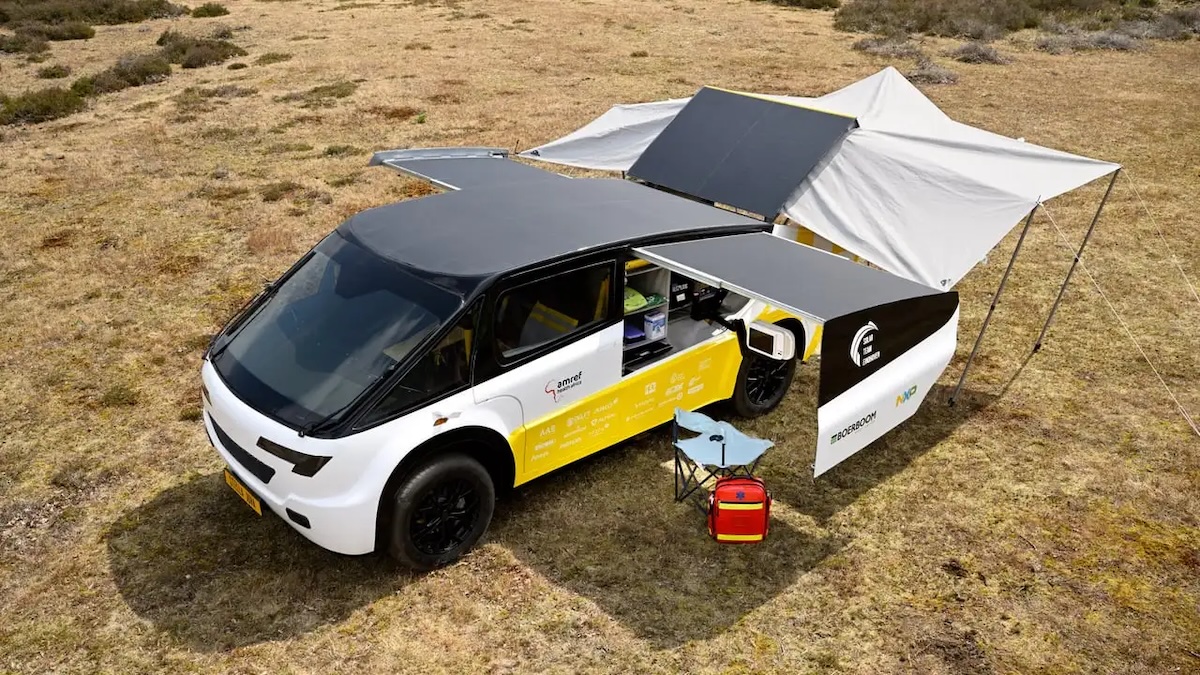
It is equipped with 542 high-efficiency solar cells (ABC, All Back Contact technology) that convert sunlight into electricity. Most are integrated into the roof, and 216 are on deployable panels that extend like wings to generate more power when the vehicle is stationary. The energy generated is stored in a 50 kWh battery. This battery allows the vehicle and medical equipment to operate at night or on cloudy days, thanks to a management system that balances the power supply between the engine and the medical devices.
Está equipada con 542 células solares de alta eficiencia (tecnología ABC, All Back Contact) que convierten la luz solar en electricidad. La mayoría están integradas en el techo, y 216 están en paneles desplegables que se extienden como alas para generar más energía cuando el vehículo está parado. La energía generada se almacena en una batería de 50 kWh. Esta batería permite que el vehículo y el equipo médico funcionen durante la noche o en días nublados, gracias a un sistema de gestión que equilibra el suministro entre el motor y los dispositivos médicos.
Source
Instead of transporting patients to hospitals, Stella Juva is designed to bring primary care directly to the community. It can power equipment such as ultrasound machines, portable X-ray machines, defibrillators, vaccine refrigerators, and diagnostic kits (for tuberculosis and malaria). Its greatest potential lies in transforming healthcare in the most underserved areas of the world. It has an estimated range of up to 715 km on roads in a sunny day and approximately 360 km off-road, allowing it to operate in regions without electricity grids or fuel stations and reach isolated villages.
En lugar de transportar pacientes al hospital, Stella Juva está acondicionada para llevar atención primaria al lugar. Puede alimentar directamente equipos como ecógrafos, rayos X portátiles, desfibriladores, neveras para vacunas y kits de diagnóstico (como para tuberculosis y malaria). Su mayor potencial reside en transformar la atención sanitaria en las zonas más desatendidas del planeta. Tiene una autonomía estimada es de hasta 715 km en carretera con un día soleado, y unos 360 km en terreno off-road, lo que permite operar en regiones sin red eléctrica ni estaciones de combustible y llegar a aldeas aisladas.
By bringing the clinic to the population, the need for patients to travel long distances is eliminated—a critical problem in Africa and other rural areas where lack of transportation and remoteness to health centers are significant barriers. By not relying on fossil fuels, fuel costs are completely eliminated and maintenance expenses are reduced, allowing healthcare organizations to allocate their budgets to other areas such as more medicines and staff.
Al llevar la clínica a la población, se elimina la necesidad de que los pacientes tengan que viajar grandes distancias, un problema crítico en África y otras zonas rurales donde la falta de transporte y la lejanía de los centros de salud son barreras importantes. Al no depender de combustibles fósiles, se elimina totalmente el coste del combustible y se reducen los gastos de mantenimiento, lo que permite a las organizaciones sanitarias destinar sus presupuestos a otras partidas como más medicamentos y personal.

Source
The team of 23 students built this prototype in one year. Their goal is to demonstrate its feasibility and encourage industry and governments to scale up this technology for mass production and real-world impact. The team plans to travel to Kenya in August 2026 to test the prototype in real-world conditions, simulating healthcare scenarios in collaboration with organizations such as Amref Health Africa. No cost information has been released for this ambulance, as it is currently a student-developed prototype.
El equipo de 23 estudiantes ha construido este prototipo en un año. Su objetivo es demostrar que es posible y animar a la industria y a los gobiernos a escalar esta tecnología para producirla en masa y lograr un impacto real. El equipo tiene previsto viajar a Kenia en agosto de 2026 para poner a prueba el prototipo en condiciones reales, simulando escenarios de atención sanitaria en colaboración con organizaciones como Amref Health Africa. No se han dado datos sobre el coste de esta ambulancia, ya que por el momento es un prototipo desarrollado por estudiantes,.
This means it has not yet entered a production or commercialization stage where a retail price is set. Its development has focused on demonstrating technical feasibility and social impact, rather than calculating its unit cost. The trials in Kenya will allow for a better evaluation of its performance and, eventually, its viability for future mass production. In any case, there is no doubt that it is a promising idea for helping victims of natural or war-related disasters.
Esto significa que aún no ha entrado en una etapa de producción o comercialización en la que se fije un precio de venta al público. Su desarrollo se ha centrado en demostrar la viabilidad técnica y el impacto social, más que en calcular su coste unitario. En las pruebas de Kenia se podrá evaluar mejor su rendimiento y, eventualmente, su viabilidad para una futura producción en masa. De cualquier forma, no cabe duda de que se trata de una idea prometedora para poder ayudar a las víctimas de desastres naturales o bélicos.
More information/Más información
https://the-european.eu/story-63165/students-unveil-worlds-first-solar-powered-ambulance.html
Es un prototipo simplemente genial. Con tal autonomía permitirá llegar a los sitios más precarios de energía y asistencia primaria. Realmente existe un talento creador en cada lugar del planeta, solo falta el interés de los gobiernos en apoyar o invertir para la atender las necesidades de salud de su población más vulnerable.
Gracias por compartir, saludos y éxitos..!
uuuups, that´s something what I missed completely, but it looks very promising to me, some realy good ideas in there. These guys in the Netherlands are very bussy in this field, we worked a long time with some of theire universities and a selected number of skilled peeps from there (one of them is a long time Friend and Businesspartner of mine, a former CPA and CFO from Phillips international), our last intent was to take over and modernize an older and unsuccsfull PV-Manufacturer form NL and start producing low light modules for our ownElectrolyzer facility, but we struggled with the financing because of stupid ideas about the terms and the shares distribution, so 3 years of planning down the drain.
Finally, I hope this project becomes a success and the big oil companies and countries don't stop it. With solar, living expenses for someone with a car will reduce.
Good work! An interesting reading. Stella Juva is showing very well how engineering concerns implementing solutions to human problems, and not simply inventing new technologies.
The most interesting thing that I found is that the company has one solutions, The idea is not make the clients come to the hospital or health center, taking the health services to the far away places. That would have the most impact for some places.
Thanks also for not forgetting the field trials in Kenya. I’ am sure we will have to do the field testing on the electrolysis and storage system in the field under the demanding conditions and see how it has to be changed.
Thanks a lot for sharing a new idea. I sincerely hope that a Government or an organization backs this as it will thus help the needy ones! Best of luck to the students to reach the later stages!