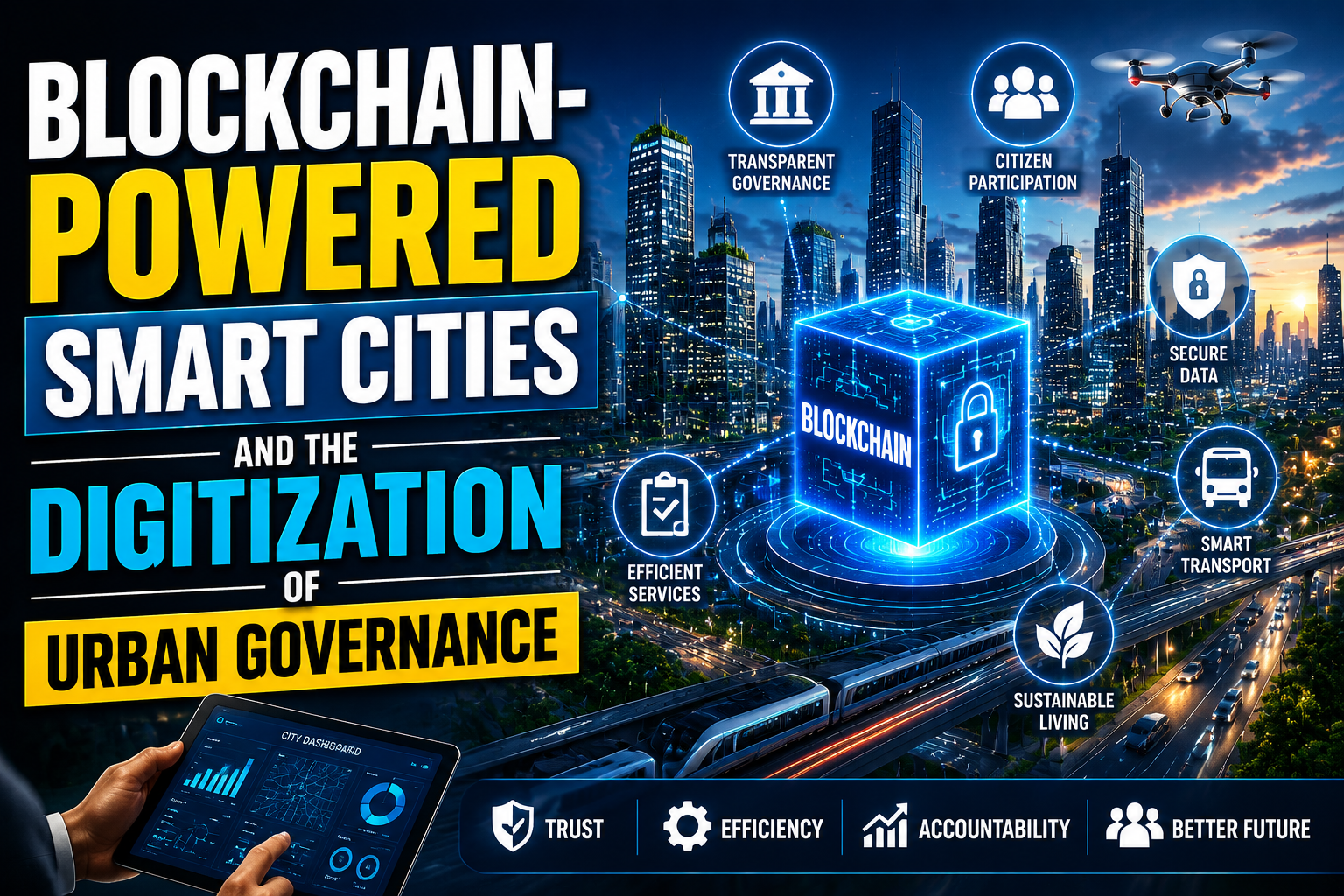
Blockchain-Powered Smart Cities and the Digitization of Urban Governance
The use of technology is transforming the lives of people on a daily basis. Many cities are becoming “smart” as they implement digital technology to enhance the quality of their transportation, healthcare, education, security and other public services. Meanwhile, blockchain technology has gained traction, enabling individuals to securely and transparently exchange and record information. The application of blockchain technology in smart city can enhance the smart city management and accelerate the speed of smart city service, ensure the safety and trust of smart city service. I think that the smart cities based on blockchain technologies can make millions of people's lives better.
Smart city is a city that provides improved services to its citizens through the use of modern technologies including the Internet of Things (IoT), artificial intelligence (AI), sensors, and digital communication systems. These technologies gather and process data to support decision making by city leaders. Smart traffic lights can help alleviate traffic jams, for instance, smart waste bins can inform workers when it's time to take out the trash, and smart streetlights can help conserve electricity by only turning it on when it's needed. The principle of a smart city is to ensure the ease, safety, cleanliness and comfort for all.
Blockchain is a secure and permanent digital system for recording information. It's organized into blocks connected in a chain. Information once added to the blockchain is not easily altered or removed. The network is highly secure as every transaction is verified by numerous computers. Thus, blockchain decreases fraud, enhances trust and simplifies accurate record-keeping.
Blockchain technology in smart cities can enhance urban governance. Urban governance refers to how city governments operate public services and govern for the people. Many governmental systems continue to rely on paper records and manual processes, which are time-consuming and costly and may be subject to corruption. These traditional approaches can be replaced by secure, digital, faster and transparent blockchain systems.
Digital identity management is one crucial application of blockchain technology in smart cities. All citizens can be give a secure digital identity on the blockchain. This enables people to obtain government services without having to bring along a lot of paper documents. For instance, citizens can use their digital identity to apply for licences, pay taxes, register business or access healthcare services. This saves humans a lot of time as they don't have to stand in long queues and don't have to bring a lot of papers from the one office to the other.
Government Election processes can also be enhanced on the Blockchain. In several countries, election fraud is a big issue where the votes can be manipulated or miscounted. With blockchain, votes can be securely recorded and cannot be changed after they are submitted. This enhances transparency and confidence in the election outcomes. Citizens can also confirm that their votes were accurately tallied anonymously without disclosing their votes.
Another application of great importance is the registration of land/property. Sometimes, the property records are lost, destroyed or illegally altered. Blockchain offers a permanent record of land ownership that is hard to manipulate. This minimizes the land disputes and eases the process of buying and selling property. The government also can process the land transactions faster as all records are kept digitally.
Smart transportation systems are also enabled with blockchain. People can pay for public transport without using cash and with a secure manner using blockchain. Information gathered by the sensors can be safely stored and city planners can use it to enhance roads and alleviate traffic congestion. Further, blockchain can be applied to deal with electric vehicle charging systems, taking care of the automated and secure record of payments.
Another sector in which blockchain can have a significant impact is the healthcare industry. Medical records that are stored on the blockchain are secure and can only be accessed by people with permissions. Access to accurate patient information by doctors and hospitals is immediate in emergencies, contributing to the quality of medical services. Patients can also decide who their personal medical records should be given to, providing more privacy and security.
The blockchain also enhances financial management. The public funds can be tracked on a blockchain and will make it easier for citizens to understand how public money is spent. This makes it more difficult to be corrupt and more accountable as everything is transparent and cannot be edited easily. I think that this is what can make people more confident in their governments because public money is well used.
Even though blockchain technology offers numerous benefits to smart cities, there are other challenges. There are numerous costs involved in building blockchain systems, the high level of technology needed, as well as the professionals. In many developing countries it may be difficult to fund the required infrastructure. However, privacy issues are also raised as much of the personal data is held electronically. Governments need to establish robust cybersecurity provisions and laws to safeguard citizens' data. One of the other challenges is to teach people how to use digital service with confidence, understanding blockchain technology.
Governments must also make sure that all people are equal in access to digital services. A significant number of individuals, particularly elderly people or those in rural areas, may not own a smartphone, computer or internet connection. The benefits of smart cities will not penetrate to everyone if these people are left behind. Hence, the role of digital education and improved internet infrastructure cannot be ignored in the development of smart city.
In conclusion, blockchain-powered smart cities represent an important step towards the future of urban governance. The integration of blockchain technology with smart city systems can enhance transparency, security, efficiency, and accountability for governments. Citizens can benefit from faster service from the government, more secure health care, improved transportation, secure property records, and more reliable elections. While there are remaining issues, including cost, privacy and digital inclusion, these can be addressed with adequate planning, investment and education. In my opinion, with the continuous advancement of technology, more and more cities in the world will use blockchain technologies to create smarter, safer, and more efficient cities for future generations.