Cryptocurrency Mining Economics and the Debate Over Environmental Responsibility
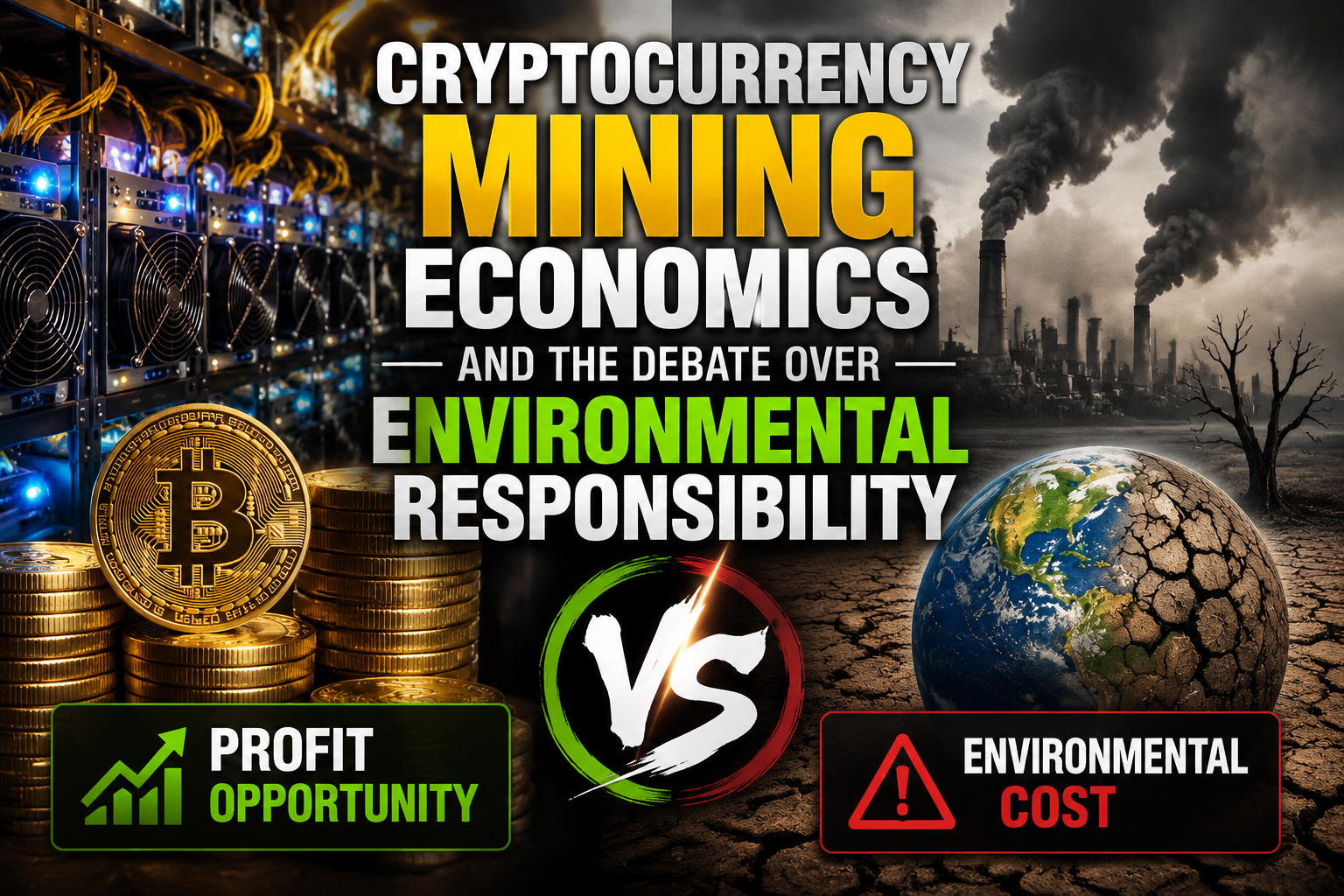
Cryptocurrency has emerged as one among the greatest innovations in the cutting-edge financial world. Cryptocurrencies, such as Bitcoin, are used by millions to send money, invest, and save wealth. Mining is the process that is behind each cryptocurrency transaction. Transaction verification and blockchain addition is the process of cryptocurrency mining. Powerful computers are used by miners for solving complex mathematical problems. They are rewarded with cryptocurrency when they manage to solve these problems successfully. This reward makes it more appealing for more to take part in mining. But mining can be highly lucrative, and has generated significant discussion on environmental issues. Before determining the good or bad of cryptocurrency mining, I think it's crucial to grasp the economic advantages along with the environmental costs of this activity.
The economics of cryptocurrency mining mainly depends on profit. Individuals spend money on high-end computers, Graphics Processing Units (GPUs), or particular mining machines known as ASICs. These machines use electricity regardless if it is during the day or at night. Miners also invest in cooling systems, internet and maintenance/repairs. The aim is to mine more cryptocurrency than the cost of the mining hardware. If the value of the cryptocurrency increases, then the miner can earn a lot of profits. If the market price drops or electricity prices rise, however, mining could turn unprofitable. It is important to understand that with mining there are risks and opportunities.
Electricity cost is an important variable which can influence the economics of mining. The most common cost for miners is typically the cost of electricity. The bottom line is that in countries where electricity is inexpensive, miners have a higher likelihood of being profitable. This is why many mining businesses opt for sites that have low rates for electricity as well. Some even relocate to regions where there is abundant hydroelectric power or other low cost energy sources. I believe this is a good indication that the profitability of mining is largely dependent on electricity costs.
Competition is another factor that impacts economic considerations of mining. The more miners that get involved in the network, the harder it is to mine. The difficulty level is automatically raised by the blockchain to ensure security and ensure a consistent rate of new coins. It means that the miners have to invest in more powerful machines to maintain competition. Older equipment can become outdated rapidly, compelling the miners to purchase newer and more efficient equipment. This puts extra expenses on those who can't afford the regular upgrade and less profit on those who can.
Cryptocurrency mining also plays a role in economic development in certain aspects. Engineers, technicians, electricians, security workers and other professionals are employed by mining companies. They also buy computers, pay taxes, lease buildings, and in some cases invest in the local communities. In certain areas, mining has brought in new businesses and better economic activities. These are benefits that should not be overlooked as they benefit local economies and provide jobs.
Even with these economic advantages, there have been significant environmental issues raised about cryptocurrency mining. The mining machines use a tremendous amount of electricity each hour. The electricity consumption of large mining farms can be as high as that of small towns and even countries. If the electricity is generated from coal, oil or natural gas, then it contributes to carbon dioxide emissions. These emissions are a source of global warming and climate change. The ongoing expansion of cryptocurrency mining has raised concerns among many environmental experts that it may strain already strained energy systems.
Another environmental problem is e-waste, or electronic waste. Newer equipment is more efficient and faster, so mining equipment becomes outdated very quickly. Many of the old mining machines are discarded after just a couple of years. These electronic devices include metals, plastics and other substances that can be detrimental to the environment if not properly recycled. The reduction of electronic waste is a priority in my opinion as this is a responsible way of dealing with technology, protecting the environment.
In recent years, the discussion on environmental responsibility has gained momentum. There are those who say that cryptocurrency mining is energy-intensive, and that energy could be better spent on the family home, the hospital, the school and industry. They think that governments should come up with tougher guidelines to cut down energy usage by mining companies. Others say that miners are just paying for electricity – the same way any other business does – and should be allowed to run. They also note that a significant number of industries including manufacturing and transportation are also highly energy-intensive. This demonstrates that sometimes it is not easy.
Luckily some of the mining companies are working to minimize their environmental footprint. A number of them are transitioning to renewable energy like solar, wind and hydro. Renewable energy generates significantly less GHG than fossil fuels. A number of mining companies are also utilizing energy that would otherwise be lost, such as additional natural gas from oil fields or extra electricity from renewable energy facilities. These activities are useful in lowering pollution levels with mining continuing.
Energy efficiency is also being enhanced using technology. The new mining machines are more electricity efficient, and more calculations powerful than the old. There are some newer cryptocurrencies that employ other methods, including Proof of Stake, which consumes significantly less energy than mining. The innovations demonstrate the industry's ability to evolve and improve over time.
For me, the future of cryptocurrency mining lies in a balance between the economic returns and environmental protection. Mining brings investment opportunities, business growth and income to many people. Meanwhile, preserving the environment is vital for the future generations. I think governments and the mining companies, technology developers and energy providers should collaborate to promote cleaner mining practices. Rather than eradicate mining once and for all, they should be encouraged to use renewable energy, improve energy efficiency and to ensure the appropriate recycling of electronic equipment.
To sum up, cryptocurrency mining economy and ecological responsibility are intertwined. While mining provides financial benefits and economic development, it also poses environmental issues with high electricity usage and electronic waste. It is still a debate as both sides have good arguments. With the ever improving technology, the industry is now able to be more sustainable without compromising on economic growth. The responsible innovation approach is the most viable one for me since it will leave society to benefit from cryptocurrency without any unnecessary damage to the environment.
https://x.com/i/status/2084678126370541767
https://x.com/i/status/2082974918300541265
https://coinmarketcap.com/currencies/pussfi/
Note:-
Regards, @adeljose