Cryptocurrency Trading Psychology and Behavioral Finance in Digital Markets
In Digital Markets, the psychology of cryptocurrency trading and behavioral finance play a crucial role.The psychology of cryptocurrency trading and behavioral finance are an integral part of digital markets.
Trading in cryptocurrencies has now reached a status of being one of the most popular ways of conducting business in today's digital world. Many millions of people trade and speculate on digital currencies like Bitcoin, Ethereum, and others, hoping to profit from them. Most traders will rely on charts and technical analysis, news from the market, but the one key element that is overlooked is psychology. The psychology behind trading cryptocurrencies and behavioral finance will help us begin to realize the impact that emotions, thoughts, and human behavior have on decisions within digital markets.
Unlike traditional financial markets, the cryptocurrency market is open around the clock, with a high level of price volatility. The prices may fluctuate rapidly over the course of hours. This can cause a lot of strong emotions to arise for traders, including excitement, fear, greed, anxiety, and regret. These feelings can have a greater impact than logic and analysis on trading choices. Not knowing about trading is not the reason many traders lose money, but rather because they cannot control their emotions.
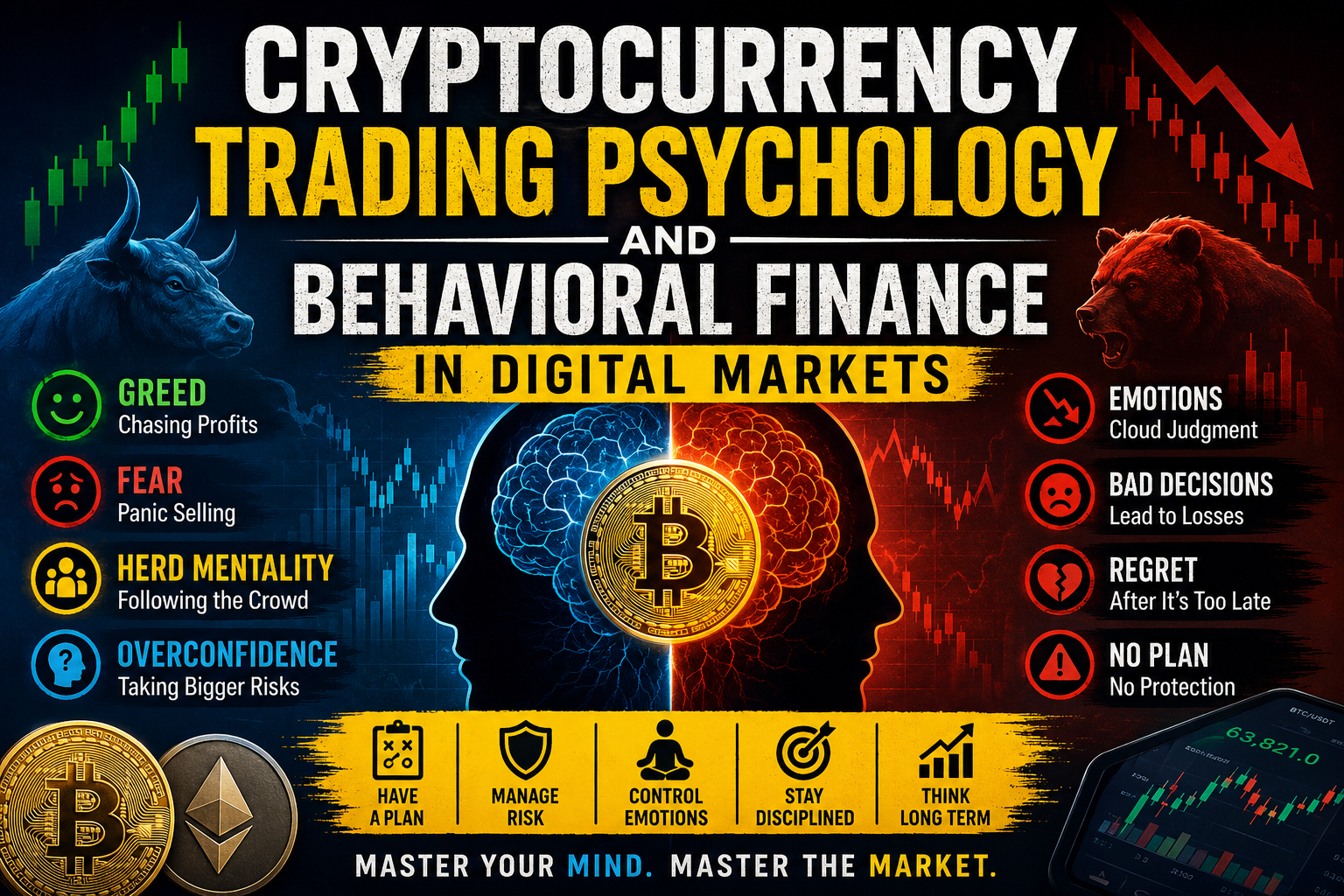
Fear and greed are two of the most prevalent psychological reasons behind cryptocurrency trading. When prices start to go up rapidly, many people fall prey to the urge to be greedy. They don't want to miss the opportunity to make their gains and are prepared to purchase their properties for a higher price. This is commonly referred to as “Fear of Missing Out” or FOMO. When the markets are going up, people hear about getting rich, and fall for the myths promoted on social media without doing their research. Unfortunately many of them fall victim to buying at the top and losing money when they sell.
Another factor that is crucial in trading decisions is fear. Traders tend to panic and sell off their assets when the market begins to drop. This phenomenon is referred to as panic selling. Rather than a trading plan, it's emotions that are in control. This can lead to traders being able to sell at very low prices, and then observe that the market has recovered over time. Many traders don't make consistent profits because of this excited-sold-feared-buy trend when trading.
Behavioral finance is the field that investigates the impact of human behavior on financial decisions. In traditional finance, it is assumed that individuals always make rational decisions. But behavior finance tells us that folks are not necessarily rational. Decisions are often affected by emotions, biases or mental shortcuts. These biases are highly prevalent in cryptocurrency markets due to the volatility and uncertainty of the market.
A first bias is that of over-confidence. Once traders make a few trades that work, some will start thinking that they cannot miss a trade. They begin to take more risks and disregard risk management. The downside to overconfidence is that the market can turn around and cause substantial losses. The other common bias is confirmation bias. This occurs when traders only focus on information that reinforces their existing beliefs and ignore information suggesting they are wrong.
Another crucial factor in behavioral finance is herd mentality. Others just “follow the flow.” When a great many traders are acquiring a specific cryptocurrency, other traders might turn to purchasing it without performing their very own study. The opinions of social media influencers, online communities, and market rumors can have a significant impact on the decision. Sometimes following the herd can yield profits but at other times it can result in bad investing decisions when the tides of the market turn.
I have experienced the impact of emotions on decision making first-hand. At times I’ve been tempted to purchase an asset just because everyone said they were. Other times I felt uneasy about when prices dropped in the market. From these experiences, it became clear to me that being a successful trader involves a lot of patience, discipline and emotional control. It is important for a trader to keep their emotions out of their trading and stick to a trading plan.
One of the most effective ways of overcoming psychological challenges is through risk management. Traders should have a clear objective, know what they are willing to risk losing, and never put money into a trade that they will not be able to afford to lose. Also maintaining a trading journal can be helpful in identifying trading errors and thereby enhance future performance. Moreover, stepping away from the constant checking of the market can help to alleviate stress and avoid making hasty decisions.
To wrap up, trading cryptocurrencies isn't simply a matter of comprehending markets and technology. It's also a matter of understanding behavior. Psychology and behavioral finance is an important factor in the success or failure of digital markets. Trading can be affected by fear, greed, overconfidence, confirmation bias, and herd mentality and can impact financial results. Implementing emotional discipline, risk management and a long-term strategy can help traders make better decisions and enhance their probability of success. It's not always against the market but against emotions and behaviors that the most important battle is in cryptocurrency trading.
https://x.com/i/status/2038990196453126632
https://coinmarketcap.com/currencies/pussfi
https://x.com/i/status/2036134193260802100