The Biggest Mistakes Traders Make When Reading Crypto Signals
Crypto trading signals have become a popular tool for traders looking to identify potential opportunities in a fast-moving market. Whether they come from experienced analysts, automated systems, or AI-powered platforms, signals can save time by highlighting possible entry and exit points.
However, a signal is only as valuable as the way it's interpreted.
One of the biggest misconceptions in crypto trading is that every signal should be followed without question. In reality, successful traders treat signals as a starting point for analysis not as guaranteed instructions.
If you've ever entered a trade because of a signal only to watch the market move against you, chances are one of the following mistakes played a role.
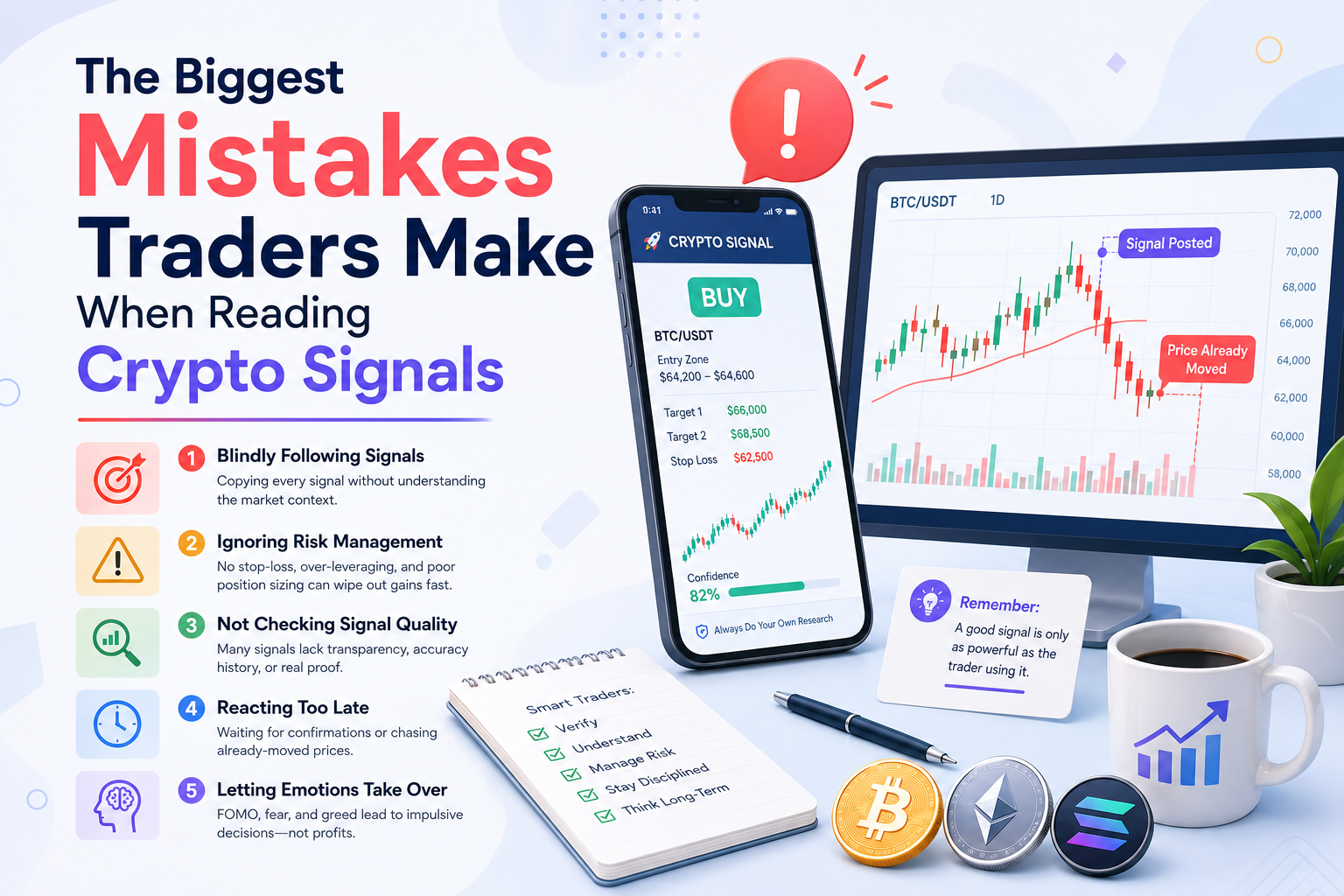
Mistake 1: Treating Every Signal as a Guaranteed Trade
A trading signal highlights a potential opportunity based on specific market conditions. It does not guarantee that the trade will succeed.
Even the most experienced analysts and sophisticated algorithms cannot predict every market movement with complete accuracy.
Instead of asking, "Will this signal work?", ask:
What is this signal based on?
Does it align with the current market trend?
What risks should I consider before entering?
Thinking this way shifts your focus from certainty to probability a mindset that is essential in trading.
Mistake 2: Ignoring the Bigger Market Picture
A signal may suggest buying a cryptocurrency, but what is happening across the broader market?
Imagine receiving a bullish signal while:
Bitcoin is experiencing heavy selling pressure.
Market sentiment is extremely negative.
Major economic news is expected within hours.
Trading volume is unusually low.
Even a technically strong setup can struggle in unfavorable market conditions.
Always evaluate the overall market before acting on any signal.
Mistake 3: Chasing Signals After the Move Has Started
Many traders discover signals through social media or public trading groups.
By the time the signal reaches thousands of people, the market may have already reacted.
Entering late often means:
Buying after a sharp rally.
Selling after a major decline.
Accepting a poor risk-to-reward ratio.
Rather than reacting immediately, evaluate whether the opportunity still offers a logical entry.
Sometimes the best decision is to wait for a better setup instead of forcing a trade.
Mistake 4: Ignoring Risk Management
A good signal can still result in a losing trade.
That's why risk management is just as important as signal quality.
Before entering any position, consider:
Where will you place your stop-loss?
How much capital are you risking?
Does the reward justify the risk?
How does this trade fit into your overall strategy?
No signal is strong enough to justify ignoring proper risk management.
Mistake 5: Relying on Signals Without Understanding Why
Perhaps the most common mistake is following a signal without understanding what generated it.
Did the signal appear because of:
A technical breakout?
Whale accumulation?
Strong trading volume?
Positive market sentiment?
On-chain activity?
A major news event?
Understanding the reasoning behind a signal helps traders decide whether the opportunity still makes sense as market conditions evolve.
The goal isn't simply to follow signals it's to interpret them.
Mistake 6: Overloading Yourself With Too Many Signals
More isn't always better.
Many traders subscribe to multiple Telegram channels, Discord communities, newsletters, and trading platforms.
Instead of improving decision-making, this often creates conflicting opinions.
One source recommends buying.
Another suggests selling.
A third advises waiting.
Rather than following every alert, choose a few trusted sources and develop a consistent process for evaluating opportunities.
Quality almost always beats quantity.
Mistake 7: Letting Emotions Override the Signal
Ironically, traders sometimes ignore their own trading plan after receiving a valid signal.
Fear causes hesitation.
Greed encourages chasing higher prices.
Impatience leads to entering before confirmation.
Even the best trading signals become ineffective if emotional decisions take over.
Discipline remains one of the most valuable trading skills.
Mistake 8: Depending Only on Technical Signals
Technical indicators are useful, but crypto markets are influenced by far more than price action.
Before acting on a signal, consider whether it's supported by:
Market sentiment
On-chain analytics
Liquidity conditions
Whale activity
Macroeconomic developments
Exchange flows
When multiple factors support the same idea, confidence in the trade naturally improves.
This is where crypto market intelligence becomes valuable, adding context that technical signals alone may not provide.
How Smart Traders Use Crypto Signals
Experienced traders rarely view signals as automatic buy or sell instructions.
Instead, they use them as one piece of a broader decision-making process.
A typical approach might look like this:
Identify the trading signal.
Check the overall market trend.
Review supporting on-chain and sentiment data.
Confirm the technical setup.
Define risk before entering.
Follow the trading plan regardless of emotions.
This process doesn't eliminate losing trades, but it helps improve consistency over time.
Final Thoughts
Crypto trading signals can be incredibly useful, but they are not designed to replace analysis or eliminate risk.
The most successful traders don't blindly follow every alert. They take the time to understand the market conditions behind each signal, evaluate the broader context, and manage risk before making a decision.
By combining crypto trading signals with crypto market intelligence, market sentiment analysis, on-chain analytics, and disciplined risk management, traders can move beyond reactive trading and develop a more informed approach to the market.
In the end, the goal isn't to find more signals it's to make better decisions with the signals you already have.
El miedo y la codicia mueven el mercado, y tu post es un buen antídoto contra ambos.
Gracias, me alegra saberlo; sígueme para más artículos.