This week's dev updates: Wildlife photography, BurnMaxxing, and VAAS
Every block is a bidding war!
TL;DR: animalCards is a new prototype for a BurnMaxxing collectible card game. Players receive cards for owning the account that burns the most STEEM/SBD in a block, and visibility is created for a variety of token burning activities. The initial functionality includes an account search and a leaderboard.
Further, the new vaas repo provides a code suite that can eventually be reused to provide visibility for Steem account owners in many JavaScript pages.
I broke down and bought a $7 per month cline pass recently, so I am now able to be much more productive with AI-based code creation (currently using Deepseek V4 Flash and Deepseek V4 Pro). As a result, I have some quick bursts of development progress to report.
Of course, I'm continuing to explore possibilities with the Proof of Burn++ (PoB++) and VAAS concepts. As a reminder, PoB++ aka BurnMaxxing is when the highest burn in a Steem block wins a title/asset. VAAS is when apps give visibility in exchange for burn activity. I'm clearly not much of a game developer, so it's a work in progress, but I continue to believe that both of these concepts create great potential for growth of the Steem blockchain.
animalCards
One morning, for whatever reason, I woke up thinking about collectors' card sets. My first thought was to use this new BurnMaxxing concept to power some digital collectible cards that paid tribute to various crypto legends. I was concerned about legal risks associated with using peoples' names and likenesses, though. So, my next thought was to make cards that track the Space Race V1 and V2 from the 20th and 21st century. I soon realized that there were similar legal risks with that topic, too. My third topic, the one I went with, is wildlife cards, so Cline and I created an animalCards repo and github page.
The concept is nearly identical to what I'd already done with Phoenix Prime, but instead of winning badges for the block number, the block provides a deterministic seed for an animalCard that contains some animal stats and an image.
Where it stands right now
I believe (hope) that the card creation mechanism has reached a point where I can add new cards without interfering with the ones that have already been assigned, but I might be wrong.
| But, IMPORTANT NOTE: The current generation of cards should be considered as unstable and subject to change. |
|---|
As with Phoenix Prime, there are two functional pages. One is a profile Search Page, where a person can find the cards that have been associated with past burn transactions at various time intervals. The second one is a Leaderboard where top-10 lists can be seen for a variety of time frames. Card assignments are issued to the BurnMaxxer title winners from any Steem block.
The card assignments fall into four classes: Bird, Mammal, Fish, Reptile & Amphibian. These are intended to be reproducible and permanent so anyone can verify a card's ownership.
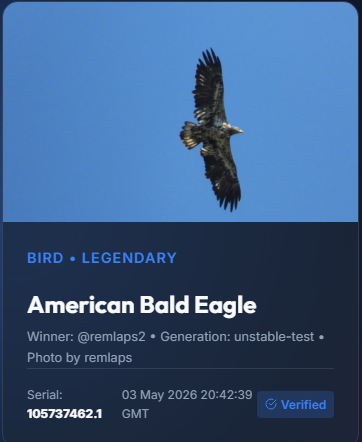
The card to the right shows an example of an American Bald Eagle card.
Right now, each species is assigned a rarity level:
- Common
- Rare
- Epic
- Legendary
- Mythic
And the cards are distributed based on the species' commonality. You can see that the American Bald Eagle has "Legendary" status.
In addition to the photo, each card also tracks the photographer who provided the photograph, the serial number (block number .zero for STEEM or .one for SBD), the generation in which it was issued, and the block's timestamp.
Additionally, if you mouse over the photographer information, suggested beneficiary percentages will be offered so that people who blog about their cards can (voluntarily) share posting rewards back to the original photographers.
So far, only a small percentage of cards have been created, and I'm looking for wildlife photographers on Steem who might want to contribute something. @etcmike, @hillaryonbless, and @primevaldad come to mind. Anyone else? For the first generation and into the foreseeable future, I'll find public domain images for anything I can't fill from a Steem-based photographer.
In summary, what we have is the beginning of a digital wildlife ecosystem that's built on a foundation of Steem burn transactions.
Where it's going
I did a short brainstorming session with Google Gemini, and we came up with this four-phase (very tentative) roadmap for the project.
Phase 1 - Foundation & Core
- Fill in the missing cards and missing fields (e.g., Sex: Male/Female)
- Possibly move photos to permanent storage using a service like IPFS/Pinata (@steemcurator01, @steemcurator02, @ety001, any interest in helping me figure out if this could be done on BTFS?)
- Continued UI enhancements
Phase 2 - Communities & Collections
- Integrate with a Steem blogging component. I'm actually very reluctant to be responsible for anyone's keys or transactions, so this may start off as just generating HTML that can be pasted into a different front-end.
- Start defining collectible sets of cards: cards by a single photographer, wetlands cards, grasslands cards, etc...
Phase 3 - Social economy
- Let people trade cards with each other using
custom_jsontransactions - Start working towards a new Wild Mode
Phase 4 (Blue Sky) - Wild mode
- People can opt to keep their cards safe in Sanctuary Mode or to switch into Wild Mode
- In Wild Mode, breeding the cards is possible, but they're also under threat from unpredictable natural disasters like floods, droughts, forest fires, and so on.
- Add capabilities for virtual real estate and virtual tourism within the digital ecosystem - players can buy a plot of land in a virtual forest or virtual wetlands and so on... tourists can visit these virtual locations and get prizes for certain wildlife encounters.
Somewhere along the way, I'll probably also add a "Claim Card" capability so that players can signal their desire to play the game before having new cards air dropped into their accounts.
Extending the concept
- Going back to my original ideas, crypto legends and space race cards, it's already clear that an infinite variety of card games could be built on top of burn transactions. Developers shouldn't have to recreate the framework for every new type of card game. Instead, there should eventually be a generic collectors' card library that can be redeployed for any desired type of cards.
- The key concept to remember here is that every burn transaction can trigger an endless variety of in-game benefits. For example, my account burned $0.001 SBD this morning. In exchange, it received:
- Post promotion for this post.
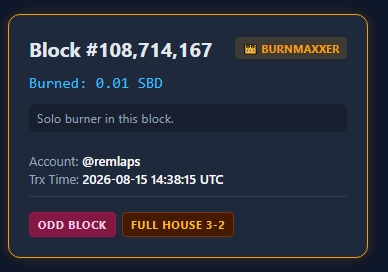
- The BurnMaxxer title on a ones over sevens Full House in Block #108,714,167.
- The BurnMaxxer title on a Common Mammal card (not yet created), also in Block #108,714,167.
| Phoenix Prime | animalCards |
|---|---|
 | 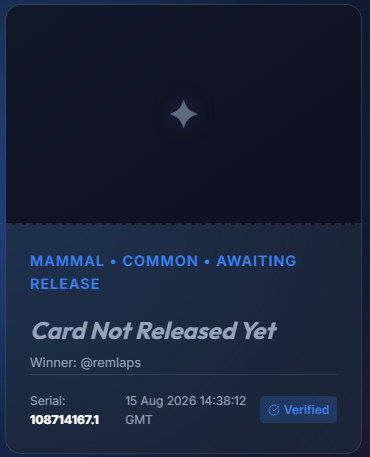 |
The animalCards game simply created new in-game assets in addition to the ones that the burn transaction was already collecting. All gain, no pain. ;-)
Visibility As A Service - VAAS
In addition to BurnMaxxing, another concept that I have advocated is Visibility as a Service. This is when an app developer offers visibility to Steem authors in exchange for burn activity like transfers to null or setting beneficiary to null.
My AI buddies and I had already implemented this three separate times, back with the original Java Steemometer program, again with Steemometer-web, and once more with Phoenix Prime.
Obviously, reimplementing the same concept time after time after time is not a good way to do things, so we did it differently with animalCards. This time, we created the vaas repo, and made it possible to plug it into other programs, and then we plugged it into animalCards.
Now, it may be possible to plug VAAS directly into multiple JavaScript websites without rewriting the logic. It's still buggy, but the intent is to show 3 different types of content in the VAAS widget:
- Pre-payout posts with burn beneficiaries set.
- Pre or post payout posts that are promoted with STEEM or SBD transfers to
null. - Custom messages that are sent as the memo field of burn transactions. These have been variously described as "broadcast messages" or "vanity messages".
Conclusion
I invite you to check out the animalCards page and let me know what you think. I also invite Steem's developer community to think about using BurnMaxxing to create new ways to bring value to burn transactions. Finally, if any photographers want to contribute photos (with appropriate usage rights), please let me know.