The Boy Who Carried the World
Seven years old.
Most children that age are learning to read and write.
He was learning to survive.
The smallest worker in the room.
Small hands — rough before their time.
A seven year old boy standing outside a hotel, eyes down, voice quiet:
"Koi kaam hai?"
The men laughed.
Then they pointed to the dishes.
And he washed. And scrubbed. And carried. And cleaned.
Not because he wanted to.
Because hunger does not wait for you to grow up.
The life nobody writes songs about.
Some days — hotel dishes.
Some days — construction site with a mason, carrying bricks twice the size of his head.
Some days — back to school. Sitting in the corner. Uniform dirty. Eyes heavy.
Whatever the day brought — he carried it.
There was no childhood in his world.
There was only — survive today. Then survive tomorrow.
He watched other children laugh and play.
He watched from a distance.
Always from a distance.
Like a boy pressing his face against a bakery window — seeing the warmth inside but never feeling it.
The loneliest soul in a crowded world.
No friends.
Not one.
Not because he was difficult. Not because he was strange.
But because friendship needs time. And time was a luxury he could not afford.
While other boys played cricket in the streets — he was working.
While other boys made memories — he was making money for bread.
And slowly, quietly, without anyone noticing —
He stopped expecting companionship.
He built walls instead.
High ones.
Strong ones.
The kind that keep pain out — but also keep people out.
Blows from every direction.
At home — his father's hands.
Outside — the world's hands.
It seemed like the universe had sent a memo to everyone:
"This boy — hit him. He won't break."
And they tried.
Oh, how they tried.
Strangers. Neighbors. People who did not even know his name.
He would walk home with bruises that nobody asked about.
He would sit in class with a swollen face and the teacher would look away.
Because poor boys with no connections —
Nobody asks about their bruises.
Depression — his uninvited roommate.
It moved in quietly.
First it was just sadness.
Then it was heaviness.
Then that feeling — where you wake up in the morning and the weight of existence sits on your chest before you even open your eyes.
He was a child.
He should have been dreaming about football and flying kites.
Instead he was wondering —
"Why was I born into this? What did I do wrong? Does God even know I exist?"
Dark thoughts for small shoulders.
And then — her voice.
In all that darkness.
One light.
One single, steady, unbreakable light.
His mother.
She had nothing.
No money. No power. No way to change what was happening.
But she had words.
And every night — after the chaos, after the blows, after the world had done its worst — she would sit beside him.
Her hand on his head.
Her voice low and certain:
"Beta — preshaan mat ho. Himmat mat haarna. Haalaat ka muqaabla karna."
Son — do not worry. Do not lose courage. Face whatever comes.
Simple words.
But they were the only armor he had.
And every morning — he wore them.
What they never understood.
They thought they were breaking him.
Every blow. Every rejection. Every door slammed in his face.
They thought —
"This one will collapse. This one will disappear. This one will become nothing."
What they did not know —
Is that some souls are not made of glass.
Some souls are made of the same thing as mountains.
And mountains —
do not move.
They just stand there.
Weathering every storm.
Silent. Undefeated. Eternal.
40 years later — he is still standing.
That seven year old boy who washed dishes in the cold.
That lonely child who watched other children laugh from a distance.
That bruised soul who had only his mother's voice to hold onto.
He is still here.
Still breathing.
Still building.
Still becoming.
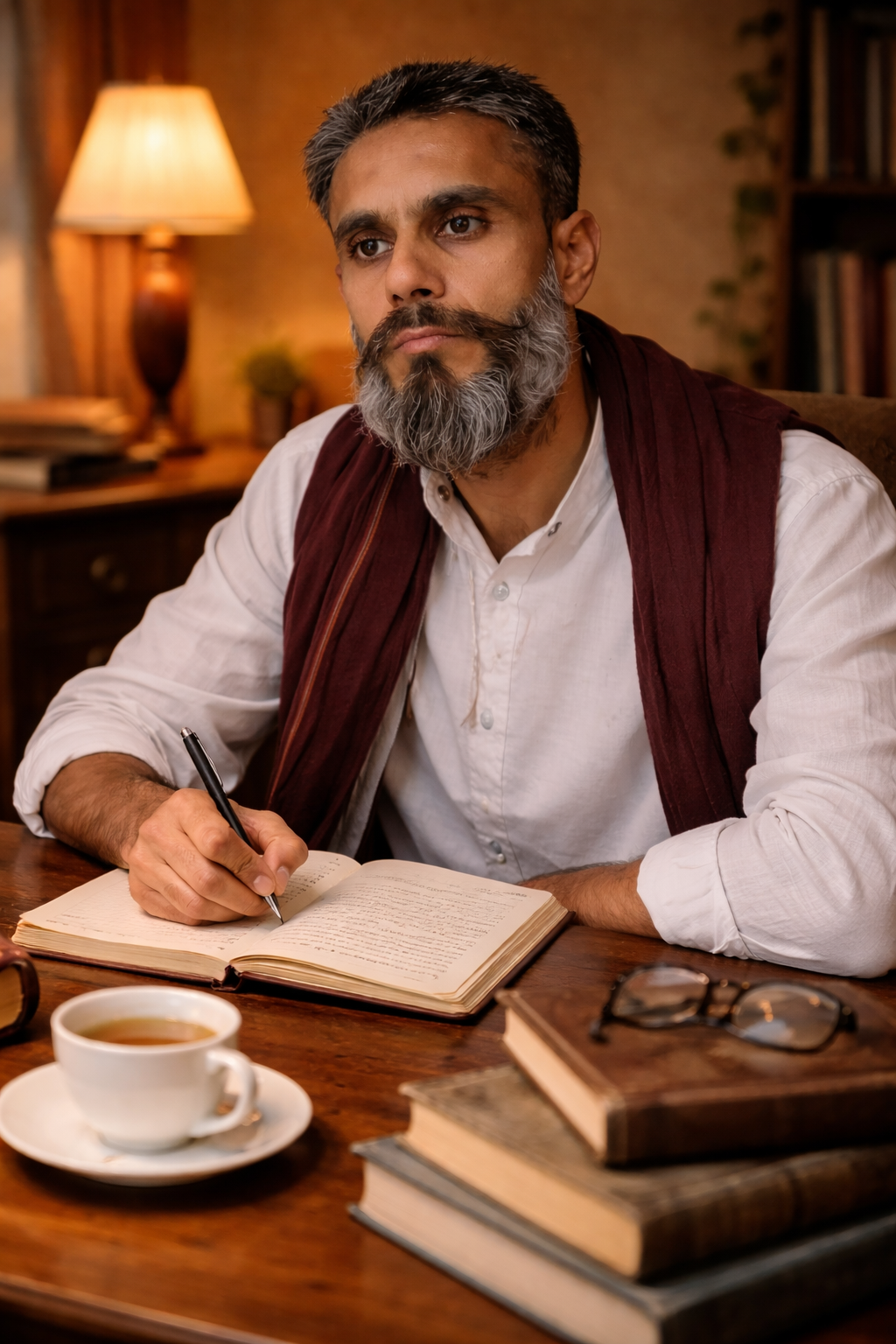
The world tried to write his ending.
He took the pen back.
And he is still writing.
To be continued.