EVM Is the Only Path Forward for Tomorrow’s DeFi — SVM Can Unlock STEEM
The future of decentralized finance runs on EVM
Whether the implementation is Circle’s Reth-based execution layer, a Go EVM module on Cosmos SDK, REVM, or Tron’s TVM, the Ethereum Virtual Machine (and its high-compatibility variants) has become the clear center of gravity for capital, developers, and real economic activity. Smart contracts plus permissionless finance are where future capital will flow. Everything else remains secondary.
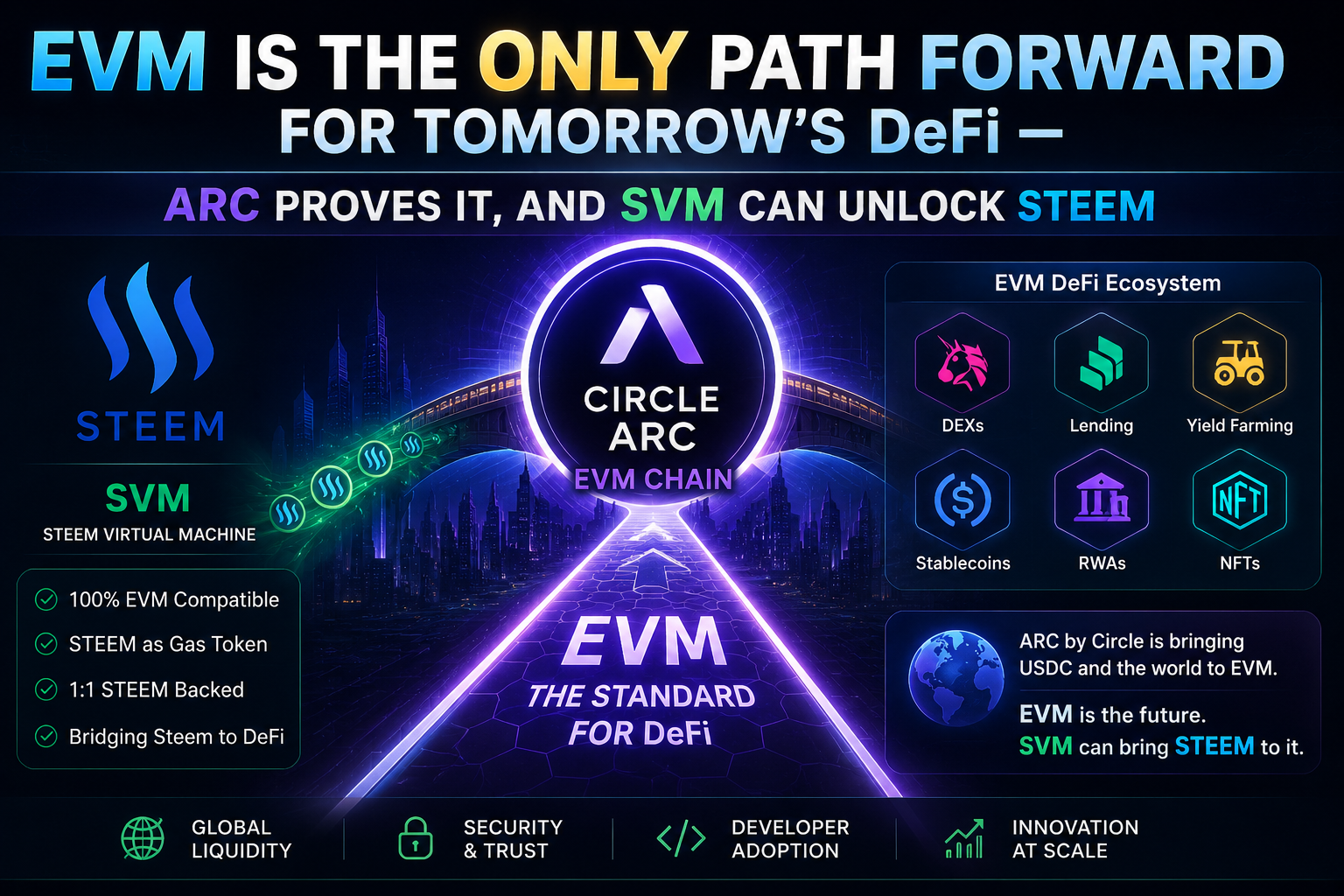
Arc: The Institutional Proof
Circle’s Arc is the clearest recent demonstration. It is a purpose-built Layer-1 for stablecoin-native finance: USDC as the native gas token, sub-second deterministic finality via Malachite BFT, opt-in privacy, and deep integration with Circle’s full stack.
Its execution layer uses Reth (the high-performance Rust Ethereum client). Developers deploy the same Solidity contracts, use the same wallets and tooling, and inherit the existing DeFi ecosystem with minimal friction. When institutions such as BlackRock, Visa, Mastercard, and DTCC join as founding validators for a mid-September 2026 mainnet, they are joining an environment they already understand.
Arc shows the pattern in action: purpose-built for institutional stablecoin rails, yet deliberately EVM. Predictable dollar-denominated fees. Instant settlement. Full compatibility with the largest smart-contract universe in crypto. Capital follows liquidity, and liquidity follows what developers and institutions can actually ship and integrate.
This is why EVM keeps winning across variants — Cosmos SDK + EVM modules, Reth/REVM stacks, TVM, and others. Network effects in tooling, audited code, developer talent, and existing liquidity are decisive. Permissionless smart contracts remain the mechanism that attracts the next wave of capital.
Why SVM Can Be Key for STEEM
Steem has long excelled as a social blockchain — fast blocks, feeless content interactions, Proof-of-Brain rewards, and a real user base. What it has lacked is modern programmable finance. That is the gap the Steem Virtual Machine (SVM) aims to fill.
SVM is an EVM-compatible Cosmos SDK sidechain designed as a financial extension layer for Steem rather than a competing chain. STEEM is the native gas and primary asset. Existing Steem accounts can be linked. A validator-native bridge is intended to move native STEEM without wrapped tokens or centralized custodians. Full Ethereum tooling works from day one.
On top of it sits Sherpa Protocol, the planned native DeFi layer featuring a concentrated-liquidity DEX, the overcollateralized stablecoin sUSD, permissionless liquidity farming, a decentralized oracle network, and protocol-owned liquidity.
SVM is currently in public testnet. It is not yet production infrastructure and therefore does not itself “prove” the broader EVM thesis the way institutional deployments like Arc do. Its value proposition is prospective: if the bridge, economics, and applications mature, it can create real utility and demand for STEEM by turning it into the gas and primary asset of a programmable SocialFi environment.
For the detailed technical design, architecture, bridge mechanics, Sherpa components, tokenomics, roadmap, and current progress, see the whitepaper post by the developer:
The Steem Virtual Machine (SVM) & Sherpa Protocol - STEEM’s Gateway to SocialFI
(Version 1.0 · July 2026)
That article lays out exactly why this approach — STEEM as native gas + EVM compatibility + SocialFi-native DeFi — can become a meaningful utility layer for the Steem economy without abandoning the social chain that already works for users.
The Bigger Picture
Arc (and similar institutional EVM approaches) demonstrates that capital is already flowing toward EVM-based smart-contract platforms optimized for real finance. SVM, still in testnet, represents one concrete path for Steem to participate in that same world: keep the social DNA, add programmable money and DeFi primitives, and make STEEM the economic fuel.
EVM-compatible smart contracts running permissionless finance are the common language of tomorrow’s DeFi. Chains and communities that connect to that reality while preserving their unique strengths will be better positioned than those that do not.
The institutional proof is already visible in projects like Arc. For Steem, the opportunity is still being built — and the full case for why SVM + Sherpa can be the key is in the linked whitepaper above.