Nepal’s Fast Track Toward Marijuana Legalization: 100 Days After Nepal’s Gen-Z Movement, Cannabis Reform Accelerates Nationwide
Nepal’s cannabis legalization movement is no longer a fringe discussion — it is rapidly becoming a mainstream political and economic agenda.
Less than 100 days after the rise of Nepal’s Gen-Z-driven political momentum and government restructuring, multiple provincial governments, lawmakers, ministries, and public figures have openly pushed forward cannabis reform discussions at an unprecedented pace.
What was once politically untouchable is now appearing directly inside provincial Niti Tatha Karyakram (Policy and Program) documents, parliamentary discussions, economic development plans, and industrial policy conversations.
The speed of these developments signals something important:
Nepal is entering the early stages of a regulated cannabis economy.
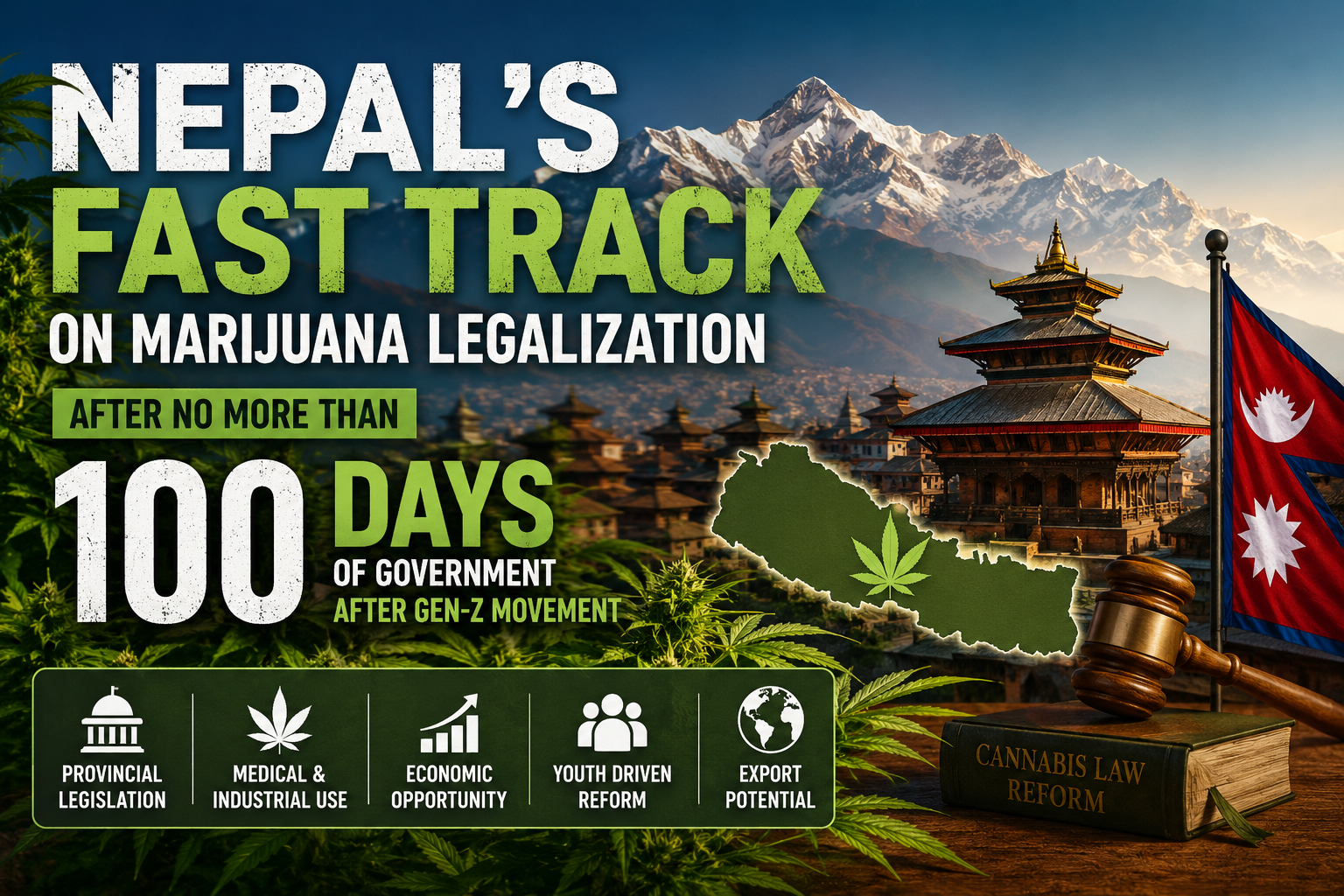
Thanks to ChatGPT for the Image
From Gandaki’s Historic Bill to a Nationwide Policy Shift
Earlier, Gandaki Province became the first province in Nepal to formally table comprehensive cannabis legislation through the Cannabis Cultivation Regulation and Management Bill 2082.
That bill introduced a tightly controlled framework for:
- Medicinal cannabis cultivation
- Industrial hemp production
- Government-supervised licensing
- Local monitoring mechanisms
- Export-oriented production systems
At the time, many viewed Gandaki’s initiative as an isolated provincial experiment.
Now, less than 100 days later, it increasingly looks like the beginning of a national shift.
Bagmati Province Officially Brings Cannabis Into Policy Discussions
One of the biggest developments came when the Bagmati Provincial Government included cannabis-related policy direction within its latest Niti Karyakram discussions.
The province has openly discussed:
- Legalizing medicinal marijuana production
- Industrial hemp cultivation
- Economic commercialization opportunities
- Rural employment generation
- Export potential
This is highly significant because Bagmati is Nepal’s political and administrative center.
When Nepal’s most influential province starts publicly discussing regulated cannabis industries inside official government policy frameworks, it indicates that legalization discussions have moved far beyond activist circles.
Cannabis Is Now Being Framed as Economic Policy — Not Just Drug Policy
A major transformation in Nepal’s cannabis debate is the language being used by politicians and policymakers.
Instead of focusing on recreational consumption, current discussions are centered around:
Economic Development
Cannabis is increasingly being presented as a tool for:
- Reviving rural economies
- Utilizing barren land
- Creating export industries
- Generating provincial tax revenue
- Attracting foreign investment
- Reducing youth migration abroad
Industrial Hemp Opportunities
Industrial hemp alone has massive global applications:
- Textiles
- Bioplastics
- Construction materials
- Paper products
- Cosmetics
- CBD extraction
- Medical products
Nepal’s geography and climate naturally support cannabis growth across many provinces, giving the country a potentially strong competitive advantage.
Medical Cannabis
Medical marijuana legalization is becoming the politically safest and fastest-moving pathway.
Government discussions increasingly focus on:
- Pharmaceutical processing
- CBD-based medicines
- Scientific research
- Controlled medicinal licensing
- Export-oriented medical production
This mirrors the early legalization models used in countries like Thailand, parts of Europe, and several US states.
The Gen-Z Effect on Cannabis Policy
The rapid acceleration of cannabis discussions did not happen in isolation.
Nepal’s Gen-Z political movement created a major shift in how younger citizens engage with governance, transparency, economic policy, and outdated legislation.
Young Nepalis increasingly view cannabis prohibition as:
- Economically outdated
- Hypocritical
- Difficult to enforce
- A missed agricultural opportunity
Social media has also played a massive role.
Cannabis reform discussions that once happened quietly are now openly debated across:
- TikTok
- YouTube
- X (Twitter)
- Podcasts
- Independent media platforms
For many young Nepalis, cannabis legalization is now associated with:
- Entrepreneurship
- Startup culture
- Agricultural modernization
- Decentralized economic opportunities
- Global competitiveness
The political class has clearly noticed the shift.
Nepal Is Quietly Competing for a Future Cannabis Market
What makes the current moment particularly important is that Nepal is no longer discussing cannabis only culturally or historically.
The conversation is becoming strategic.
Countries around the world are rapidly expanding regulated cannabis industries worth billions of dollars annually.
Nepal already has:
✓ Ideal growing climate
✓ Historical cannabis reputation
✓ Naturally occurring cannabis genetics
✓ Agricultural labor force
✓ International tourism appeal
✓ Large areas of underutilized land
Provincial governments increasingly appear concerned that Nepal could miss another global economic opportunity if reform moves too slowly.
Major Obstacles Still Remain
Despite the momentum, full legalization is still far from complete.
Several major barriers remain:
Federal Law
Nepal’s Narcotic Drugs (Control) Act 1976 still broadly criminalizes cannabis cultivation and distribution outside government authorization.
Provincial governments can propose frameworks, but federal coordination will ultimately be necessary.
Regulatory Complexity
Nepal still lacks:
- National licensing systems
- THC/CBD regulatory standards
- Export certification systems
- Cannabis taxation structures
- Quality control laboratories
- Clear investor frameworks
International Compliance
Nepal must also navigate international drug treaty obligations while creating any regulated cannabis market.
What Happens Next?
Over the next year, Nepal will likely move through several important phases:
1. More Provincial Policy Inclusion
Other provinces may begin introducing cannabis language into their own policy programs.
2. Federal Pressure Will Increase
As provinces push ahead, pressure on Kathmandu to modernize national cannabis laws will intensify.
3. Pilot Licensing Systems Could Emerge
The government may initially approve limited medicinal or industrial pilot programs before broader commercialization.
4. Foreign Investment Interest Will Grow
If regulatory clarity improves, Nepal could attract international interest in:
- Medical cannabis
- Hemp manufacturing
- CBD extraction
- Agricultural technology
- Export partnerships
Nepal’s Cannabis Future Is Moving Faster Than Expected
Only a few years ago, nationwide cannabis legalization discussions seemed politically unrealistic.
Today:
- Provincial assemblies are debating cannabis bills
- Cannabis appears inside official policy programs
- Ministries openly discuss commercialization
- Economic arguments dominate public discourse
- Younger generations strongly support reform
The speed of change over the past 100 days suggests Nepal may be entering the fastest phase of cannabis policy transformation in its modern history.
The question is no longer whether Nepal will discuss cannabis legalization.
The real question now is:
How fast will Nepal build its legal cannabis economy?
This article references ongoing cannabis policy developments in Nepal following Gandaki Province’s historic cannabis legislation initiative and subsequent provincial policy discussions across the country.
Qwen AI and ChatGPT were used for research assistance, structuring, and rewriting based on publicly available local news reporting and policy discussions.