How Smart Contracts Are Transforming Global Business
Business is being transformed by technology every day. Smart Contracts are one of the most recent innovations in the past few years. Smart contracts are computer programs that self-execute the terms of a contract when they are met. They primarily operate on a blockchain, which is a secure, transparent and immutable network. Many businesses around the world are now adopting smart contracts, as they can cut down on time and costs and build trust between parties. I don't think smart contracts will be out of the picture in the future of global business.
A smart contract is different from a traditional contract. In a typical deal between two businesses, they might need the assistance of a lawyer, bank, or other entity in order to ensure everything is completed properly. This can take days or weeks. In a smart contract, all information is coded into a computer program. If the conditions of the contract are fulfilled, then the contract automatically carries out the required action. Let's say that one customer pays for a product, then the smart contract can confirm the payment and give the product or service to the customer without waiting for another customer to approve it.
One of the biggest ways smart contracts are changing the way business is done globally is by cutting down on the cost. There are numerous companies that invest a significant amount of cash into paperwork, legal fees and transaction costs. Many of these costs can be eliminated with smart contracts, as many of these tasks are automated. The amount of money saved can be used by businesses to enhance their products, hire more staff or invest in different ideas. That's why I believe this technology is gaining interest for a lot of companies.
The other crucial advantage is speed. Many more steps are required in traditional business agreements before they can be completed. Documents need to be checked and approved by multiple people, different people. Delays may occur due to office closures, or when individuals are in various countries. Smart contracts operate on autopilot, whenever the time calls for it. If certain conditions are met, the agreement comes to fruition almost instantly. It enables businesses to extend customers quicker and enhance daily operations.
Smart contracts enhance trust among business partners, too. In the business world, businesses may not be known to one another. This can lead to insecurity and doubt. Each transaction is secured and transparent on blockchain technology. It is harder to alter the records, so both parties can check that the agreement has been adhered to accurately. This engenders confidence, even if companies are situated in various countries.
Another aspect where smart contracts are significantly impacting is supply chain management. Products may pass through several countries to reach the customers. Manufacturers, shipping firms, warehouses, wholesalers and retailers are involved. Smart contracts can be used to monitor movement of goods from one stage to another. The payment may also be automatically made when the products are safely delivered at their destination. This shortens delays, enhances transparency, and aids prevent companies from unneeded conflicts.
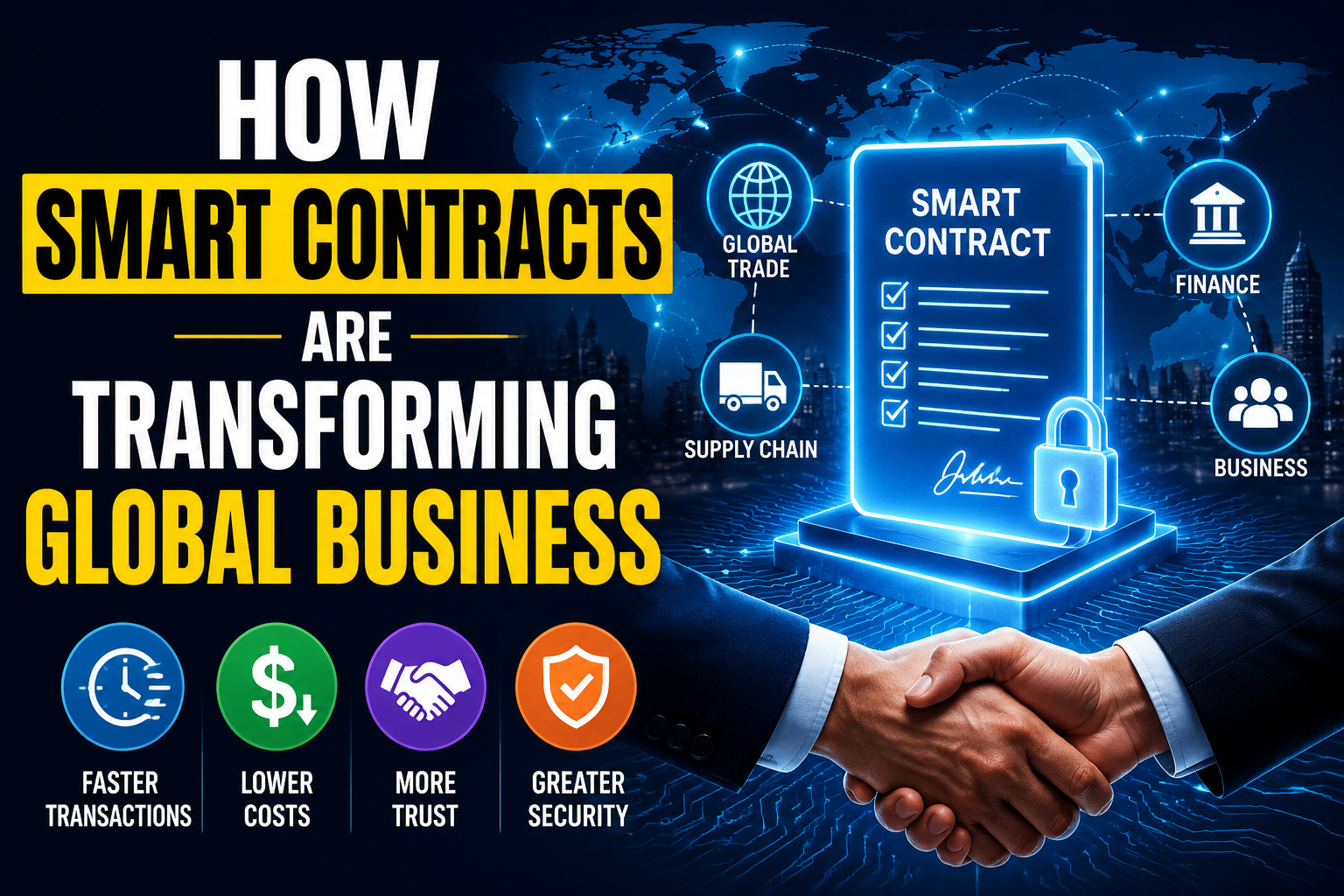
Smart contracts are also finding their way into the financial sector. Financial institutions like banks run millions of transactions daily. Spending many of these transactions needs manual checking and approval. Smart contracts can execute loan repayments, insurance claims, investment contracts – all these and more are examples of financial activities, which can be automated. The services are quicker for customers, and financial institutions have fewer errors and lower operating expenses. This makes for an improved experience for everyone involved.
Smart contracts have also greatly facilitated international trade. Businesses trading with other countries typically have to deal with different currencies, laws and regulations. This can cause slow and complex business transactions. Smart contracts automate many of these steps by automatically verifying contracts and executing payments whenever conditions are met. Companies can confidently do business with foreign counterparts, because the contract will be carried out in the manner in which it was made.
Smart contracts are also beneficial for small businesses. Traditionally, there was a strong association between business technology solutions and large businesses with large budgets. The existence of blockchain platforms, the accessibility of which is increasing today, enables smaller enterprises to benefit from smart contracts too. This facilitates them to participate in the international markets by lowering the prices, working efficiently and gaining the trust of their foreign customers.
While these are the advantages, there are disadvantages to smart contracts as well. A difficulty is that the computer program has to be programmed right. A contract may not function as intended if there's any error in the code. Another difficulty that arises is that not all countries have laws for smart contracts at this moment. Blockchain technology is also new to many people, making it difficult for some businesses to comprehend. Moreover, hackers might look for vulnerabilities in under-designed systems, making security always a priority.
I think these challenges will slowly get smaller and smaller as technology advances. The number of governments developing regulations for digital businesses is growing, and software developers are developing more robust and secure blockchain platforms. Blockchain and smart contract are also being taught in more Universities and training centers. That is, it will be possible to hire professionals that can build secure and reliable smart contract systems.
To summarize, smart contracts are revolutionizing the way business is conducted around the world by providing a faster, cheaper, safer, and more transparent way to conduct transactions. They cut out the middleman, boost trust between business partners and streamline businesses. This technology is already being used by industries like finance, supply chain management, insurance and international trade, and is producing benefits. There are still some problems to be solved, but the future is bright. Smart contracts will play a vital role in daily business operations globally and will bring a lot of value to companies to increase their growth, enhance customer satisfaction and make the global economy more efficient.