Centralized vs. Decentralized Systems
Assalamu Alaikum
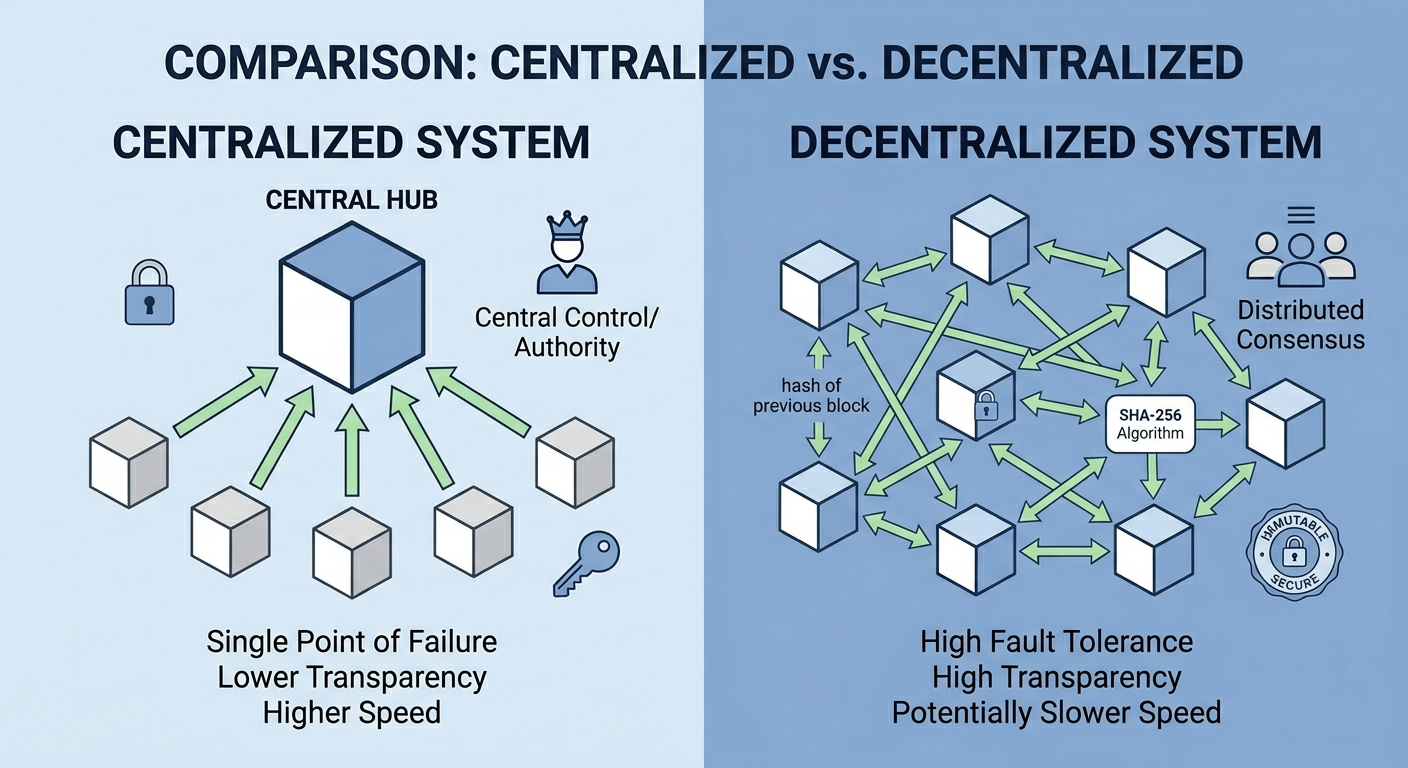
In today's technology-driven world, almost every activity in our lives depends on some system or system. These systems can be mainly divided into two categories: Centralized or central system and Decentralized or decentralized system. The main difference between these two systems is where and with whom the power and information are stored.
In a centralized system, a specific person, institution or server maintains control of the entire network. Our conventional banking system is the biggest example of this. When you deposit money in a bank, the bank has complete accounting and control over that money. Similarly, Facebook or Google are centralized platforms, where your personal information is stored on their central server. The advantage of this system is that it is easy to manage and customer care support is available in case of any problem. However, its big risk is that if the central server is hacked or the authorities close your account for some reason, you will have nothing to do.
In a decentralized system, there is no single owner or central authority. Here, power and information are distributed equally among each participant (Node) of the network. Blockchain technology and Bitcoin are good examples of this system. There is no bank here, so no one can block your transactions. Since the information is stored on thousands of computers, it is almost impossible to hack or change it. The big advantage of this system is transparency and independence. Here, "you are your own bank". However, its disadvantage is that it is a bit complicated to manage and there is no central authority to recover the password or secret key if it is lost.
Decentralized systems are much stronger in terms of security. In a centralized system, there is a "single point of failure"—that is, if the central server is damaged, the entire system becomes unusable. But in a decentralized system, even if one computer is shut down, the network is not damaged. Again, centralized systems are ahead in terms of speed, because here the decision-making power is in the hands of one person. On the other hand, in decentralized systems, the speed of transactions can be a little slower in many cases because consensus has to be taken by everyone in the network.
In short, centralized systems are a traditional system built on trust, where we hand over the responsibility of our information to others. On the other hand, decentralized systems are the freedom achieved through technology, where the user has full control over the information. In today's world, when information privacy and security have become major concerns, the importance of decentralized systems is increasing day by day with the help of Web 3.0 and blockchain. However, both systems have their own requirements depending on the situation. The future world is probably moving towards a balanced combination of these two systems. Today's discussion concludes here. I hope you've found it interesting. Please share your thoughts on today's topic. Prayers for everyone. May everyone be well. Amen.

Twitter
https://x.com/i/status/2051562545790771425
https://x.com/i/status/2051593242731569547
https://x.com/i/status/2051593360964792336