BIP-110 Soft Fork Officially Fails: Bitcoin’s Anti-Spam Proposal Mines Just Two Blocks and Stalls
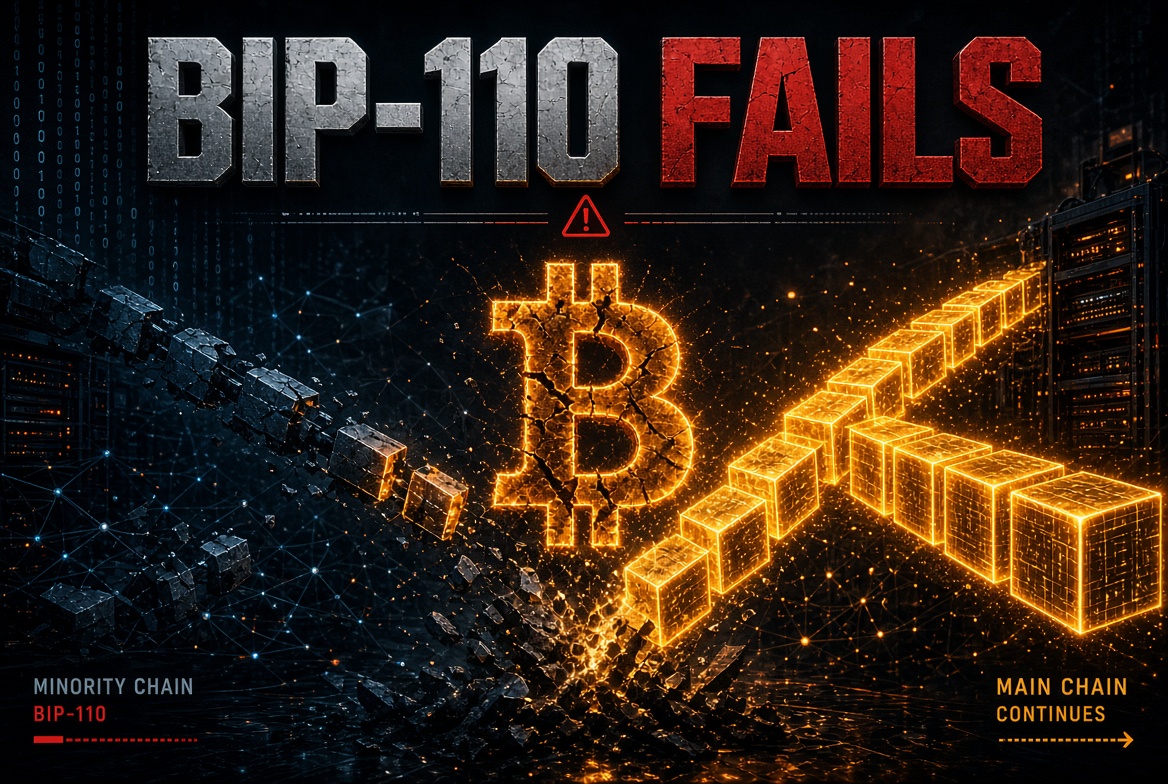
Bitcoin just delivered another reminder of how its consensus works in practice. Over the weekend of August 8–9, 2026, the long-debated BIP-110 proposal triggered a chain split—and the minority chain enforcing it promptly ran out of energy after producing only two blocks.
What was billed by supporters as a temporary fix for blockchain “spam” has, for all practical purposes, failed. The main Bitcoin network continued as usual while the BIP-110 branch inherited the full network difficulty with almost none of the hashrate, leaving it stuck and rapidly falling behind.
What Exactly Was BIP-110?
BIP-110 (also known as the Reduced Data Temporary Softfork or RDTS) was a proposed one-year soft fork designed to restrict arbitrary non-financial data embedded in Bitcoin transactions.
Its core goal: curb the techniques popularized by Ordinals inscriptions, BRC-20 tokens, Runes, and large OP_RETURN or Taproot data payloads that some view as spam clogging the blockchain, raising fees for ordinary users, and burdening node operators.
Key temporary rules included:
- Limiting most new transaction outputs to 34 bytes (with OP_RETURN capped at 83 bytes)
- Capping data pushes and certain witness elements at 256 bytes
- Restricting specific Taproot features commonly used for inscriptions (annexes, large control blocks, certain opcodes, etc.)
Pre-existing UTXOs were grandfathered in. The restrictions were meant to expire automatically after roughly one year (about 52,416 blocks). The proposal was authored by the pseudonymous Dathon Ohm, with significant input and advocacy from Luke Dashjr (Bitcoin Knots maintainer and Ocean pool figure).
Supporters argued it would refocus Bitcoin on its primary purpose as sound money rather than a general-purpose data storage layer. Critics—including prominent voices like Michael Saylor, Adam Back, and Jameson Lopp—called it technically flawed, potentially dangerous to Bitcoin’s neutrality and credibility, and a risky path toward a contentious chain split. They noted that data embedding can often be done in other ways and that changing consensus rules for a temporary spam filter sets a problematic precedent.
The Activation Plan and the Reality Check
BIP-110 used a modified BIP-9 style deployment. Early lock-in required 55% miner signaling (1,109 of 2,016 blocks in a difficulty period)—far lower than Bitcoin’s traditional ~95% threshold. If that failed, a mandatory signaling window would begin at block 961,632. Nodes enforcing BIP-110 would reject any block that did not signal support (version bit 4).
Signaling never came close. In the period leading up to the window, support hovered around 2.53% (just 51 of 2,016 blocks). Earlier months showed even lower figures, often under 1–3%.
When block 961,632 arrived (around August 8), the split happened. Most of the network (including major pools like AntPool) continued producing non-signaling blocks on the main chain. A small group of supporting miners (notably Roughnecks via Ocean’s DATUM protocol) produced alternative blocks that BIP-110 nodes accepted.
The result: a minority chain that managed to mine exactly two blocks (reaching height 961,633) before effectively stalling. Meanwhile, the main Bitcoin chain kept producing blocks roughly every 10 minutes and quickly pulled dozens of blocks ahead (reports showed gaps of 48, 80+, 88, or more blocks within hours).
Why It Stalled So Fast
The minority chain inherited Bitcoin’s full current mining difficulty (around 127.48 trillion) while commanding only a tiny fraction of the network’s hashrate—estimates put supporting power in the low single-digit percent or even lower effective share once the split occurred. Bitcoin only adjusts difficulty every 2,016 blocks. At that pace, the next adjustment for the BIP-110 chain was estimated hundreds of days away (some calculations suggested ~350 days or longer, with extreme low-hashrate projections stretching into years).
Without meaningful hashrate, block times stretched to many hours instead of 10 minutes. Progress froze. Michael Saylor summarized the outcome bluntly: roughly 99.85% of hashrate stayed with the main chain. “Bitcoin worked exactly as designed. BIP-110 was free to fork, and the network was free not to follow… BIP-110 will then stall or fork into irrelevance while Bitcoin continues normally.”
Some BIP-110 supporters have already floated the idea of switching to a different proof-of-work algorithm—which would effectively turn the project into an entirely new coin rather than a Bitcoin soft fork.
What This Means for Bitcoin
This episode underscores a few enduring realities of Bitcoin governance:
- Soft forks still require broad economic and hashrate buy-in to succeed without creating a dead or irrelevant minority chain.
- User-activated soft fork (UASF) style mechanisms can force a split, but they do not magically create consensus or security.
- Debates over block space usage, spam, and Bitcoin’s “purpose” remain heated, but the network’s heaviest-chain and economic majority dynamics proved decisive once again.
Ordinals-style inscriptions and similar data use can continue on the main chain for now. The underlying philosophical fight—whether Bitcoin should prioritize pure monetary use or allow more expressive data—will likely continue in other forms.
For ordinary users and holders, nothing fundamental changed on the main Bitcoin network. Transactions, security, and the 21 million supply schedule remain unaffected. The minority chain, with its extreme confirmation delays and negligible security, holds little practical value at present and carries classic replay-risk considerations for anyone who might experiment with it.
Bitcoin’s consensus process is messy, slow, and conservative by design. BIP-110’s rapid failure after the mandatory window opened is a textbook demonstration of that design working as intended: radical changes without overwhelming support simply do not stick.
The anti-spam conversation is far from over, but this particular soft-fork attempt has already joined the list of proposals that forked into irrelevance.