Can You Return to Sports After an ACL Injury?
An ACL injury can be a major concern for athletes and active individuals. A sudden change in direction, awkward landing, or direct impact can cause the knee to twist beyond its normal range, resulting in ligament damage. Pain and swelling may settle with time, but instability can continue to affect running, jumping, pivoting, and other sports movements.
The good news is that an ACL injury does not necessarily mean the end of an active lifestyle. With an accurate diagnosis, appropriate treatment, and disciplined rehabilitation, many patients can return to sports. For selected patients, ACL Repair in Jaipur or arthroscopic ACL reconstruction can help restore knee stability and create a foundation for a safe return to physical activity.
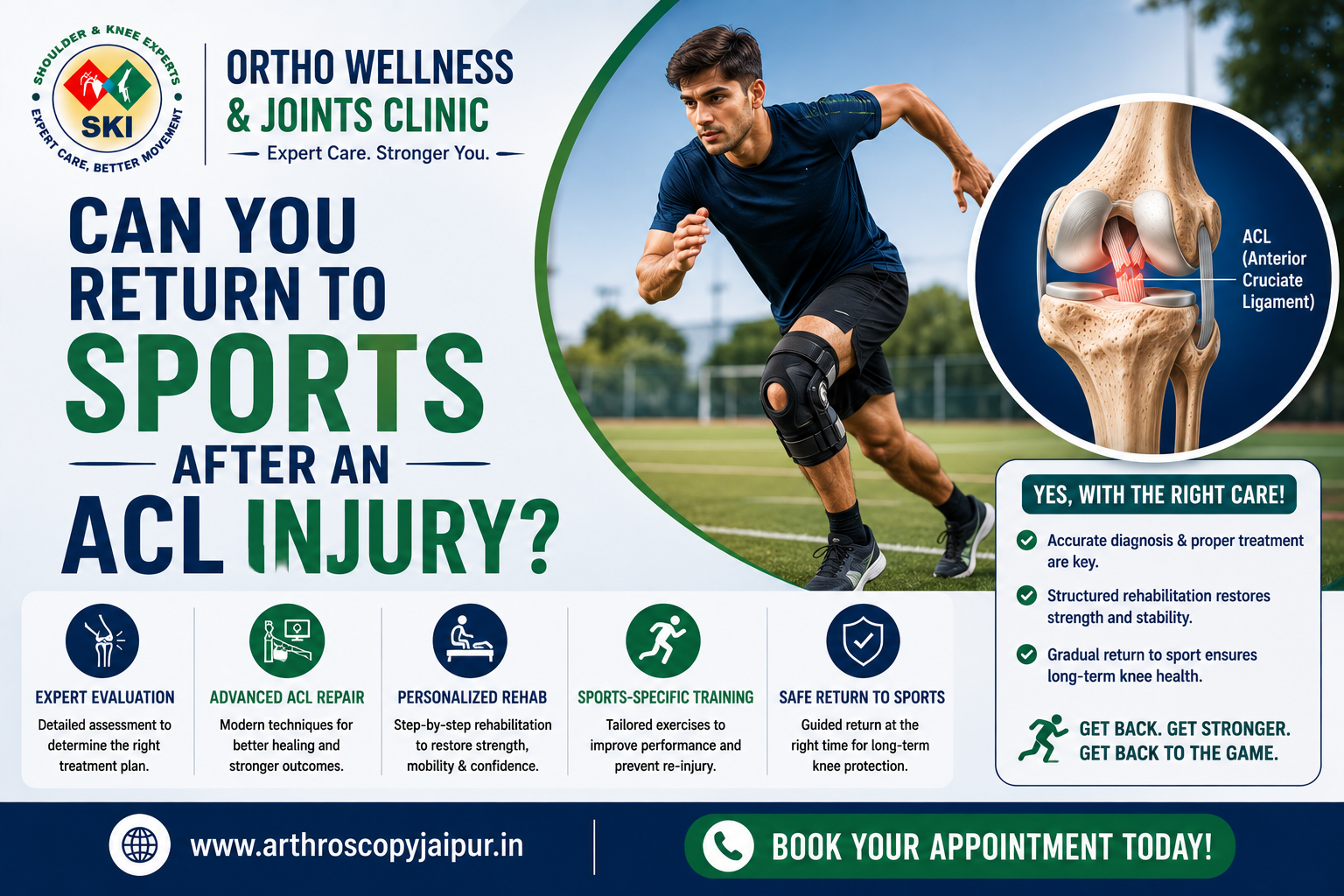
What Happens to the Knee After an ACL Injury?
The anterior cruciate ligament helps control forward and rotational movement of the knee. When it is significantly damaged, the knee may become unstable.
Patients may notice:
Swelling shortly after the injury
Pain while walking or exercising
Difficulty fully bending or straightening the knee
A sensation that the knee is giving way
Reduced confidence during sports
Difficulty with sudden turns or changes in direction
An unstable knee can place additional stress on the meniscus and cartilage, particularly when an athlete continues playing without appropriate treatment.
Can Everyone Return to Sports?
Returning to sports depends on several factors, including the severity of the ACL injury, associated damage, treatment method, physical condition, rehabilitation progress, and the demands of the chosen sport.
A recreational walker and a competitive football player may have very different rehabilitation requirements.
The objective is not simply to make the knee pain-free. The knee must regain sufficient strength, stability, coordination, and movement control to handle the demands of the activity.
When Is ACL Surgery Considered?
Some patients with partial ACL injuries and stable knees may improve with structured rehabilitation and activity modification.
Surgery may be considered when there is a complete tear accompanied by instability, associated meniscus or cartilage injuries, repeated giving-way episodes, or a strong requirement to return to sports involving pivoting and sudden direction changes.
An experienced orthopaedic specialist can assess the injury and explain whether rehabilitation alone or surgical treatment is more appropriate.
How Arthroscopic Treatment Can Help
When ACL surgery is recommended, minimally invasive techniques are commonly used for reconstruction or suitable repair procedures.
Knee Arthroscopy Surgery in Jaipur allows the surgeon to examine the inside of the knee through small incisions using a camera. Specialized instruments can be used to address the injured ligament and treat associated problems such as selected meniscus injuries when required.
The minimally invasive approach can reduce disruption to surrounding tissues and provides a clear view of the joint during treatment.
Rehabilitation Is the Key to Returning to Sports
Surgery does not mean that an athlete can immediately return to training. Rehabilitation is one of the most important parts of ACL recovery.
The program usually progresses through different stages.
Early Stage
The initial focus is on controlling swelling, restoring knee movement, activating muscles, and developing a safe walking pattern.
Strengthening Stage
Exercises progressively target the quadriceps, hamstrings, hips, and core. Improving strength helps the knee handle increasing physical demands.
Balance and Control
Proprioception, balance, coordination, and movement-control exercises become increasingly important as rehabilitation progresses.
Sport-Specific Training
Before returning to competition, athletes may need running, agility, jumping, landing, and direction-change exercises that replicate the demands of their sport.
Progress should be based on functional recovery rather than simply the passage of time.
Why Returning Too Early Can Be Dangerous
One of the most common mistakes after ACL treatment is returning to sports because the knee feels better.
Reduced pain does not necessarily mean the ligament and supporting muscles are ready for high-demand activity. Returning before adequate strength and neuromuscular control have been restored can increase the risk of reinjury.
Athletes should therefore follow objective rehabilitation milestones and obtain appropriate professional clearance before returning to competitive sport.
Experience Makes a Difference
ACL treatment requires careful assessment because the injury can occur alongside damage to other structures within the knee.
Dr. Abhishek Gupta, Senior Consultant Orthopaedic & Joint Replacement Surgeon, has more than 25 years of experience in arthroscopy, ligament reconstruction, joint replacement, and sports injury management. His approach considers the patient's injury pattern, activity requirements, associated damage, and long-term goals before developing a treatment plan.
For an athlete, this means treatment can be planned not only around healing the injury but also around restoring the strength and movement needed for a safe return to activity.
What About Other Orthopaedic Conditions?
Active patients may experience injuries affecting multiple joints during their sporting or fitness journey.
Individuals with persistent knee locking, cartilage problems, or meniscus injuries may require assessment by an orthopaedic specialist to determine whether arthroscopy or another treatment is appropriate.
Patients with advanced joint degeneration may eventually require a different approach. A Joint Replacement Doctor in Jaipur can evaluate severe arthritis affecting the knee or hip and determine whether joint replacement is appropriate when conservative measures no longer provide adequate relief.
This distinction is important because ligament injuries and advanced arthritis require very different treatment strategies.
How Can Athletes Reduce Future ACL Risk?
Returning to sport is only one part of long-term recovery. Injury prevention should continue even after rehabilitation is completed.
Athletes can reduce risk by maintaining lower-limb strength, improving balance and landing mechanics, warming up properly, gradually increasing training intensity, and avoiding sudden increases in workload.
Sport-specific conditioning can also help prepare the knee for repeated jumping, pivoting, acceleration, and deceleration.
When Can You Start Playing Again?
There is no universal date when every ACL patient is ready to return to sports. Recovery depends on the procedure, healing, strength, stability, associated injuries, and individual progress.
Before returning to competitive activity, patients should demonstrate adequate muscle strength, good balance, controlled movement, and confidence in the operated knee. Sport-specific testing may also be useful.
A gradual return is generally safer than immediately returning to full-intensity competition.
Final Thoughts
An ACL injury does not necessarily mean giving up the sport you love. With timely diagnosis, appropriate treatment, structured rehabilitation, and patience, many patients can work toward returning to an active lifestyle.
If you are considering ACL Repair in Jaipur, consulting an experienced specialist like Dr. Abhishek Gupta can help you understand your treatment options and expected recovery pathway. His experience in arthroscopy, ligament treatment, sports injuries, and joint replacement allows treatment to be tailored to the patient's individual needs and long-term activity goals.
The ultimate goal is not simply to repair the injured ligament—it is to restore a stable, functional knee that gives you the confidence to move again.