What Is the Difference Between AI Development, AI Agents, and AI Automation?
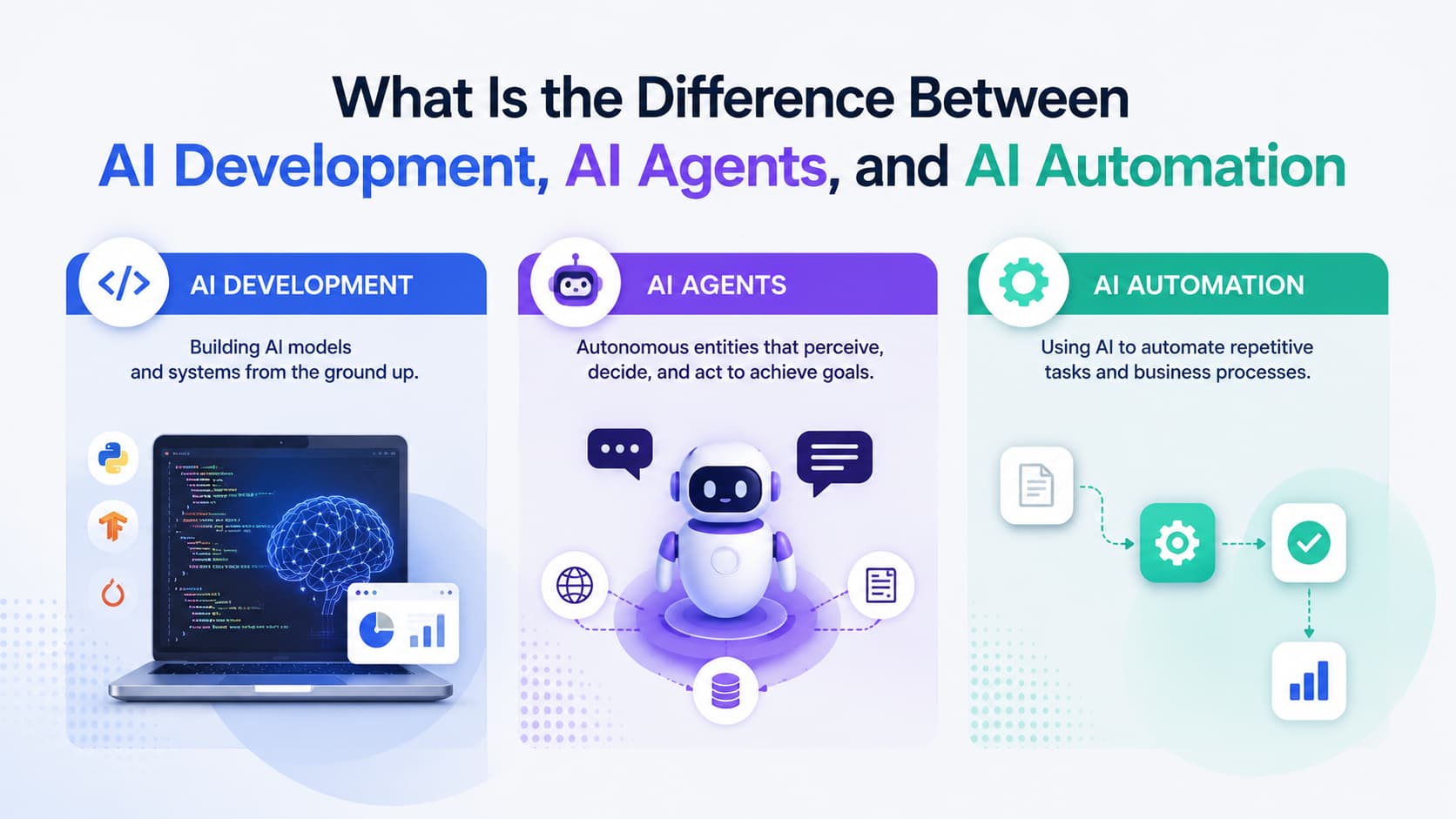
People mix up these three terms all the time. You hear "AI development," "AI agents," and "AI automation" used like they mean the same thing. They don't.
Each one plays a different role. Knowing the difference helps you pick the right solution for your business. It also saves you money and time.
If you search for artificial intelligence development services in USA, you will find companies offering all three. But not every company builds all three well. Let's break it down in plain words.
What Is AI Development?
AI development is the base layer. It's where models get built, trained, and tested. Think of it as writing the actual brain of the system.
This work includes:
- Collecting and cleaning data
- Training machine learning models
- Testing accuracy and fixing errors
- Deploying the model into an app or system
A company doing AI development might build a model that reads X-rays. Or one that predicts stock prices. The model itself does not act on its own yet. It just processes input and gives output.
Google's machine learning guide explains this process well for beginners. It's the foundation everything else sits on.
What Is an AI Agent?
An AI agent goes one step further. It doesn't just process data. It makes decisions and takes action on its own.
IBM describes an AI agent as a system that carries out tasks on its own, building its own workflow using the tools it has. That's a fancy way of saying it thinks and acts without you telling it every step.
Say you run an online store. An AI agent could:
- Read a customer email
- Understand what they want
- Check your inventory
- Reply with an answer, no human needed
That's very different from plain AI development. The model isn't just predicting something. It's completing a full task, start to finish.
Many businesses now hire AI agent development company teams to build these systems for support, sales, or internal operations. The demand grew fast in the last two years.
What Is AI Automation?
AI automation is different again. It connects tools, tasks, and rules into one flow. It often uses AI models, but not always in a smart or thoughtful way.
Picture a simple example. A form gets filled online. Automation sends an email, updates a spreadsheet, and alerts your team on Slack. No thinking involved. Just rules doing their job.
Automation can include AI agents inside it. But automation by itself is often rule-based, not decision-based.
Side By Side, In Plain Words
AI development is about building the model. It needs human input during training. Think fraud detection systems built from scratch.
AI agents make decisions and act on their own. Once deployed, they need very little human input. A customer support bot is a good example.
AI automation connects tasks into a flow. It rarely needs human input after setup. An auto-invoice system fits this well.
Development learns patterns from data. Agents reason and decide in real time. Automation just follows fixed steps, again and again.
If your task involves judgment or changing conditions, agents fit better. If it's repetitive and predictable, automation gets the job done faster and cheaper.
Real Examples That Show the Difference
A hospital builds a model to detect tumors in scans. That's AI development. Doctors still review every result.
A logistics company uses an agent to reroute trucks during bad weather. The agent checks maps, weather data, and delivery times on its own. That's an AI agent at work.
An HR team sets up a system where new hire forms trigger email, payroll setup, and account creation automatically. That's AI automation. Simple, fixed steps, repeated every time.
Why This Matters for Your Business?
Picking the wrong one wastes budget. A business owner who needs simple task automation doesn't need a full custom model built from scratch.
On the other hand, a company chasing complex decision-making needs more than basic automation tools. It needs a real agent, one that adjusts based on context.
Ask yourself these questions before choosing:
- Does the task involve judgment or changing conditions?
- Do you need something built from raw data, or connecting existing tools?
- How often will the rules or inputs change?
Answering these narrows your choice fast.
How They Work Together?
These three aren't rivals. They often stack on top of each other. AI development creates the model. The agent uses that model to make decisions. Automation carries the output into your daily workflow.
For instance, a bank might develop a fraud detection model first. Then build an agent that flags suspicious accounts and freezes them. Then automate the alert process to notify the fraud team instantly.
Microsoft's guide on agents shows similar layered systems used across finance and retail. Layer by layer, the system gets smarter and faster.
Common Mistakes Businesses Make
Some companies buy expensive AI development projects when a basic automation tool would do the job. That's wasted money.
Others try to automate tasks that actually need judgment. The rules break constantly because real-world situations don't follow fixed patterns. That's wasted time.
A smaller number skip agents entirely and stick with manual review, even where an agent could safely handle 80% of the work. That's wasted labor.
Quick Questions People Ask
Is an AI agent the same as a chatbot?
No. A basic chatbot follows scripted replies. An agent reasons through steps and picks its own path.
Can automation exist without AI?
Yes. Old-school automation used rules only, no learning involved. AI just makes it smarter now.
Do small businesses need AI development?
Not always. Many small businesses only need automation or a pre-built agent, not a custom model.
How long does AI development take?
It depends on the data and the goal. Simple models take weeks. Complex ones take months.
Final Thoughts
AI development builds the brain. AI agents use that brain to act. AI automation moves tasks along a fixed path, often with AI stitched in.
Know which one solves your actual problem before you spend on any of them. Talk to a team that understands all three, not just one.