From 1 kW to 1 MW: The Scalability of Paralleled High‑Power Bidirectional DC Supplies
Introduction
The test and measurement industry has long grappled with a fundamental tension: the need for high-power DC testing capabilities versus the physical and financial constraints of laboratory and production floor space. Traditional approaches required separate programmable power supplies for sourcing and regenerative electronic loads for sinking, each occupying its own chassis, consuming valuable rack real estate, and generating significant heat that demanded costly cooling infrastructure.
This paradigm is shifting. The emergence of the high-power bidirectional DC power supply that integrates both source and load functions into a single, compact unit is transforming how engineers approach high-power testing. But perhaps the most compelling advancement is the ability to scale these systems from modest single-unit configurations all the way up to megawatt-class installations through parallel operation.
This article explores the scalability of paralleled high-power bidirectional DC supplies, examining the technology that makes it possible, the applications that demand it, and the tangible benefits it delivers to organizations ranging from automotive R&D labs to renewable energy test facilities.
The Foundation: Bidirectional Topography and Energy Recapture
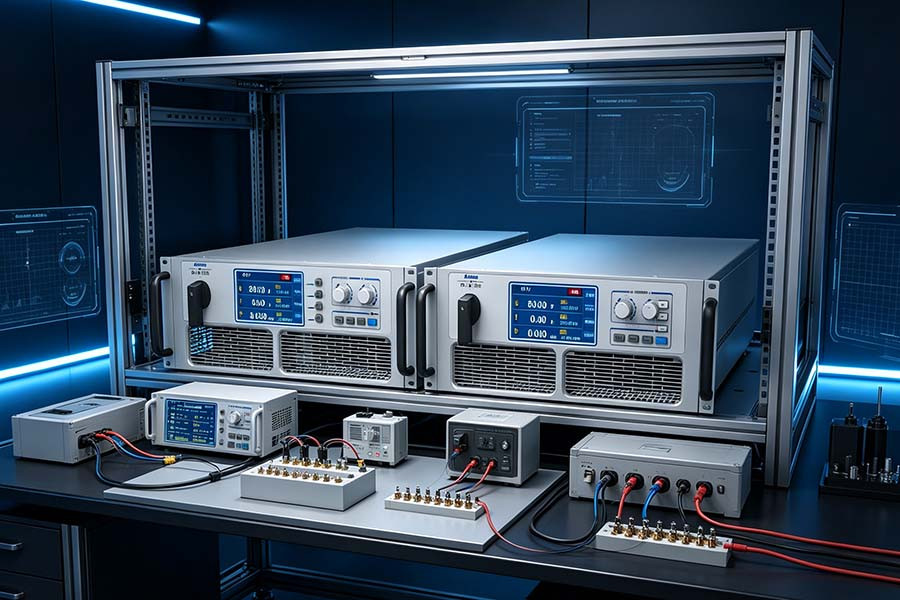
Before examining scalability, it is essential to understand what makes modern bidirectional DC supplies fundamentally different from their predecessors. The ANEVH(F) Series, for example, integrates a fully programmable digital DC power source and a regenerative electronic load into a unified two-quadrant system architecture. Unlike conventional test setups that demand individual sourcing and sinking instruments—adding complex multi-chassis routing, high parasitic impedances, and thermal management overhead—this unified topology handles both roles seamlessly.
The architecture employs high-frequency PWM rectification and bidirectional DC-DC conversion to enable energy to flow in both directions. When configured as a sink to mimic an electronic load, the device filters and returns absorbed power cleanly to the local three-phase AC grid. This regenerative approach achieves a feedback efficiency of up to 95% and maintains a power factor of ≥0.99 under rated power conditions.
The implications are substantial. Instead of dissipating test energy as heat—which would require expensive water cooling systems or massive resistive load banks—the energy is returned to the grid. This reduces the total thermal dissipation inside the testing laboratory, drops localized HVAC cooling costs, and lowers utility demands during long-duration duty-cycle testing. Less heat generated means less strain on facility HVAC, and returning energy to the grid instead of burning it off in resistive loads has real operating cost implications over the life of a test system.
The Scalability Challenge: From Single Unit to Megawatt-Class Systems
The power electronics industry is witnessing a rapid escalation in power requirements. Electric vehicle battery packs are growing larger. Charging infrastructure is advancing toward megawatt-class ultra-fast chargers. Renewable energy systems—from solar farms to wind turbines—demand increasingly powerful grid-tied inverter testing. Industrial drives and marine propulsion systems operate at power levels that would have been unthinkable just a decade ago.
Meeting these demands requires test equipment that can scale accordingly. This is where parallel operation becomes not just a convenience, but a necessity.
The ANEVH(F) Series, for instance, spans power ratings from 5 kW to 30 kW in a 3U rack-mounted package, with an industry-leading 50 kW configuration available in a 4U chassis. By achieving a power density of up to 12.5 kW per rack unit (kW/U), the instruments significantly compress the required floor space and rack infrastructure for high-capacity test environments.
But the true scalability lies in the ability to parallel multiple units. The series supports the parallel operation of multiple units, with the platform scaling up to 1 MW when combined. This means an organization can start with a single 5 kW or 30 kW unit for initial R&D work and, as power requirements grow, seamlessly expand the system by adding more units in parallel—all the way to a 1 MW powerhouse.
Technical Enablers: What Makes Parallel Operation Possible?
Scaling multiple power supplies in parallel is not as simple as connecting outputs. Without proper engineering, parallel operation can lead to current imbalances, circulating currents, and system instability. Several technical innovations make reliable parallel scaling possible.
Master-Slave Configuration: Modern bidirectional supplies employ master-slave parallel operation, allowing multiple units to be combined into high-power automated test systems. This approach designates one unit as the master that controls the overall system, while slave units follow its commands, ensuring coordinated operation.
Advanced Current Sharing: The parallel control methods employed in these systems—such as average current sharing control—maintain equal current distribution among each converter module. This ensures that no single unit is overloaded while others remain underutilized, maximizing the system's effective capacity and protecting individual units from stress.
Seamless Mode Transition: The ability to switch automatically and seamlessly between source and sink modes is critical for parallel operation. This matters for test sequences that need to move between charging and discharging profiles, such as battery or inverter testing, without introducing settling delays or requiring a manual mode change. The ANEVH(F) achieves transition times as low as 1.4 ms from maximum reverse current to maximum forward current.
High-Voltage Series Technology: The series covers seven voltage levels from 0 V to 2250 V, representing the industry's highest voltage level with unique high-voltage series technology. This broad voltage coverage ensures that as systems are paralleled for increased power, they can still accommodate the voltage requirements of next-generation higher-voltage batteries and industrial microgrids.
Applications Demanding Scalable Power
The ability to scale from 1 kW to 1 MW opens up a wide range of testing applications that would otherwise be impractical or impossible with single-unit solutions.
Electric Vehicle and Battery Testing
Bidirectional supplies and regenerative loads like the ANEVH(F) are a staple of EV battery, powertrain, and charger test benches, where the energy pulled out of a pack during cycling can be fed back to the grid rather than burned off as heat. As EV battery packs increase in capacity and voltage, the power required to test them scales accordingly. The ANEVH(F) Series can simulate power batteries and the grid to support battery and on-board charger-related tests efficiently, with parallel connection enabling maximum power up to 1 MW.
Ultra-Fast Charging Infrastructure
Some supercharging piles under development and testing have already reached 1 MW. Testing these high-power charging systems requires test equipment capable of both sourcing and sinking at equivalent power levels—a perfect application for paralleled bidirectional supplies.
Renewable Energy and Grid-Tied Inverter Testing
The ANEVH(F) can simulate solar cell I-V characteristics and test maximum power point tracking (MPPT) capability and efficiency. For utility-scale solar inverters and grid-tied systems, power levels routinely exceed what a single unit can provide. Parallel configurations enable comprehensive testing of these megawatt-class systems.
Microgrid and Energy Storage Systems
In microgrid applications, bidirectional DC/DC converters play a crucial role as interface devices for photovoltaics, energy storage, and loads. Scalable bidirectional supplies enable testing of these systems at their full operational power levels, ensuring reliability and performance under real-world conditions.
High-Power Industrial and Marine Drives
Large industrial motor drives and marine propulsion systems operate at power levels that demand megawatt-scale test capabilities. Parallel operation enables validation of these systems without building custom one-off test equipment.
Economic and Operational Benefits
The scalability of paralleled bidirectional supplies delivers benefits that extend beyond raw power capacity.
Capital Expenditure Efficiency: Organizations can start with a smaller investment and scale as needs grow, avoiding the upfront cost of a massive, underutilized system. This pay-as-you-grow approach aligns capital expenditure with actual testing requirements.
Space Optimization: By achieving up to 12.5 kW per rack unit, these systems dramatically reduce the physical footprint of high-power test capabilities. A 1 MW system that might once have filled an entire lab can now be accommodated in a fraction of the space.
Energy Cost Reduction: With up to 95% energy recapture efficiency, the energy that would otherwise be wasted as heat is returned to the grid. For facilities running continuous test cycles—such as battery aging or inverter burn-in—this translates into substantial utility savings over the life of the equipment.
Cooling Cost Reduction: Traditional high-power test setups generate enormous amounts of heat, requiring expensive water-cooling systems or massive air conditioning capacity. By returning energy to the grid rather than dissipating it as heat, regenerative systems significantly reduce cooling requirements.
Operational Flexibility: The ability to reconfigure the system—using fewer units for lower-power tests and more units for high-power tests—provides operational flexibility that fixed-capacity systems cannot match.
Software Integration and Test Automation
Scalability extends beyond hardware to software. Modern bidirectional supplies integrate with test development platforms that enable engineers to build test programs without writing code from scratch. The ANEVH(F) integrates with Intepro's PowerStar software platform, which is built around a fill-in-the-blank programming model aimed at engineers who need to build out custom test programs without writing code. This software integration ensures that as hardware scales, test automation scales with it.
Conclusion
The ability to scale high-power bidirectional DC supplies from a single 5 kW unit to a 1 MW parallel system represents a fundamental advancement in test and measurement capability. By integrating source and load functions into a single chassis, achieving industry-leading power density, and enabling reliable parallel operation, these systems address the growing power demands of EV testing, renewable energy validation, microgrid development, and industrial drive verification.
The economic benefits are equally compelling: reduced capital expenditure through scalable investment, lower operating costs through energy recapture, minimized cooling requirements, and optimized use of valuable lab space. As power electronics continue their relentless march toward higher voltages and power levels, the scalability of paralleled bidirectional supplies will become not just an advantage, but a necessity for organizations seeking to stay at the forefront of their industries.
For engineers and test managers evaluating their next generation of test equipment, the question is no longer whether bidirectional technology is appropriate, but rather how much scalability they will need—and how soon.