The Rise of Bidirectional DC Power Supplies in Energy Storage and Microgrid Testing
The global energy landscape is undergoing a historic transformation. Renewable energy adoption is accelerating, electric vehicles are becoming mainstream, battery energy storage systems are expanding rapidly, and microgrids are emerging as critical infrastructure for energy resilience and grid stability. At the center of this transition lies a powerful enabling technology: the bidirectional DC power supply.
Unlike traditional power supplies that only deliver energy in one direction, bidirectional DC power supplies can both source and absorb power. This capability is becoming increasingly important as modern energy systems evolve from centralized, one-way electrical networks into highly dynamic ecosystems characterized by distributed generation, energy storage, vehicle-to-grid interaction, and intelligent power management.
As energy storage systems and microgrids become more sophisticated, the demand for advanced bidirectional power testing solutions is growing rapidly across industries including renewable energy, electric vehicles, utilities, aerospace, semiconductor manufacturing, and research laboratories.
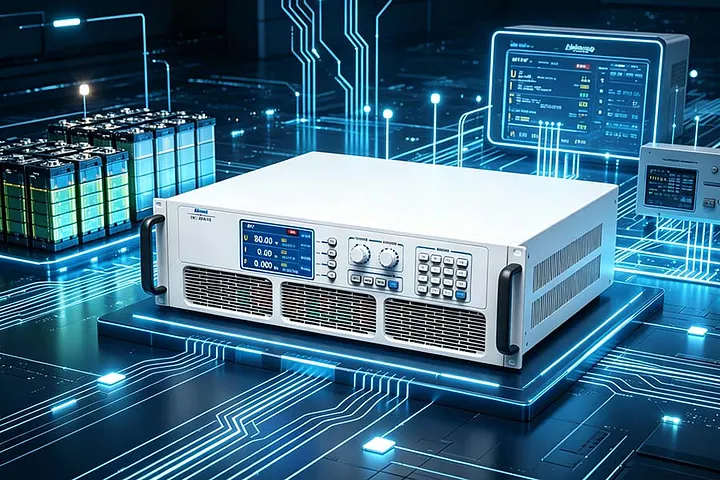
What Is a Bidirectional DC Power Supply?
A bidirectional DC power supply is an advanced programmable power device capable of operating in two modes simultaneously:
- Source mode: supplying DC power to a device under test
- Sink mode: absorbing energy returned from the device under test
Traditional DC power supplies only provide power outward. When testing systems such as batteries, inverters, or regenerative motor drives, excess energy is often dissipated as heat through resistive loads. Bidirectional systems, however, can recover and recycle this energy back into the grid or internal power system, significantly improving efficiency.
This dual-function capability makes bidirectional power supplies particularly valuable for testing energy storage systems, renewable energy converters, electric vehicle systems, and microgrids where energy constantly flows in multiple directions.
Industry analysts project strong growth for the bidirectional DC power supply market as renewable energy integration and EV adoption continue accelerating globally.
Why Energy Storage Systems Are Driving Demand
Battery energy storage systems (BESS) are becoming one of the fastest-growing segments in the global energy industry. Governments, utilities, and private companies are deploying large-scale storage systems to support renewable energy integration, grid balancing, backup power, and peak shaving applications.
Modern battery systems are highly dynamic. During operation, they constantly alternate between charging and discharging states depending on grid demand, renewable generation levels, and energy market conditions.
Testing these systems requires equipment capable of reproducing realistic bidirectional energy flows.
Bidirectional DC power supplies are widely used for:
- Battery charge-discharge cycling
- Battery management system (BMS) validation
- State-of-charge simulation
- Energy storage inverter testing
- Grid interaction simulation
- Battery degradation analysis
- Thermal performance evaluation
Because these power systems can both source and absorb energy, they allow engineers to simulate realistic operating conditions with high precision and energy efficiency.
This capability becomes especially important in large-scale battery testing environments, where energy consumption and heat generation can become significant operational challenges.
The Expansion of DC Microgrids
Traditional electrical grids were designed around centralized generation and one-way energy flow. Modern energy systems are increasingly moving toward decentralized architectures where renewable generation, battery storage, and intelligent controls operate together locally.
This is driving rapid growth in DC microgrids.
A DC microgrid is a localized energy network that integrates distributed energy resources such as:
- Solar photovoltaic systems
- Battery storage
- EV charging systems
- Fuel cells
- DC loads
- Smart inverters
DC microgrids offer several advantages over conventional AC systems, including:
- Higher energy efficiency
- Reduced conversion losses
- Easier renewable integration
- Improved battery compatibility
- Faster control response
- Simplified power electronics architecture
Research into hybrid AC/DC microgrids shows that advanced distributed energy storage and bidirectional power management are becoming essential for maintaining voltage stability and improving resilience in next-generation energy systems.
Bidirectional DC power supplies play a central role in validating and testing these systems.
Supporting Renewable Energy Integration
Renewable energy sources such as solar and wind introduce variability and intermittency into the electrical grid. Energy storage systems and microgrids help balance these fluctuations, but they also create highly dynamic electrical environments.
Bidirectional power supplies are increasingly used to test:
- Solar inverter systems
- Energy storage converters
- Hybrid renewable systems
- DC-DC converters
- Grid-forming inverters
- Smart energy controllers
Recent research highlights the importance of advanced bidirectional DC/DC converters for maintaining power balance and reducing ripple in DC microgrids.
Unlike traditional test equipment, bidirectional systems can emulate both energy generation and energy consumption scenarios. This allows engineers to evaluate how renewable energy systems behave under rapidly changing conditions, including cloud cover fluctuations, load spikes, and grid disturbances.
As renewable penetration increases globally, the need for accurate and flexible testing solutions continues to grow.
Vehicle-to-Grid (V2G) Is Accelerating Bidirectional Testing Needs
One of the most important emerging trends in the energy industry is vehicle-to-grid (V2G) technology.
V2G enables electric vehicles to function as mobile energy storage assets capable of both consuming and supplying electricity. In this model, EV batteries can discharge energy back into homes, businesses, or the utility grid during periods of high demand.
This fundamentally changes the relationship between transportation and power infrastructure.
Testing V2G systems requires advanced bidirectional power capabilities because energy must move seamlessly in both directions between the grid and the vehicle.
Industry experts note that bidirectional charging and V2G applications are rapidly moving beyond pilot projects and into commercial deployment.
Bidirectional DC power supplies are now essential for validating:
- V2G charging systems
- Vehicle-to-home (V2H) systems
- Bidirectional EV chargers
- Charging communication protocols
- Grid synchronization
- Four-quadrant power measurements
- Dynamic load transitions
As bidirectional charging infrastructure expands, testing laboratories and manufacturers increasingly require programmable source-and-sink power systems capable of reproducing realistic EV-grid interaction scenarios.
Improving Energy Efficiency Through Regeneration
One of the biggest advantages of bidirectional power supplies is regenerative energy recovery.
Traditional electronic loads dissipate absorbed energy as heat, which wastes electricity and increases cooling requirements. Bidirectional systems can instead feed absorbed energy back into the electrical grid, significantly improving overall energy efficiency.
This provides several major benefits:
- Lower operating costs
- Reduced cooling requirements
- Improved sustainability
- Smaller facility energy footprint
- Higher testing efficiency
- Reduced thermal stress
In large-scale battery testing facilities or EV charging validation labs, regenerative energy recovery can save enormous amounts of electricity.
As sustainability and carbon reduction become major priorities across industries, regenerative bidirectional systems are becoming increasingly attractive from both operational and environmental perspectives.
Microgrids Are Becoming Critical Infrastructure
Microgrids are no longer viewed as niche backup systems. They are increasingly becoming critical infrastructure for data centers, industrial facilities, hospitals, military installations, and smart cities.
According to Reuters, microgrid deployment is accelerating across the United States as utilities, technology companies, and energy developers seek more resilient and flexible power systems.
Several factors are driving this growth:
- Increasing grid instability
- Extreme weather events
- Rising electricity demand
- AI data center expansion
- Renewable energy adoption
- Energy security concerns
Microgrids rely heavily on sophisticated power electronics and intelligent energy management systems. Bidirectional DC power supplies are crucial for testing these complex systems under realistic operating conditions.
Modern microgrid testing often involves:
- Dynamic load simulation
- Grid islanding scenarios
- Renewable intermittency testing
- Battery dispatch simulation
- Power quality analysis
- Harmonic evaluation
- Voltage and frequency stabilization testing
The increasing complexity of these systems requires highly programmable and responsive test equipment.
The Role of Smart Power Electronics
As microgrids and energy storage systems become more advanced, power electronics are emerging as the true intelligence layer of modern energy infrastructure.
Industry discussions increasingly emphasize that the future of grid resilience depends heavily on advanced power conversion technologies, fault tolerance, harmonic control, and intelligent inverter systems.
This is driving innovation in:
- Wide-bandgap semiconductors
- Silicon carbide (SiC) technologies
- Gallium nitride (GaN) power devices
- High-frequency switching architectures
- AI-assisted power management
- Digital power control systems
Bidirectional DC power supplies are essential tools for validating these next-generation power electronics technologies before they are deployed into mission-critical energy systems.
Digitalization and Automated Testing
The future of energy infrastructure is increasingly digital, automated, and software-defined.
Modern bidirectional power systems now support:
- Ethernet and LAN communication
- SCPI programming
- Cloud monitoring
- Real-time diagnostics
- Automated test sequencing
- Data logging and analytics
- Remote operation
These features allow engineers to integrate bidirectional power supplies directly into automated test systems for high-volume manufacturing and advanced research environments.
As Industry 4.0 adoption grows, digitally connected power testing systems will become even more important.
The Future of Bidirectional Power Technology
The rise of renewable energy, battery storage, electric vehicles, and microgrids is fundamentally reshaping how electricity is generated, stored, distributed, and consumed.
In this new energy ecosystem, electricity no longer flows in a single direction. Energy constantly moves between batteries, vehicles, renewable generators, buildings, and the grid itself. Bidirectional DC power supplies are becoming indispensable because they mirror this new reality.
In the coming years, bidirectional power technologies will continue evolving toward:
- Higher power density
- Faster transient response
- Greater regenerative efficiency
- Smarter digital control
- AI-assisted diagnostics
- Enhanced grid simulation
- Fully automated testing environments
As energy systems become more decentralized and intelligent, bidirectional DC power supplies will remain at the heart of testing, validating, and optimizing the infrastructure powering the future energy economy.