What Is a Solar Inverter Test System and Why Is It Essential?
As the global demand for renewable energy continues to grow, solar power systems are becoming increasingly sophisticated. At the heart of every photovoltaic (PV) installation is the solar inverter—the device responsible for converting the direct current (DC) generated by solar panels into the alternating current (AC) used by homes, businesses, and the electrical grid.
Because the inverter is one of the most critical components of a solar energy system, it must undergo rigorous testing before reaching the market. This is where a solar inverter test system becomes indispensable.
In this article, we’ll explain what a solar inverter test system is, how it works, and why it plays a vital role in ensuring safety, efficiency, and compliance.
What Is a Solar Inverter Test System?
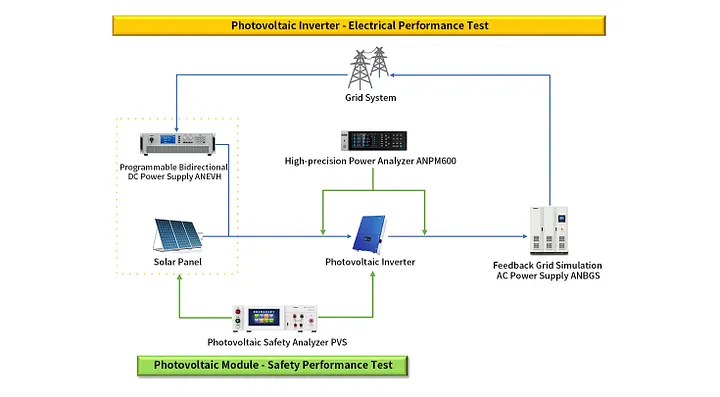
A solar inverter test system is specialized equipment designed to evaluate the performance, functionality, reliability, and safety of solar inverters under various operating conditions. It simulates real-world electrical environments, allowing manufacturers, research laboratories, and quality assurance teams to verify that an inverter performs as intended.
Rather than relying on actual solar panels and unpredictable weather, a test system provides controlled input and output conditions. This enables engineers to perform repeatable, accurate, and standardized tests throughout product development and production. A typical solar inverter test system includes:
- DC power supply or photovoltaic (PV) array simulator
- AC grid simulator
- Programmable electronic loads
- Power analyzers
- Data acquisition and monitoring software
- Safety protection systems
- Automated test control software
Together, these components create a comprehensive testing environment for evaluating inverter performance.
Why Is a Solar Inverter Test System Essential?
1. Ensures Product Safety
Solar inverters operate with high voltages and currents, making electrical safety a top priority. Testing verifies that protective features function correctly during abnormal operating conditions, such as:
- Overvoltage
- Overcurrent
- Short circuits
- Ground faults
- Grid disturbances
Proper testing helps prevent equipment failures, electrical hazards, and costly field recalls.
2. Verifies Performance and Efficiency
Efficiency directly impacts the amount of usable energy delivered to consumers. Even a small improvement in inverter efficiency can significantly increase energy production over the system’s lifetime. A solar inverter test system measures:
- Conversion efficiency
- Maximum Power Point Tracking (MPPT) accuracy
- Power factor
- Harmonic distortion
- Voltage regulation
- Dynamic response
These measurements help manufacturers optimize product performance while minimizing energy losses.
3. Supports Compliance with Industry Standards
Solar inverters must comply with numerous international and regional standards before entering the market. Testing systems help manufacturers validate compliance with requirements related to:
- Electrical safety
- Electromagnetic compatibility (EMC)
- Grid connection
- Anti-islanding protection
- Power quality
- Environmental performance
Compliance testing reduces certification risks and speeds up product approvals.
4. Accelerates Product Development
During research and development, engineers continuously improve hardware, firmware, and control algorithms. Automated testing allows development teams to:
- Validate design changes quickly
- Compare prototype performance
- Identify software bugs
- Verify firmware updates
- Reduce development cycles
Faster testing means products reach the market sooner without sacrificing quality.
5. Improves Manufacturing Quality
Production environments require every inverter to meet strict quality standards before shipment.
Modern solar inverter test systems automate end-of-line testing by performing dozens of verification procedures in just a few minutes. Automated testing improves:
- Repeatability
- Production throughput
- Traceability
- Quality consistency
- Defect detection
This reduces manufacturing costs while improving customer satisfaction.
Common Tests Performed
A comprehensive solar inverter test system can perform numerous evaluations, including:
Functional Testing
Confirms that all operating modes, communication interfaces, and control functions work correctly.
Efficiency Testing
Measures DC-to-AC conversion efficiency across varying load conditions.
MPPT Verification
Ensures the inverter accurately tracks the solar array’s maximum power point under changing irradiance and temperature conditions.
Grid Simulation Testing
Evaluates inverter behavior during:
- Voltage fluctuations
- Frequency changes
- Grid interruptions
- Voltage sags
- Voltage swells
Protection Testing
Verifies built-in safety mechanisms, including:
- Overvoltage protection
- Overcurrent protection
- Reverse polarity protection
- Anti-islanding functionality
- Thermal protection
Thermal Performance Testing
Determines inverter performance under elevated temperatures and continuous operation.
Benefits of Automated Solar Inverter Test Systems
Automation has transformed inverter testing by improving both speed and accuracy. Key advantages include:
- Reduced human error
- Faster testing cycles
- Repeatable results
- Automatic report generation
- Centralized data storage
- Remote monitoring capabilities
- Integration with manufacturing execution systems (MES)
These features enable manufacturers to maintain high production quality while reducing operational costs.
Future Trends in Solar Inverter Testing
Emerging technologies are making testing smarter and more efficient. Some of the latest trends include:
- AI-powered fault detection
- Digital twin simulation
- Cloud-based test management
- Automated regression testing
- Real-time performance analytics
- Hardware-in-the-loop (HIL) simulation
- Cybersecurity testing for smart inverters
These innovations help manufacturers improve product reliability while shortening development timelines.
Conclusion
A solar inverter test system is far more than a piece of laboratory equipment—it is an essential tool for ensuring the safety, efficiency, and reliability of modern solar power systems. From product development and certification to manufacturing quality control, comprehensive testing helps manufacturers deliver high-performance inverters that meet stringent industry standards.
As solar technology continues to evolve, advanced automated test systems will play an increasingly important role in supporting innovation, improving product quality, and accelerating the global transition toward clean energy. Investing in a robust solar inverter test system is not only a commitment to quality but also a strategic advantage in an increasingly competitive renewable energy market.