What Is a Solar Inverter Tester? A Comprehensive Guide to PV Inverter Testing Technology
Introduction
The global transition to renewable energy has placed solar photovoltaic (PV) systems at the forefront of power generation. As of 2025, solar energy accounts for a rapidly growing share of the world's electricity production, with millions of residential, commercial, and utility-scale installations operating across every continent. Central to every solar PV system is the inverter — the critical device that converts direct current (DC) generated by solar panels into the alternating current (AC) used by homes, businesses, and the power grid.
But how do engineers, technicians, and quality assurance professionals verify that a solar inverter is performing correctly, safely, and efficiently? The answer lies in a specialized category of test and measurement equipment known as the solar inverter tester.
This comprehensive guide explores what a solar inverter tester is, how it works, the key parameters it measures, the types available on the market, and why it is an indispensable tool for anyone involved in designing, manufacturing, installing, or maintaining solar energy systems.
What Is a Solar Inverter Tester?
A solar inverter tester (also called a PV inverter analyzer or photovoltaic inverter test system) is a sophisticated piece of electronic test equipment designed to evaluate the performance, efficiency, safety, and compliance of solar inverters. Unlike generic power analyzers or oscilloscopes, a solar inverter tester is purpose-built to handle the unique characteristics of inverter input and output signals, grid-connected operation, island detection, anti-islanding protection, and the complex interplay between the DC side (PV array) and the AC side (utility grid or local load), such as a bidirectional grid simulator.
At its core, a solar inverter tester performs two broad categories of evaluation:Electrical performance testing — measuring power conversion efficiency, output power quality, harmonic distortion, power factor, voltage and current waveforms, and dynamic response.Safety and compliance testing — verifying that the inverter meets national and international standards for grid interconnection, islanding protection, fault ride-through, and electromagnetic compatibility (EMC).
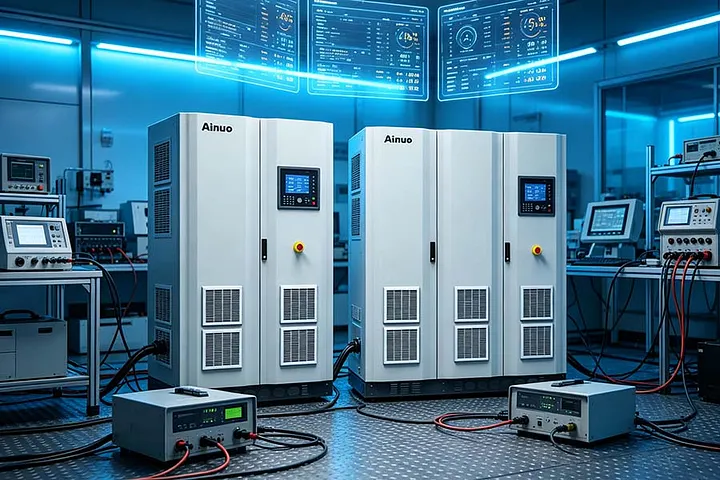
Modern solar inverter testers integrate multiple measurement capabilities into a single platform, often combining a grid simulator (to emulate utility conditions), a PV array simulator (to emulate the DC source), and high-precision power measurement instruments.
Why Is Testing Solar Inverters So Important?
1. Efficiency Directly Impacts Revenue
A string inverter or central inverter operating even 2–3% below its rated efficiency can cost a utility-scale project hundreds of thousands of dollars in lost energy production over its lifetime. Accurate efficiency characterization using a solar inverter tester helps manufacturers optimize designs, allows buyers to verify specifications, and enables operators to detect efficiency degradation over time.
2. Grid Code Compliance Is Mandatory
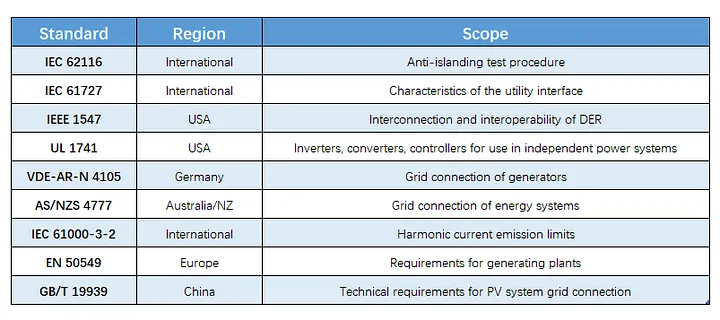
Grid operators around the world enforce strict technical requirements for equipment connected to the utility grid. Standards such as IEEE 1547 (USA), VDE-AR-N 4105 (Germany), AS/NZS 4777 (Australia), and IEC 62116 (anti-islanding) specify the conditions under which an inverter must disconnect from or remain connected to the grid. Failure to comply can result in equipment rejection, project shutdowns, or serious safety hazards.
3. Anti-Islanding Protection Is a Safety Imperative
One of the most critical safety requirements for grid-tied inverters is anti-islanding protection. If a section of the utility grid is de-energized (for example, during a fault or maintenance), the inverter must detect this condition and disconnect within a specified time window — typically a few hundred milliseconds. An inverter that fails to detect islanding can continue to energize a "dead" section of the grid, posing life-threatening dangers to utility workers. Solar inverter testers are specifically designed to verify anti-islanding response under a variety of simulated grid anomaly conditions.
4. Power Quality Matters to All Stakeholders
Inverters that inject excessive harmonic distortion, cause reactive power imbalances, or produce flicker affect the quality of power delivered to neighboring consumers. Regulatory bodies impose Total Harmonic Distortion (THD) limits and power factor requirements. A solar inverter tester quantifies these parameters with metrological accuracy.
5. Product Development and Certification
For inverter manufacturers, comprehensive testing during R&D and pre-certification phases shortens development cycles, reduces costly rework, and accelerates time-to-market. Third-party certification laboratories also rely on solar inverter testers to conduct the standardized test procedures required for certification marks such as UL 1741 (USA), CE (Europe), and CEC (Australia).
Key Parameters Measured by a Solar Inverter Tester
DC Input Side Parameters
- MPPT (Maximum Power Point Tracking) efficiency — how effectively the inverter extracts maximum power from the PV array under varying irradiance and temperature conditions
- Input voltage range — verifying operation across the full specified DC input window
- Start-up and shut-down voltage thresholds
- Input ripple current and voltage
- Leakage current from PV array to ground (important for transformerless designs)
AC Output Side Parameters
- Output voltage and frequency — accuracy and stability
- Output active power (W) and apparent power (VA)
- Power factor and displacement power factor
- Total Harmonic Distortion (THD-V and THD-I)
- Individual harmonic components (2nd through 50th order, per IEC 61000-3-2)
- DC injection into the AC grid (must be below specified limits)
- Output current waveform quality
Conversion Efficiency
- CEC (California Energy Commission) weighted efficiency
- European weighted efficiency
- Peak efficiency
- Partial-load efficiency curve (e.g., efficiency at 10%, 20%, 30%, 50%, 75%, 100% of rated power)
Grid Interaction and Protection
- Grid voltage ride-through (LVRT and HVRT — Low/High Voltage Ride-Through)
- Frequency ride-through (LFRT and HFRT)
- Reconnection time after grid disturbance
- Anti-islanding detection time and method effectiveness
- Reactive power (Q) control capability
- Volt-Var (V-Q) and Volt-Watt (V-P) response
Dynamic Response
- Ramp rate control (limiting the rate of change of output power)
- Response to rapid irradiance changes (cloud shadows)
- MPPT dynamic performance under transient conditions
Types of Solar Inverter Testers
1. Benchtop PV Inverter Test Systems
These are comprehensive, laboratory-grade systems intended for R&D, production testing, and certification. They typically include:
- A regenerative grid simulator capable of sourcing and sinking AC power, simulating voltage sags, swells, frequency deviations, and harmonic distortion
- A PV array simulator (programmable DC power supply with I-V curve simulation) to emulate the nonlinear output characteristics of a solar array under various irradiance and temperature conditions
- A precision power analyzer to measure conversion efficiency and power quality
- Control software with automated test sequences aligned to major standards
Leading manufacturers of benchtop PV inverter test systems include companies specializing in regenerative power electronics test equipment.
2. Field Service Analyzers
Portable, handheld, or suitcase-sized instruments designed for use on installed solar power systems. These typically measure:
- AC output power, voltage, current, and frequency
- Power factor and harmonic content
- Inverter operating temperature
- Event logging and data trending
Field analyzers are widely used by solar system installers, O&M (operations and maintenance) contractors, and utilities for commissioning new installations and diagnosing underperforming systems.
3. String Inverter Test Adapters
Specialized interface hardware that allows a standard power analyzer or solar analyzer to connect to string inverter input/output terminals safely, often including:
- MC4 connector adapters
- Differential voltage probes for high-voltage DC measurement
- Current clamps for AC and DC circuits
4. Production Line Testers
Automated test systems integrated into inverter manufacturing lines. These perform rapid go/no-go testing of completed inverter units, checking key parameters against specification limits in a matter of seconds to minutes per unit.
Core Technologies Inside a Solar Inverter Tester
PV Array Simulation
One of the most technically challenging aspects of solar inverter testing is accurately simulating the nonlinear I-V (current-voltage) characteristic of a photovoltaic array. A PV array does not behave like a simple DC voltage source or current source — its output is described by a complex curve that depends on irradiance, cell temperature, shading, and cell aging.A PV array simulator embedded in a solar inverter tester generates this I-V curve in real time using fast, high-bandwidth programmable power electronics. The simulator must respond quickly enough (typically within a few milliseconds) to test MPPT algorithms under rapidly changing conditions.
Regenerative Grid Simulation
On the AC side, a regenerative grid simulator emulates the utility grid. Unlike passive grid emulators, regenerative systems can absorb the power delivered by the inverter under test and return it to the supply or a resistive load bank — dramatically reducing energy waste and operating costs in production and certification test environments.
The grid simulator must accurately reproduce:
- Steady-state voltage and frequency
- Voltage sags and swells (step changes in voltage magnitude)
- Frequency ramps and step changes
- Phase jumps
- Harmonic distortion profiles
- Unbalanced three-phase conditions (for three-phase inverter testing)
Precision Power Measurement
Efficiency measurement is at the heart of solar inverter testing, and it demands the highest accuracy available. Precision power analyzers integrated into solar inverter test systems achieve:
- Voltage measurement accuracy: ±0.05% or better
- Current measurement accuracy: ±0.05% or better
- Power measurement accuracy: ±0.1% or better (some specialized instruments achieve ±0.05%)
These instruments simultaneously measure on both the DC input and AC output sides, computing conversion efficiency as the ratio of AC output power to DC input power.
International Standards for Solar Inverter Testing
A solar inverter tester must be capable of executing tests defined in a wide range of national and international standards:
How a Solar Inverter Test Is Conducted: Step-by-Step
Step 1: Set Up the Test Environment
Connect the inverter under test (IUT) to the PV array simulator on the DC input side and to the regenerative grid simulator on the AC output side. Install precision current transformers and voltage probes as required.
Step 2: Configure the PV Simulator
Program the PV array simulator with the appropriate I-V curve parameters: open-circuit voltage (Voc), short-circuit current (Isc), maximum power point voltage (Vmpp), maximum power point current (Impp), and temperature coefficients.
Step 3: Steady-State Performance Testing
Apply a series of irradiance levels (typically from 10% to 100% of STC — Standard Test Conditions at 1000 W/m², 25°C) and record input power, output power, and conversion efficiency at each operating point.
Step 4: MPPT Efficiency Testing
Follow the procedure defined in EN 50530 or equivalent standards, applying dynamic irradiance profiles and computing the ratio of actual energy harvested to the theoretical maximum.
Step 5: Grid Disturbance Testing
Program the grid simulator to generate voltage sags, swells, frequency deviations, and phase jumps. Record the inverter's response: does it ride through within tolerance, or does it trip at the correct threshold?
Step 6: Anti-Islanding Testing
Configure the grid simulator to simulate an islanding condition (typically by disconnecting the simulated grid while the inverter is operating at rated power into a resonant RLC load). Measure the time from grid disconnection to inverter shutdown. Verify compliance with the applicable standard.
Step 7: Harmonic and Power Quality Measurement
Measure THD-I, individual harmonic amplitudes, DC injection, and power factor under rated conditions and partial load.
Step 8: Generate Test Report
Automated test software compiles all measured data into a structured test report, comparing results against specified limits and generating pass/fail determinations.
Solar Inverter Tester vs. General-Purpose Power Analyzer
Many engineers wonder whether a general-purpose power analyzer can substitute for a dedicated solar inverter tester. While a high-end power analyzer can certainly measure output power quality and efficiency, it cannot:
- Simulate the PV array (no DC source with I-V curve capability)
- Simulate the utility grid under controlled disturbance conditions
- Execute standardized anti-islanding test procedures
- Perform MPPT efficiency testing per EN 50530
- Automatically sequence through all required test conditions
For serious inverter development, certification, or production testing, a purpose-built solar inverter test system is essential.
Market Trends and Future Developments
1. Higher Power Levels
As utility-scale inverter ratings climb beyond 5 MW per unit, test systems must scale accordingly, requiring multi-megawatt grid simulators and PV array simulators.
2. SiC and GaN Power Devices
The adoption of wide-bandgap semiconductor devices (Silicon Carbide and Gallium Nitride) enables higher switching frequencies and higher efficiency but also generates new electromagnetic interference challenges. Solar inverter testers must now include wideband harmonic measurement capability up to the megahertz range.
3. Energy Storage Integration
Hybrid inverters combining solar PV with battery energy storage require testing of bi-directional power flow, state-of-charge management algorithms, and grid services such as frequency response and peak shaving.
4. Virtual Power Plant (VPP) Interoperability
As distributed solar assets are aggregated into virtual power plants, inverter testers must verify communication protocol compliance (Modbus, SunSpec, IEEE 2030.5, OpenADR) alongside traditional electrical performance.
5. Automated and AI-Assisted Testing
Emerging test platforms leverage machine learning algorithms to adaptively optimize MPPT test profiles, predict failure modes from measurement signatures, and reduce test time while maintaining statistical confidence.
Conclusion
A solar inverter tester is far more than a measurement instrument — it is a comprehensive platform that bridges the DC world of photovoltaic generation with the AC world of power distribution, verifying every critical aspect of inverter performance, safety, and grid compliance. As solar energy continues its rapid expansion and inverter technology evolves toward higher efficiency, smarter grid services, and tighter integration with energy storage, the role of the solar inverter tester becomes ever more central to the industry.
Whether you are an inverter manufacturer striving for best-in-class efficiency, a certification laboratory verifying grid code compliance, or a solar system operator troubleshooting underperformance, understanding and using the right solar inverter tester is essential to the success of your work. Investing in the appropriate test equipment today means more reliable, more efficient, and safer solar energy systems for tomorrow.