ALFREDO PARISI NETTO AND THE NEW ERA OF CONSTRUCTION: WHY TRANSFORMATION WILL MATTER MORE THAN BUILDING
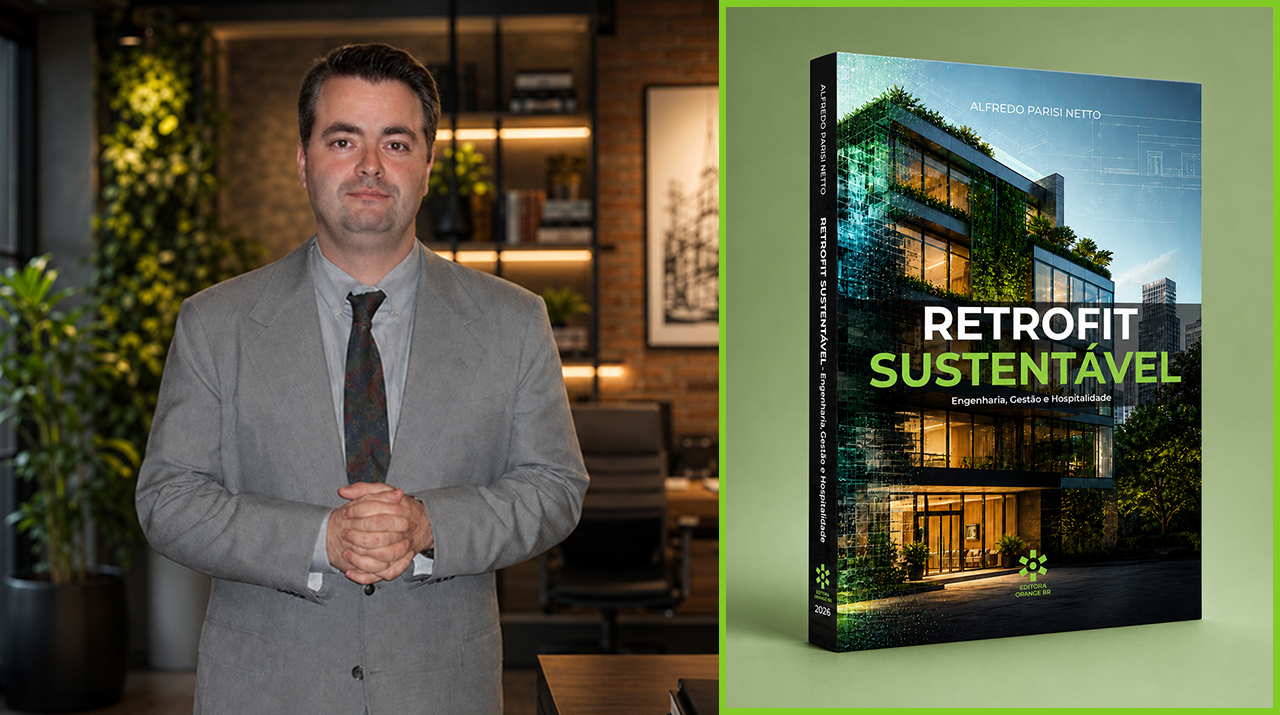
For more than a century, urban development was associated with an apparently unquestionable idea: growth meant construction. New buildings, new infrastructure, new cities, and new developments became symbols of progress, prosperity, and modernization. However, the twenty-first century introduced a new variable into this equation. For the first time in history, the construction industry began to be evaluated not only by what it produces, but also by the environmental impact it generates.
Climate change, resource scarcity, the urgent need to decarbonize the global economy, and increasing pressure for more sustainable development models are profoundly transforming the way governments, investors, engineers, and managers understand the built environment.
Today, the question is no longer simply, “What should we build?”
It now includes a far more strategic question:
What can we transform before building again?
It is within this context that Sustainable Retrofit: Engineering, Management, and Hospitality emerges. Written by Alfredo Parisi Netto, the book proposes a profound reflection on the future of construction and presents retrofit not merely as a construction technique, but as a new way of thinking about urban development, asset management, and sustainability.
Throughout fifteen chapters, the author demonstrates that the greatest asset of our cities may not be vacant land awaiting development, but rather the structures that already exist and can be reinvented to meet the demands of the present and the future.
CONSTRUCTION AT THE CENTER OF THE CLIMATE CRISIS
Few industries have as significant an impact on the planet as construction.
For decades, environmental discussions focused primarily on sectors such as transportation, heavy industry, and energy production. However, recent studies show that buildings and construction account for a substantial share of global energy consumption and carbon emissions associated with human activity.
This reality fundamentally changes the sector’s responsibility.
Every building becomes more than a physical structure—it becomes an environmental decision.
Every material carries emissions.
Every installed system influences energy consumption.
Every design choice affects future performance.
Alfredo Parisi Netto demonstrates that understanding this reality is the first step toward building a smarter and more sustainable industry.
The book provides a comprehensive perspective on embodied carbon, operational efficiency, life-cycle assessment, and decarbonization strategies, showing that contemporary engineering must incorporate variables that were often overlooked in the past.
DEMOLISH OR TRANSFORM: THE GREAT DILEMMA OF OUR TIME
One of the book’s most provocative reflections arises from a seemingly simple question:
Is demolition really worth it?
For a long time, replacing old buildings with new structures was considered the natural path of urban development.
Yet Alfredo demonstrates that this logic urgently needs to be reconsidered.
When a building is demolished, what is lost is not merely a physical structure. It is also the energy, materials, natural resources, and carbon emissions already invested in its construction.
In other words, demolition represents the disposal of a vast amount of environmental capital.
From this perspective, retrofit emerges as an alternative capable of preserving value, reducing emissions, and extending the useful life of buildings.
The book encourages professionals and investors to move beyond the logic of automatic replacement and embrace the intelligent transformation of what already exists.
RETROFIT AS A PARADIGM SHIFT
Throughout the book, it becomes clear that Alfredo does not treat retrofit as a simple renovation.
For him, retrofit represents a paradigm shift.
While traditional renovations often focus on isolated or aesthetic improvements, sustainable retrofit involves an integrated approach that considers structural performance, energy efficiency, operational management, environmental sustainability, and user experience.
This perspective significantly expands the role of engineering.
Professionals are no longer concerned solely with physical structures; they work with complex systems involving technology, economics, management, comfort, and sustainability.
Buildings cease to be static objects and become dynamic assets capable of evolving over time.
This shift in mindset may be one of the book’s most important contributions.
THE CARBON NO ONE SEES
Among the book’s most important concepts is the distinction between operational carbon and embodied carbon.
Traditionally, building sustainability has been associated with reducing energy consumption during operation.
However, Alfredo demonstrates that a significant portion of emissions occurs long before a building begins operating. These emissions are embedded in raw material extraction, manufacturing, transportation, and construction processes.
This is known as embodied carbon.
By preserving existing structures, retrofit prevents the generation of new emissions that would result from replacing components that still have useful life.
This perspective completely transforms environmental evaluation and reinforces the importance of strategies that value existing building stock.
EXISTING BUILDINGS AS AN OPPORTUNITY
In many cities, most of the buildings that will exist in the coming decades have already been built.
This fact radically changes the logic of urban sustainability.
Instead of focusing exclusively on new developments, attention must turn toward what already exists.
Alfredo Parisi Netto presents existing building stock as one of the most strategic assets of contemporary society. Older buildings, hotels, commercial centers, industrial facilities, and tourism enterprises can be upgraded, modernized, and adapted to new demands without complete reconstruction.
This approach reduces environmental impacts, optimizes investments, and strengthens the principles of the circular economy—a concept that runs throughout the entire book.
HOSPITALITY, TOURISM, AND USER EXPERIENCE
One of the book’s most distinctive features is its connection to the hospitality and tourism industries.
While many books about retrofit remain confined to technical engineering discussions, Alfredo expands the conversation to include the human experience.
Hotels, inns, resorts, and tourism facilities now face challenges that extend far beyond physical infrastructure. Modern guests seek comfort, efficiency, identity, sustainability, and memorable experiences.
In this context, retrofit becomes more than a technical solution—it becomes a competitive strategy.
The author demonstrates how building upgrades can improve user experience, reduce operational costs, increase energy efficiency, and strengthen market perception.
Sustainability ceases to be an additional expense and becomes a strategic advantage.
WHEN ENGINEERING AND MANAGEMENT WORK TOGETHER
Another strength of the book lies in its integration of engineering and management.
Throughout its chapters, Alfredo shows that successful retrofit projects depend not only on technical expertise but also on financial planning, risk management, cost control, and life-cycle analysis.
This integration reflects a growing trend within the construction industry.
The success of a project no longer depends solely on construction quality but on its ability to generate value throughout its operational life.
For this reason, the book speaks directly to investors, managers, hotel operators, architects, engineers, and entrepreneurs who must make decisions in increasingly complex environments.
SUSTAINABILITY BEYOND THE RHETORIC
We live in an era in which the word sustainability is used everywhere.
However, Alfredo Parisi Netto highlights a recurring problem: the gap between discourse and practice.
The book takes a critical stance toward superficial approaches that transform sustainability into marketing language or public relations strategy.
Instead, it proposes objective criteria, measurable indicators, and technically grounded solutions.
This position gives the work particular relevance for professionals seeking real results rather than merely attractive narratives.
THE FUTURE OF CONSTRUCTION
By the end of the book, one conclusion becomes unavoidable.
The future of construction will not be defined solely by the ability to create new buildings.
It will be defined by the ability to intelligently transform what already exists.
The cities of the future will probably not be built from scratch.
They will be reinvented.
Existing structures will be adapted.
Historic assets will be revitalized.
Infrastructure will be modernized.
And retrofit will occupy a central position in this transformation.
This is precisely the vision presented by Alfredo Parisi Netto in Sustainable Retrofit.
More than a technical manual, the book serves as an invitation to reflect on the role of engineering in a world that must reduce impacts, preserve resources, and develop smarter solutions for future generations.
By combining engineering, management, sustainability, and hospitality, the author demonstrates that transforming what already exists is not merely a technical alternative.
It is an economic strategy.
It is an environmental decision.
And above all, it is a commitment to the future.
Title: Sustainable Retrofit
Subtitle: Engineering, Management and Hospitality
Author: Alfredo Parisi Netto
Genre: Civil Engineering / Sustainability / Construction Management
Language: Portuguese
Format: Print and Digital
Edition: 1st
Location: Belo Horizonte-MG, Brazil
Publisher: Editora Orangê BR
Publication Year: 2026
Link: https://www.amazon.com/dp/6597565010