Bitcoin Halving
Bitcoin Halving: The Hidden Clock Driving Every Crypto Cycle
Every four years, without fanfare from any central bank or government committee, Bitcoin quietly cuts its own money supply in half. No press conference. No vote. Just code executing exactly as it was written in 2009. This event — the halving — is arguably the single most important mechanism in the entire crypto market, yet most retail investors only start paying attention once prices are already moving.
What Actually Happens During a Halving
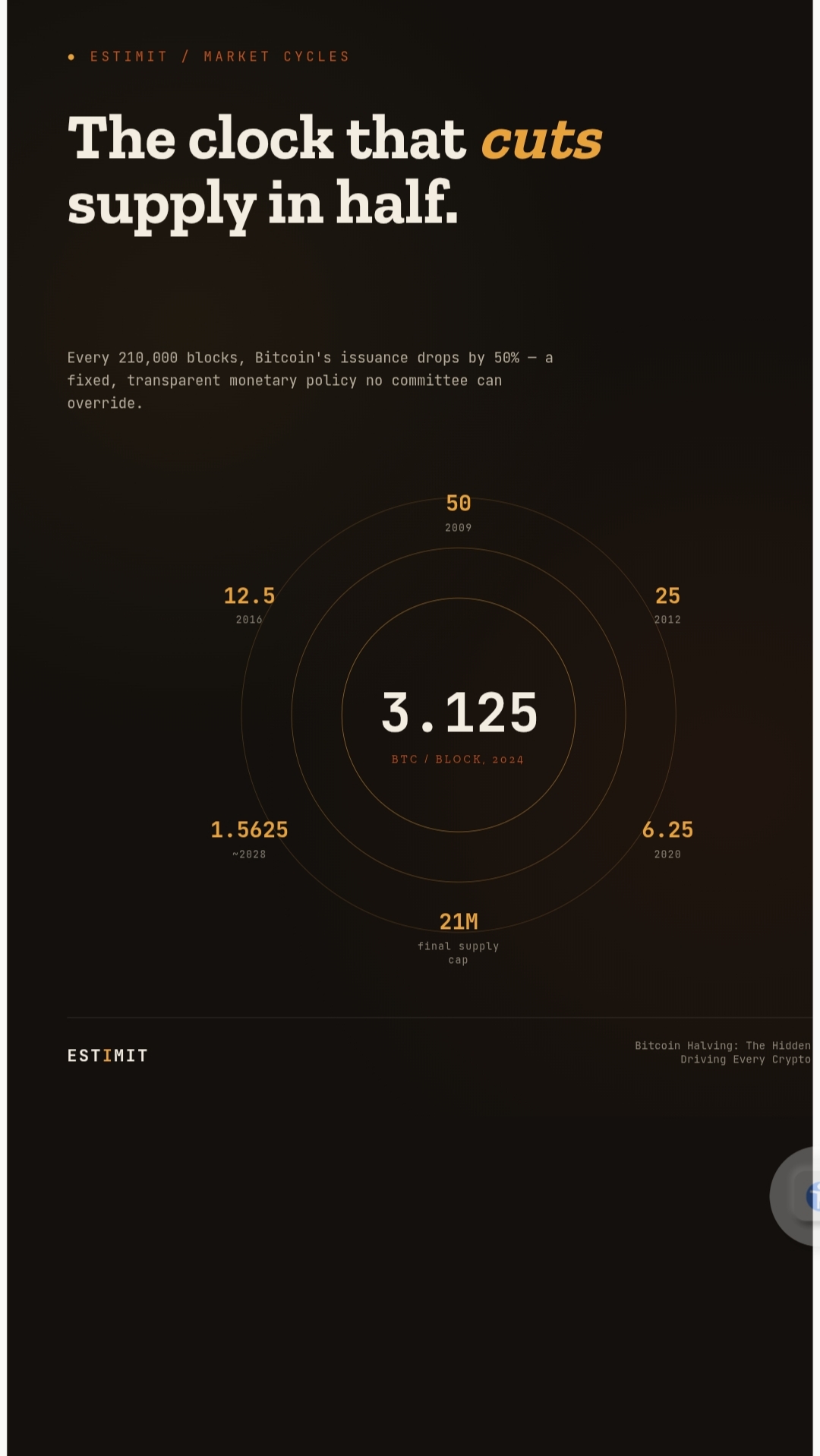
Bitcoin miners are rewarded with newly minted coins every time they successfully add a block to the blockchain, roughly every ten minutes. When Bitcoin launched, that reward was 50 BTC per block. In 2012, it dropped to 25. In 2016, to 12.5. In 2020, to 6.25. In April 2024, it fell again to 3.125 BTC per block. The next halving, expected around 2028, will cut it to 1.5625.
This isn't a policy decision — it's hardcoded into Bitcoin's protocol, set to occur every 210,000 blocks. The total supply is capped at 21 million coins, and the halving schedule is how that cap gets enforced gradually, mimicking the extraction curve of a finite resource like gold. By around the year 2140, the last fraction of a Bitcoin will be mined, and miners will rely entirely on transaction fees for revenue.
Why the Market Obsesses Over This
The economic logic is straightforward on paper: if demand for Bitcoin stays constant or grows while the rate of new supply entering the market gets cut in half, basic supply-and-demand pressure should push prices upward over time. Historically, this has played out in dramatic fashion. Each of the previous three halvings was followed, months later, by a substantial bull run that pushed Bitcoin to new all-time highs.
But correlation isn't causation, and it's worth being skeptical of oversimplified "halving equals moon" narratives that circulate on social media every cycle. Several other factors have coincided with past halvings — growing institutional adoption, macroeconomic liquidity cycles, retail speculation waves, and regulatory shifts. Attributing price action to the halving alone ignores how tightly interconnected these forces are.
The Miner's Dilemma
Halvings don't just affect price speculation; they reshape the economics of mining itself. When block rewards drop overnight, mining revenue drops with them unless price appreciation compensates. This squeezes out less efficient miners who can't cover their electricity and hardware costs, often triggering a temporary drop in network hash rate followed by a period of consolidation. Larger, better-capitalized mining operations tend to survive and even expand their market share, which has sparked ongoing debate about centralization risk within a system explicitly designed to be decentralized.
What This Means for 2028 and Beyond
As halvings continue, their proportional impact on new supply naturally shrinks. Going from 50 to 25 BTC per block was a much larger relative supply shock than going from 3.125 to 1.5625 will be. Some analysts argue this means future halvings will have progressively muted price effects, since the market has already priced in scarcity and the marginal reduction in new supply becomes less significant against a growing existing supply base.
Others counter that as institutional capital — through ETFs, corporate treasuries, and sovereign wealth allocations — becomes a larger share of demand, the halving's psychological and narrative power may matter more than the raw math, functioning as a recurring catalyst that resets market attention every four years regardless of the diminishing supply shock.
The Takeaway
Understanding the halving isn't about predicting exact price targets — it's about understanding Bitcoin's core value proposition: a monetary policy that nobody can change on a whim, running on a fixed, transparent, and disinflationary schedule. Whatever your view on where the price goes next, the halving remains one of the few genuinely novel economic experiments running in real time, in public, on a global scale. That alone makes it worth watching closely, cycle after cycle.