Monero vs Bitcoin Mixing: Why the 'Just Use a Privacy Coin' Answer Is Incomplete
In any discussion about Bitcoin privacy, someone inevitably arrives with the same suggestion: "Just use Monero." It is offered as though it settles the matter. And in fairness, Monero is a genuinely impressive piece of privacy engineering. But the suggestion misunderstands the problem most Bitcoin users are actually trying to solve, and it ignores where privacy reliably breaks down: the conversion edges.
What Monero Gets Right
Monero builds privacy into the base protocol. Ring signatures obscure the true sender among a set of decoys. Stealth addresses prevent the recipient's address from appearing on-chain. Confidential transactions hide the amounts. The result is a ledger that does not leak the granular financial data Bitcoin's ledger exposes by default. For value that originates in Monero and stays in Monero, the privacy is strong and the praise is deserved.
The Edge Problem
Here is what the "just use Monero" answer skips: most of the world's crypto activity is still denominated in Bitcoin. Exchanges list it, merchants accept it, counterparties expect it, and a great deal of value is simply held in it. So in practice, a privacy-coin strategy is rarely "live entirely in Monero." It is usually "convert BTC to XMR, then convert back to BTC to actually use."
Both of those conversions touch the transparent Bitcoin ledger. You have a visible BTC output before the conversion and a visible BTC input after it. If those two endpoints can be correlated — through timing, amount, or the conversion venue's own records — the privacy benefit of the round trip is diminished or undone. You have added complexity and conversion costs without necessarily achieving the privacy you wanted for your Bitcoin.
Different Tools for Different Layers
The cleaner way to think about it: Monero and Bitcoin mixers are not rivals. They operate on different assets and solve different problems. Monero protects value denominated in Monero. A Bitcoin mixer protects value denominated in Bitcoin. If your financial life — savings, income, the services you rely on — is in BTC, then privacy that requires leaving BTC is privacy with friction and leaky endpoints.
How MixTum Keeps Privacy in Bitcoin
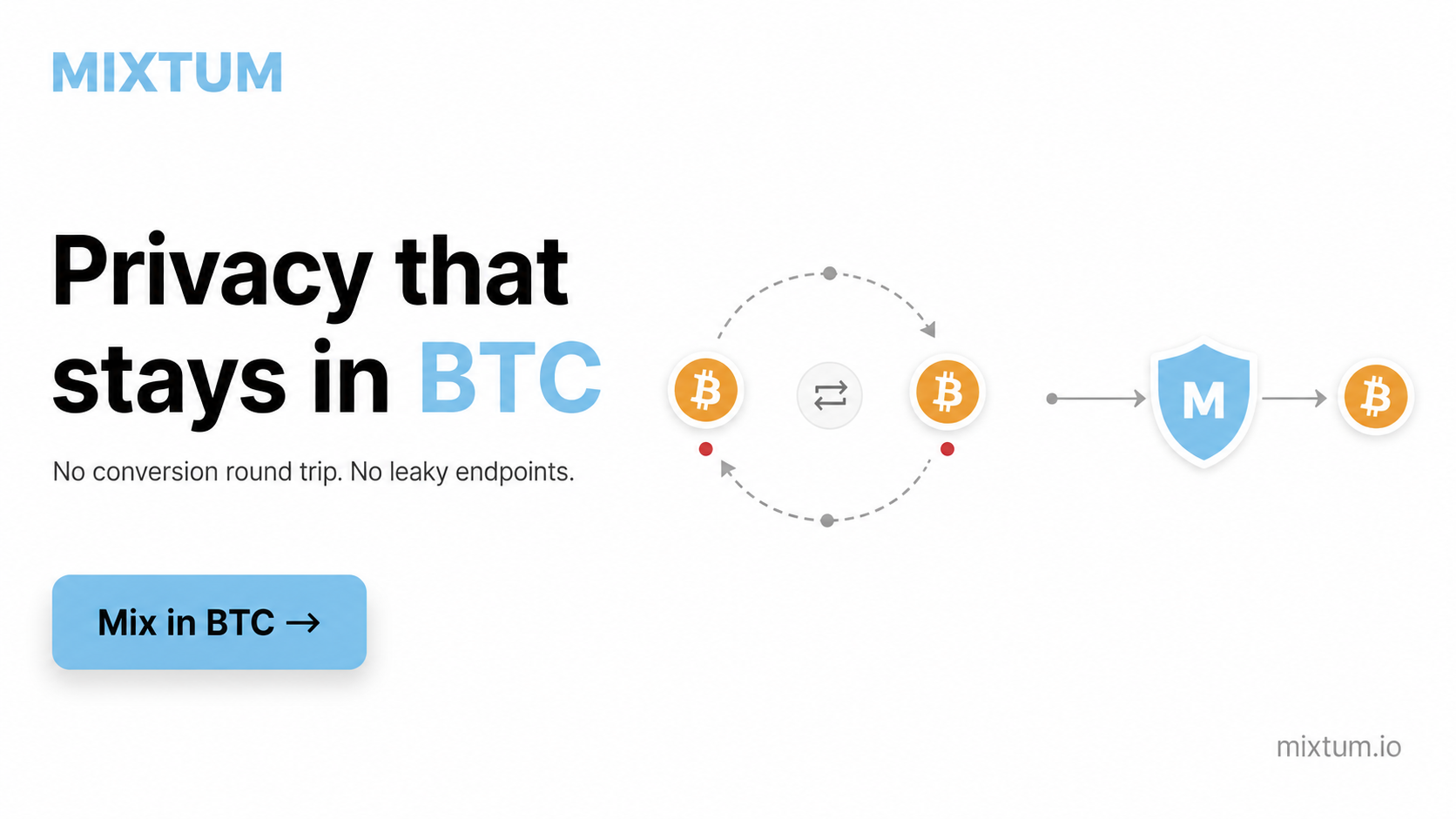
MixTum does not route you through a conversion. It exchanges your incoming BTC for coins purchased from independent investors at major cryptocurrency exchanges, removing the link between the coins you send and the coins you receive. The privacy stays in Bitcoin. There is no second conversion, no XMR leg, and no pair of transparent endpoints to correlate.
The protections are layered: output in randomized amounts across two or more transactions, randomized delays up to six hours, a randomized 4–5% commission that prevents fee-based reverse-calculation, no registration, no logs, and a PGP-signed guarantee per order (verifiable at bitlist.co/pgp). MixTum has operated since 2018 with a USD 50,000 escrow on AltcoinsTalks.
A Practical Comparison
Say you want to privately move 1 BTC into savings. The Monero route: buy XMR with your BTC (visible BTC output), hold, then sell XMR for BTC into your savings wallet (visible BTC input) — two conversions, two fees, two on-chain endpoints. The mixer route: send 1 BTC to MixTum, receive clean exchange-sourced BTC to your savings wallet in randomized portions — one step, privacy denominated in the asset you actually hold.
Discussion: Do you use Monero, a mixer, or both? Where do you find the conversion edges leak the most?
Privacy that stays in Bitcoin → https://mixtum.io or https://t.me/mixtum_bot