Black Silicon Carbide Sandblasting for Stone
Black Silicon Carbide Sandblasting for Stone
Learn how to choose black silicon carbide sandblasting media for stone, granite, marble and basalt surface texturing, engraving and anti-slip treatment.
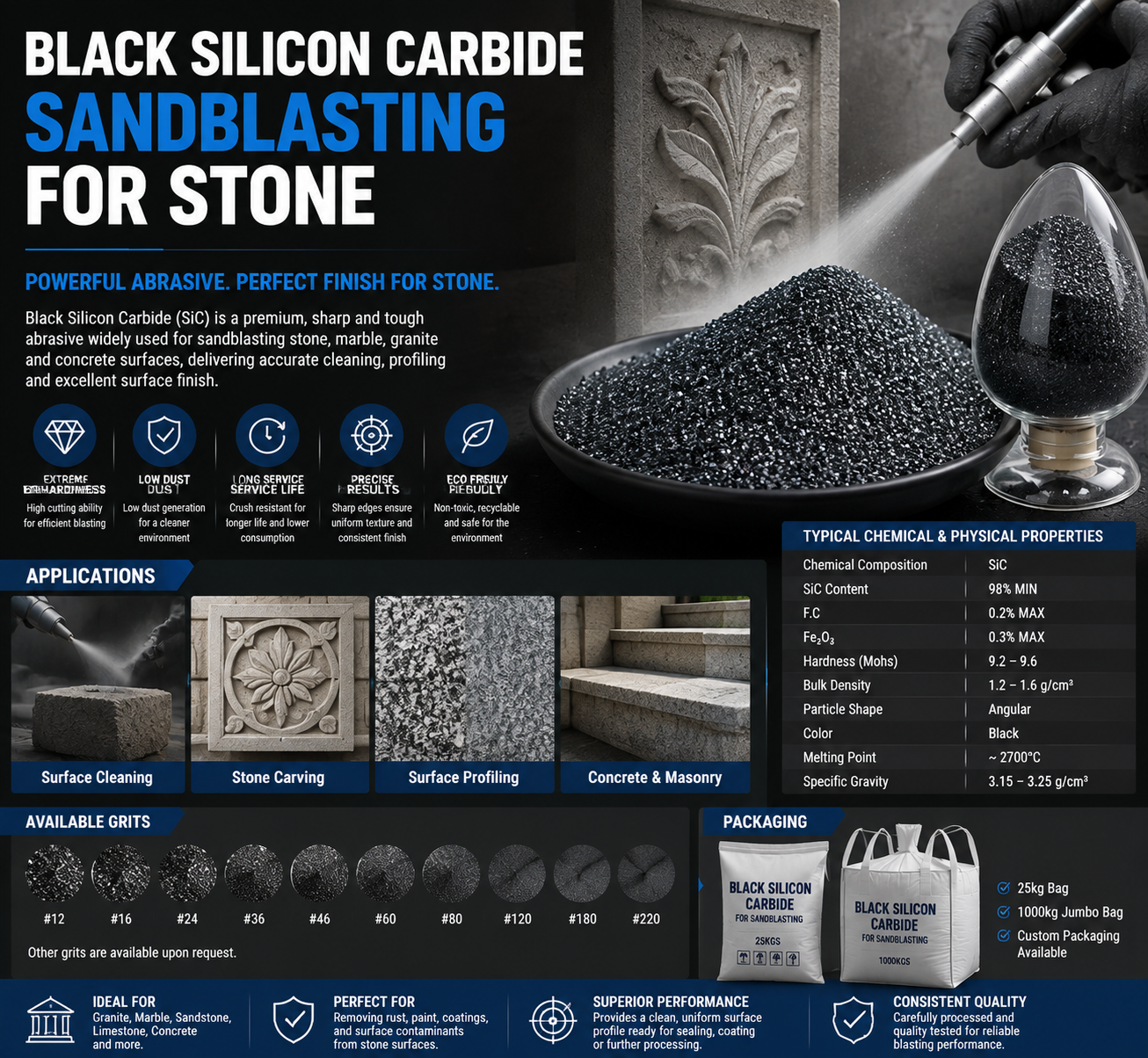
Black Silicon Carbide Sandblasting for Stone: Grit Size and Application Guide
- Why Use Black Silicon Carbide for Stone Sandblasting?
Black silicon carbide sandblasting for stone means using black SiC abrasive media to texture, engrave, roughen, restore or create anti-slip surfaces on stone materials. Black silicon carbide is also called black SiC or black carborundum. It is a very hard and sharp synthetic abrasive material.
Stone sandblasting is different from metal rust removal. Stone processors care more about surface texture, pattern clarity, engraving depth, anti-slip performance, edge control, color change and processing speed. The abrasive must be selected according to stone hardness, surface target and blasting method.
For hard stones such as granite, basalt, engineered stone and quartz stone, black silicon carbide can provide fast cutting and clear surface texturing. For softer or more fragile stones such as marble, limestone and sandstone, the blasting pressure and grit size must be selected more carefully to avoid excessive surface damage.
- Main Properties of Black Silicon Carbide Blasting Media
Black silicon carbide is selected for stone sandblasting because of the following properties:
High hardness:
Black SiC is harder than many common mineral abrasives, making it suitable for hard stone surface processing.
Sharp cutting action:
Angular grains can impact and cut the stone surface effectively, creating a clear matte, rough or engraved surface.
High processing efficiency:
For granite and basalt, black silicon carbide can work faster than softer abrasive media.
Wide grit size range:
Different sizes can be selected for rough texturing, anti-slip treatment, decorative patterns, lettering and fine surface finishing.
Suitable for dry and wet blasting:
Black silicon carbide can be used in dry blasting and wet blasting systems. Wet blasting can reduce dust and create a softer surface effect.
- Stone Types Suitable for Black Silicon Carbide Sandblasting
Granite
Granite is hard and suitable for black silicon carbide blasting. Typical uses include surface roughening, anti-slip treatment, monument engraving, decorative texturing and pattern work.
Basalt
Basalt is hard and wear-resistant. Black silicon carbide can be used for surface roughening, anti-slip texture and engineering stone surface treatment.
Quartz Stone and Engineered Stone
These materials are relatively hard, but the blasting result may be affected by resin content and surface structure. Coarse grit or high pressure may create uneven surfaces, so testing is recommended.
Marble
Marble is softer than granite. Coarse grit and high pressure are not recommended. Fine grit such as F100-F150 should be tested first with lower pressure and controlled blasting time.
Sandstone and Limestone
These stones may have higher porosity and weaker structure. Because black silicon carbide cuts aggressively, small sample testing is necessary before bulk processing.
- Common Stone Sandblasting Applications
Surface Roughening
Used to create a matte or rough texture on polished or smooth stone surfaces.
Anti-Slip Treatment
Used for stone steps, paving stones, outdoor flooring, ramps, public squares and wet areas to improve surface friction.
Monument and Tombstone Engraving
Used for lettering, logos, patterns and different depth effects. Grit size affects line sharpness and engraving depth.
Decorative Stone Texturing
Used for architectural stone, wall panels, landscape stone, art stone and interior decorative stone.
Stone Restoration
Used to remove weathered layers, dirt, coatings or surface contamination from old stone. The blasting force must be controlled to avoid damaging the base material.
- Grit Size Selection for Stone Sandblasting
Grit size is one of the most important factors in stone sandblasting. Coarser grit cuts faster and creates deeper texture. Finer grit creates a softer surface and better edge control for patterns.
Common size reference:
F24-F36:
Suitable for strong roughening, deep texture, anti-slip surfaces and fast processing on hard stones such as granite and basalt. The surface becomes rough, so this range is not suitable for fine patterns.
F46-F60:
Suitable for general stone sandblasting, anti-slip treatment, matte finish and medium surface texture. This range offers a practical balance between processing speed and surface control.
F80-F100:
Suitable for decorative texture, monument lettering, logo blasting and finer surface treatment. Pattern edges are easier to control than with coarse grit.
F120-F150:
Suitable for fine patterns, light marble blasting, shallow surface treatment and lower roughness requirements.
F180-F220:
Suitable for very light surface treatment, fine matte effects or special decorative finishes. Processing speed is slower and testing is recommended.
For granite or basalt anti-slip surfaces, F36, F46 and F60 are common trial sizes. For monument lettering and decorative patterns, F80 and F100 are good starting points. For marble or softer stone, F120 or F150 should be tested first.
- Size Selection by Stone and Surface Effect
Application: Strong granite roughening
Recommended size: F24-F46
Effect: Strong cutting, obvious rough texture
Application: Granite anti-slip surface
Recommended size: F46-F80
Effect: Good grip, more uniform texture
Application: Basalt surface treatment
Recommended size: F36-F60
Effect: Suitable for fast processing on hard stone
Application: Monument lettering
Recommended size: F80-F120
Effect: Better line control
Application: Logo and decorative pattern
Recommended size: F80-F150
Effect: Clear pattern and finer surface
Application: Light marble blasting
Recommended size: F120-F180
Effect: Softer impact and smoother surface
Application: Old stone restoration
Recommended size: F60-F120
Effect: Depends on dirt layer and stone hardness
- Dry Blasting vs Wet Blasting for Stone
Dry Blasting
Dry blasting has high efficiency and is commonly used for granite, basalt, monuments, rough texture and anti-slip surfaces. However, it creates more dust, so dust collection and worker protection are important.
Wet Blasting
Wet blasting reduces dust and usually creates a softer surface impact. It is suitable for decorative stone, finer textures, light marble treatment and projects where site dust control is important.
If the buyer needs fast processing and strong texture, dry blasting is usually selected. If the buyer needs dust control, softer finish or finer patterns, wet blasting can be tested.
- Common Problems and Solutions
Surface Is Too Rough
The grit may be too coarse, the pressure may be too high, or blasting time may be too long. Try a finer size, such as changing from F46 to F80, or reduce pressure.
Pattern Edge Is Not Clear
The grit may be too coarse, the masking film may not be attached firmly, or the nozzle may be too close. Try F80-F120 and check stencil quality.
Stone Chipping or Edge Damage
The stone may be brittle, the grit may be too coarse, or the blasting angle may be unsuitable. Reduce pressure, increase nozzle distance, select finer grit and test a small area first.
Processing Speed Is Too Slow
The grit may be too fine, pressure may be too low, or reused media may have become dull. Test a slightly coarser size, such as changing from F120 to F80.
Uneven Stone Color
This may be related to stone structure, mineral composition, blasting path or unstable grit size. Keep nozzle movement consistent and use stable black silicon carbide grading.
- What Buyers Should Check Before Purchase
When buying black silicon carbide blasting media for stone, buyers should confirm:
Product name: black silicon carbide / black SiC / black carborundum
Application: stone sandblasting, granite blasting, stone engraving or anti-slip treatment
Exact grit size: F36, F46, F60, F80, F100, F120, F150 or other size
SiC content
Particle size distribution
Dust content
Magnetic material or impurity level
Packaging
Sample availability
Required documents: COA, TDS or MSDS
For stone sandblasting buyers, stable grit size and low dust content are important. Unstable grading may create inconsistent surface texture, while high dust content may affect the working environment and surface result.
- RFQ Information Buyers Should Provide
To get a suitable recommendation and quotation, buyers should provide:
Product name: black silicon carbide sandblasting media
Application: stone sandblasting, granite blasting, monument engraving or anti-slip treatment
Stone type: granite, basalt, marble, sandstone, engineered stone or other material
Target effect: strong roughening, anti-slip, lettering, logo pattern or fine matte finish
Required size: F36, F46, F60, F80, F100, F120, F150 or other size
Blasting method: dry blasting or wet blasting
Trial order quantity and bulk order quantity
Packaging requirement
Destination country or port
Required documents: COA, TDS or MSDS
Clear inquiry example:
We need black silicon carbide sandblasting media for granite stone surface texturing and anti-slip treatment. Please recommend F46, F60 and F80 samples, and provide COA and quotation.
- FAQ
Can black silicon carbide be used for stone sandblasting?
Yes. Black silicon carbide is hard and sharp, making it suitable for sandblasting hard stones such as granite, basalt and engineered stone.
What grit size is used for stone sandblasting?
F36-F80 is commonly used for roughening and anti-slip treatment on hard stone. F80-F120 is often used for lettering and patterns. F120-F180 can be tested for light marble blasting.
Is black silicon carbide suitable for marble blasting?
It can be tested, but carefully. Marble is softer than granite, so finer grit and lower pressure are recommended to avoid excessive surface damage.
Is dry blasting or wet blasting better for stone?
Dry blasting is efficient and suitable for hard stone roughening and anti-slip treatment. Wet blasting creates less dust and is suitable for finer texture and decorative stone work.
Is coarser grit always better?
No. Coarser grit works faster and creates deeper texture, but it may make the surface too rough or cause edge damage. The right size depends on stone hardness and target effect.
Should buyers test samples before bulk order?
Yes. Stone hardness, porosity and structure vary widely. Sample testing helps confirm grit size, pressure and final surface appearance before bulk processing.
If you are looking for black silicon carbide sandblasting media for stone, please send your stone type, target surface effect, required grit size, blasting method, order quantity and packaging requirement. We can recommend a suitable black SiC grit and provide samples, COA and quotation for your granite, marble, basalt or engineered stone sandblasting application.