I'm curious to know more about how the room and pillar method is adapted for different types of minerals and rocks, given its flexibility in salt mining. 🤔💡🔨
One Method, Many Materials: How Room and Pillar Mining Adapts Across Minerals
Room and pillar mining sounds like a single, fixed technique — carve out rooms, leave pillars standing, repeat. And at its core, that's exactly what it is. But spend a little time looking at how it's actually applied around the world, and you realize it's less a rigid blueprint and more a flexible framework that gets reshaped depending on what's actually being dug out of the ground.
Salt mines like Khewra are a great entry point into this method, but they're really just one variation among many. Here's how the same basic idea gets adapted across coal, salt, potash, limestone, and even hard-rock metal ores.
The Constant: Leave Enough Standing to Hold the Roof Up
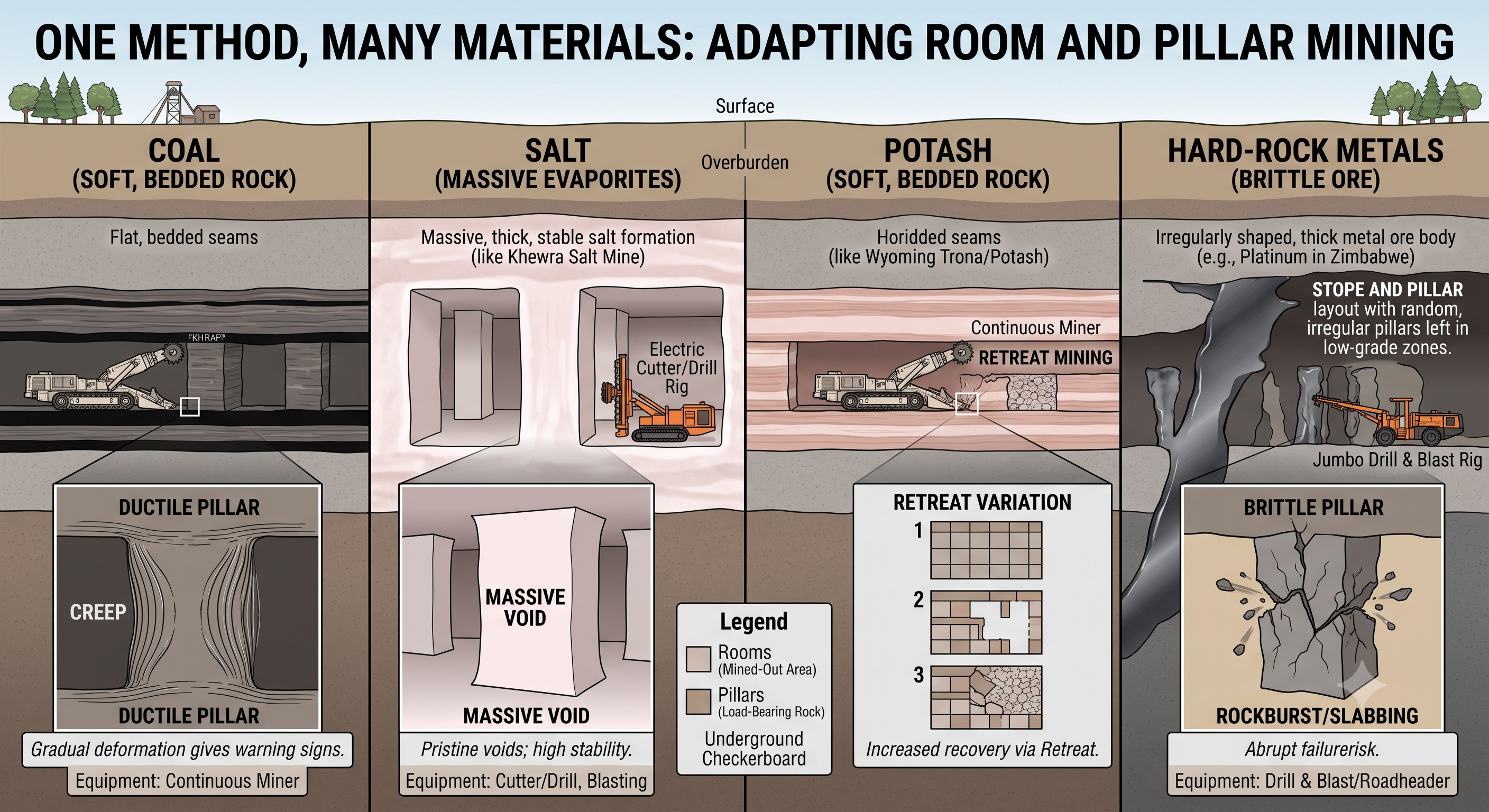
No matter what material is being mined, the underlying logic never changes. Rooms are excavated to extract the mineral, and pillars — regularly spaced columns of untouched material — are left behind to bear the weight of everything above. It's essentially an underground checkerboard, with mined-out rooms as one color and load-bearing pillars as the other.
What does change, deposit by deposit, is how that checkerboard gets engineered.
Pillar Size and Shape Shift With Rock Strength
Soft, more ductile materials — coal, salt, potash, trona — can often support slightly slimmer pillars, because the material tends to deform gradually under pressure rather than fracturing suddenly. That gradual give is actually useful; it gives engineers warning signs before a real structural problem develops.
Harder, more brittle rock is a different story. Because brittle materials can crack and fail more abruptly, pillars in hard-rock settings are typically sized more conservatively, with a bigger safety margin built in. Calculating the right size, shape, and spacing for pillars is a genuinely complex, ongoing area of mining engineering — get it wrong, and a failing pillar can shift stress onto its neighbors, creating a chain reaction.
The Equipment Changes Depending on What's Being Cut
This is where the differences become most visible on the ground.
- Soft-rock deposits — coal, salt, potash, trona — are usually cut using continuous miners, machines that mechanically shear material away without any blasting at all. This is often called continuous mining, as opposed to conventional mining, which follows a cycle of cutting, drilling, blasting, loading, and hauling.
- Harder rock — limestone, certain metal ores — often can't be cut mechanically with the same ease, so operations fall back on drill-and-blast methods, or bring in a road header: a powerful continuous miner fitted with a tougher cutterhead specifically designed to chew through more resistant material.
In other words, the same "room and pillar" label can describe a quiet, continuous shearing operation in a salt mine and a much noisier drill-and-blast sequence in a hard-rock mine — same layout philosophy, completely different daily operation.
It's Not Just for Flat Deposits
There's a common assumption that room and pillar only works on perfectly flat, horizontal deposits. In practice, it's used across a wider range of slopes — rectangular or square rooms can be driven into deposits dipping anywhere from flat up to roughly 40 degrees. The steeper the dip gets, though, the more complicated pillar design becomes, since gravity starts working against pillar stability in ways it doesn't on flatter ground.
Real-World Variations Worth Knowing
The method's adaptability shows up clearly once you look at specific mines:
- Avery Island, Louisiana — Morton Salt's operation here uses room and pillar in a salt dome, leaving large, stable voids that have since been partly repurposed for underground storage, a nice example of how mined-out rooms can get a second life.
- Mimosa platinum mine, Zimbabwe — a hard-rock application of the same method, adapted for metal ore rather than a soft, bedded deposit.
- Wyoming's trona operations — use hybrid retreat variations, where some pillars are later partially extracted for additional recovery once the initial rooms are stable.
- Underground coal mining in the US and India — coal remains one of the most common materials mined this way, with recovery rates that vary widely (often only 50% on average in the US) depending on pillar sizing and local geology.
There's even an older term for a related variation: when pillars are irregular in size and placement — more common in certain metal and nonmetal deposits — the method used to be called "stope and pillar" rather than room and pillar. The naming distinction has mostly faded today, but it's a reminder that the technique has never been perfectly uniform, even within its own category.
The Bigger Picture
Room and pillar isn't a single fixed system so much as a design principle: extract what you can, but always leave enough behind to keep the roof from coming down. How that principle gets executed — pillar size, cutting method, blast versus mechanical extraction, even how steep a slope it can handle — depends entirely on the material and the geology underneath it.
That's really the throughline connecting a salt mine like Khewra to a platinum mine in Zimbabwe or a trona operation in Wyoming. Different minerals, different machinery, different risk profiles — but the same basic bet: that leaving some of the resource behind is worth it if it means the whole operation stays standing.
I was wondering if you've explored how the room and pillar method handles variable density minerals like quartz or pyrite in metal ore mining, considering the need for extra structural support? 💡🔨