The Room and Pillar Method: Why It's Kept Khewra Standing for 150+ Years And Where Else It Actually Works
The Khewra Salt Mine has been in operation since the 1870s.. You know what is really surprising? The mountain has not caved in. This is not just luck. It is because of a mining method called "room and pillar". This method is one of the most widely used mining techniques in the world.
What does "room and pillar" actually mean?
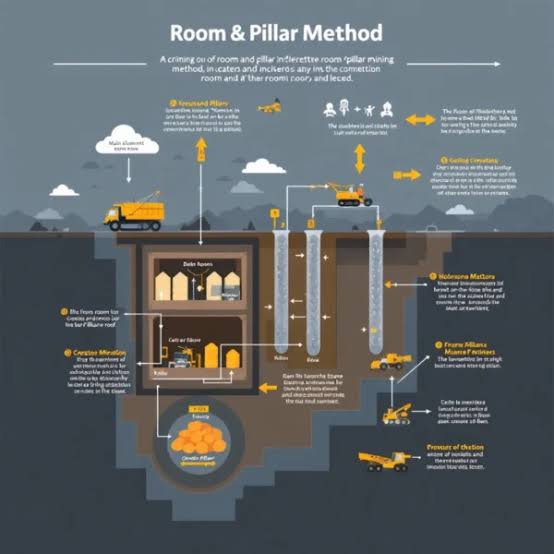
The idea is pretty simple. Miners do not dig out the deposit at once. Instead they create a grid of "rooms" where the mineral is extracted. They leave behind "pillars" of the material to hold up the roof. It is like an underground checkerboard. The black squares are mined out. The white squares stay standing to bear the weight of everything above.
At the Khewra Salt Mine, only about half of the salt in any given section is actually extracted. The rest stays where it is acting as a support column. This is a trade-off. You give up extracting all of the salt. You get a structure that does not collapse.
This method is not just used for salt mining. It is used over the world for coal, potash, gypsum, limestone, trona and uranium mining. It works best in flat or gently sloping deposits with stable rock above and below. This is the kind of geology found in the Khewra Salt Range.
So why has this method worked well at the Khewra Salt Mine?
There are a reasons. The salt itself is very strong. It can function as a pillar material without needing extra support. The deposit is thick and stable which makes it easier to plan a pillar layout. The mine is also very dry which is important because salt is sensitive to water. If the mine were too wet the pillars could dissolve.
This method also reduces the risk of the mine collapsing over time. Because much material is left in place the mine does not need to be extended into unstable areas.
However there are some downsides to this method.
The main one is that it can be less efficient. Depending on the deposit up to 60% of the material can be left behind in pillars. This material is technically there. It is not possible to extract it without additional mining. There is also a risk that the pillars could fail if they are not sized correctly. If one pillar fails it can put stress on the surrounding pillars. Cause a chain reaction. This is rare in planned mines like the Khewra Salt Mine but it is still a risk.
So could this method be used in mines?
The answer is that it already is. The room and pillar method is used in mines over the world including the Goderich salt mine in Ontario, Canada and potash mines in Saskatchewan, Canada. It is also used in coal mines in India, the US Australia, China and the Czech Republic.
The reason this method works well is that it is a good match for the geology of these deposits. The deposit is relatively flat or gently sloping the mineral is strong enough to act as a pillar and the overlying rock is stable. However this method may not work well in deposits that are steeply dipping or where the rock is not stable.
The real lesson from the Khewra Salt Mine is that sustainability in mining is not about finding one technique and using it everywhere. It is about matching the method to the geology and executing it with discipline. The Khewra Salt Mine is proof that when the method fits the deposit and the engineering is taken seriously a mine can stay productive and structurally sound for, over a century.
I'm curious to know more about how the room and pillar method is adapted for different types of minerals and rocks, given its flexibility in salt mining. 🤔💡🔨