1 BLURT = 0.016 HIVE - Uncensored micro-rewarded social media, powered by positive-sum game economics
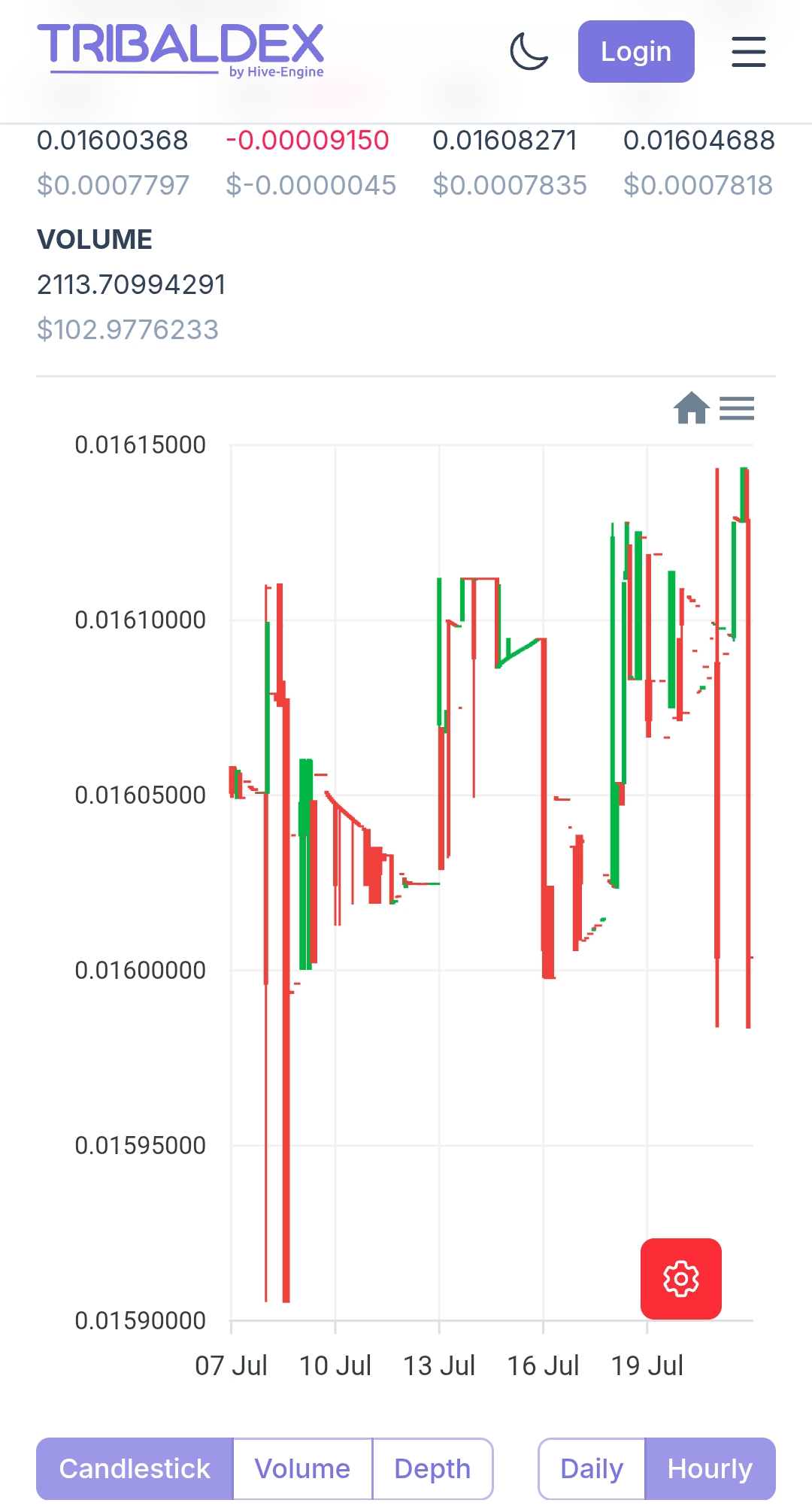
(Chart by Tribaldex)
What do you think of BLURT price in the next one month? Reply in the comments!
Blurt is a Graphene-based layer-1 SoFi blockchain forked from Steem and Hive that rewards social participation while redesigning token economics to reduce centralization, inefficiency, and censorship.
Blurt differs from Steem and Hive by eliminating downvotes, avoiding downvote wars where powerful users could suppress competitors, limit expression, and distort content visibility. Currently, the price is subtly increasing against HIVE albeit very volatile.
Blurt uses DPoS, staking, positive-only curation, and transaction fees to build a low-energy decentralized attention economy that rewards creators and supports sustainable network governance.
About Blurt Blockchain (BLURT)
The Blurt Blockchain (BLURT) is a specialized layer-1 Social Finance (SoFi) protocol built on the Graphene framework that economically rewards content creation, content curation, and social interaction. Created as a hard fork of the Steem and Hive codebases, Blurt redesigns the economic game theory behind decentralized social platforms to address problems such as structural inefficiencies, concentrated stake ownership, and content suppression that existed in its predecessors.
A central component of Blurt's economy is an automated inflationary reward pool. New BLURT tokens are continuously created through an algorithm and distributed to active participants according to community curation activity. Users who wish to influence reward distribution can convert liquid BLURT into Blurt Power (BP) through staking. Holding more BP increases voting influence, allowing participants to direct a proportionally larger share of the daily inflationary token issuance toward valuable content creators or toward their own content.
Unlike traditional Delegated Proof-of-Stake (DPoS) social networks such as Steem and Hive, which rely on downvotes to discourage spam and low-quality content, Blurt removes downvoting entirely from its consensus rules. In earlier systems, downvotes often evolved into "downvote wars," enabling large stakeholders to reduce competitors' earnings, suppress free expression, and distort the discovery of content.
By eliminating downvotes, Blurt removes these negative economic effects. Stakeholders are no longer able to reduce or destroy another user's earned rewards, making value distribution entirely additive. This creates a positive-sum incentive structure that encourages genuine content creation without exposing creators to economic retaliation or targeted censorship.
Blurt also replaces the complex Resource Credit or renewable bandwidth systems used by earlier networks with a straightforward on-chain micro-transaction fee model. Instead of offering effectively free transactions through indirect resource allocation, every blockchain state change—including posting, commenting, transferring tokens, and voting—requires payment of a small fee in native BLURT tokens.
This direct pricing mechanism serves two economic purposes. First, it discourages automated spam, sybil attacks, and other forms of network abuse by assigning a real cost to blockchain usage. Second, the collected fees function as a token sink or burn mechanism, helping offset the inflation created by the continuous issuance of rewards from the daily inflationary reward pool.
Blurt uses the Delegated Proof-of-Stake (DPoS) consensus mechanism to provide fast block finality, high transaction throughput, and low energy consumption. Its staking asset, Blurt Power (BP), encourages long-term capital commitment while supporting curation governance. Governance incentives are based on positive-only curation voting, with the goal of attracting more creators and increasing platform engagement. The transaction model charges a direct fee for each operation, preventing bandwidth abuse and establishing a sustainable pricing structure for network resources.
Through the combination of a positive-only voting system and explicit micro-transaction fees, Blurt creates a decentralized attention economy intended to safeguard creators' economic interests while preserving free-market valuation of content.
What do you think of BLURT price in the next one month? Reply in the comments!
Disclaimer: This information is for educational purposes only, not financial, legal, or tax advice. Crypto assets like BLURT are highly risky; research independently and seek professional advice before investing.
Assisted by https://gemini.google.com/.
See also:
- By eliminating downvotes, Blurt ensures users are rewarded based on positive consensus, not through whale punishment. Please join through this link or this link with the invite code "puncakbukit."
- 🌀 SteemTwist — Steem with a Twist
- 🧬 Introducing SteemBiota — Raise, Breed & Evolve Creatures on the Steem Blockchain!
- 🎮 Reversteem — Play Reversi on the Steem Blockchain!
- @steem.amal: Charity At Your Fingertips
- Maximize curation rewards: follow our trail! Maksimalkan reward kurasi: ikuti trail kami! トレイルをフォローし、キユレーション報酬を最大化!
Upvoted! Thank you for supporting witness @jswit.