1 BTC = $64125 USD - Digital gold with a hard cap: decentralized, borderless, and immune to inflation
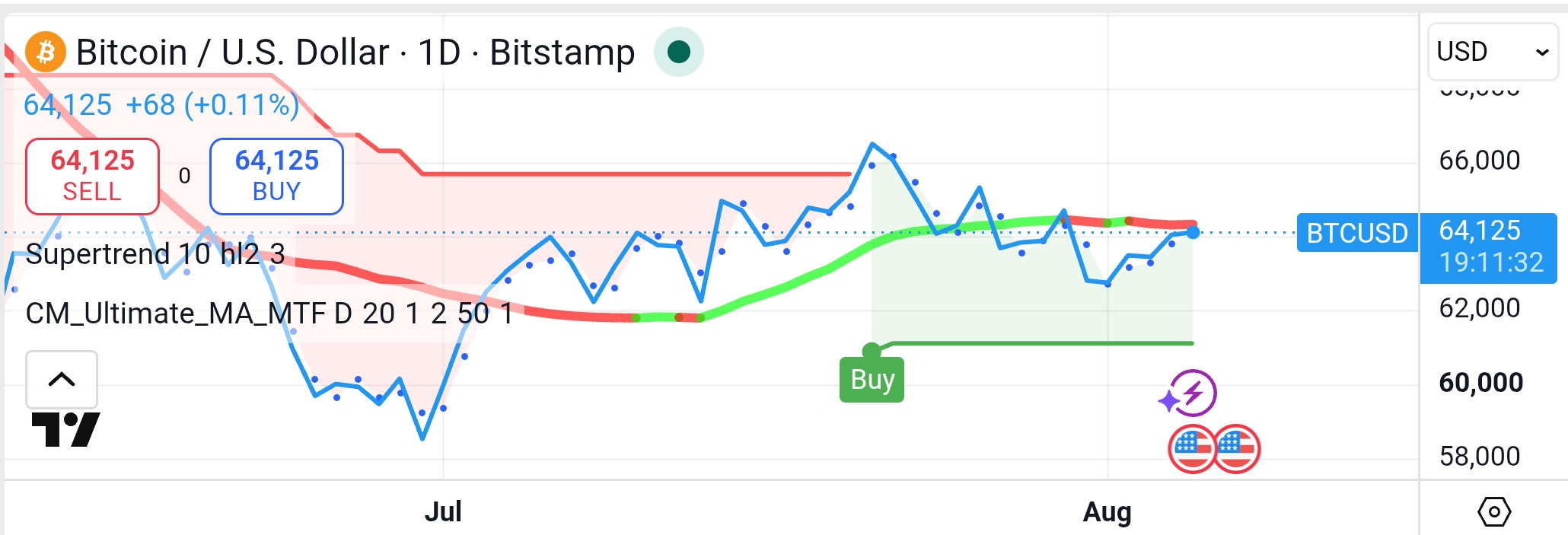
(Chart by TradingView)
What do you think of BTC price in the next one month? Reply in the comments!
Bitcoin (BTC) is a decentralized peer-to-peer digital money protocol created by Satoshi Nakamoto in 2008, serving as an independent store of value and medium of exchange. Recently, the Ultimate Moving Average indicator is just decreasing subtly.
Bitcoin has a fixed 21 million coin limit, with new BTC issued on a predictable schedule that halves every 210,000 blocks until the full supply is reached around 2140. Meanwhile, the SuperTrend indicator has switched to give a buy signal.
Finally, Bitcoin is a scarce, censorship-resistant digital asset secured by cryptography, enabling borderless transfers and serving as an inflation-resistant store of value comparable to digital gold.
About Bitcoin (BTC)
Bitcoin (BTC) is a decentralized peer-to-peer digital monetary protocol created in 2008 by the anonymous figure known as Satoshi Nakamoto. Economically, it is regarded as a synthetic commodity, a medium of exchange, and a sovereign store of value that operates independently of centralized government-issued monetary systems.
One of Bitcoin’s defining characteristics is its algorithmically enforced scarcity and predictable monetary supply. In contrast to fiat currencies, whose issuance can be adjusted through central bank policy, Bitcoin has a fixed maximum supply of 21 million coins. New BTC enters circulation according to a predetermined issuance schedule, with the creation rate reduced by half approximately every four years, or every 210,000 blocks, through events known as halvings. This process continues until the full supply is expected to be issued around the year 2140.
Bitcoin also provides trustless transaction settlement through its Proof-of-Work (PoW) consensus mechanism. Its blockchain serves as a publicly accessible distributed ledger maintained by a worldwide network of miners and node operators. Using cryptographic consensus, transactions are verified and permanently recorded without relying on intermediaries such as central banks or commercial clearing institutions.
Ownership of Bitcoin is secured through cryptographic private keys rather than identity-based financial accounts, giving users direct sovereign control over their assets. As a result, Bitcoin transactions are permissionless, resistant to censorship, globally accessible, and irreversible once confirmed, allowing value to be transferred across borders without dependence on national jurisdictions or regulatory approval.
Within modern macroeconomic analysis, Bitcoin is frequently compared with traditional reserve assets such as gold. Whereas fiat monetary systems depend on institutional trust and may experience inflation through currency expansion, Bitcoin’s fixed and inelastic supply provides inherent resistance to inflationary debasement. For this reason, an increasing number of institutional investors and corporate treasuries view BTC as a digital safe-haven asset and a neutral, difficult-to-confiscate reserve designed for the global digital economy.
What do you think of BTC price in the next one month? Reply in the comments!
Disclaimer: This content is for education only, not financial, tax, or legal advice. Crypto investments are risky; do your own research and consult professionals before making decisions.
Assisted by https://gemini.google.com/.
See also:
- By eliminating downvotes, Blurt ensures users are rewarded based on positive consensus, not through whale punishment. Please join through this link or this link with the invite code "puncakbukit."
- 🌀 SteemTwist — Steem with a Twist
- 🧬 Introducing SteemBiota — Raise, Breed & Evolve Creatures on the Steem Blockchain!
- 🎮 Reversteem — Play Reversi on the Steem Blockchain!
- @steem.amal: Charity At Your Fingertips
- Maximize curation rewards: follow our trail! Maksimalkan reward kurasi: ikuti trail kami! トレイルをフォローし、キユレーション報酬を最大化!
Upvoted! Thank you for supporting witness @jswit.