1 BTC = $76,006 USD - The decentralized, digital gold with a mathematically enforced limit of 21 million
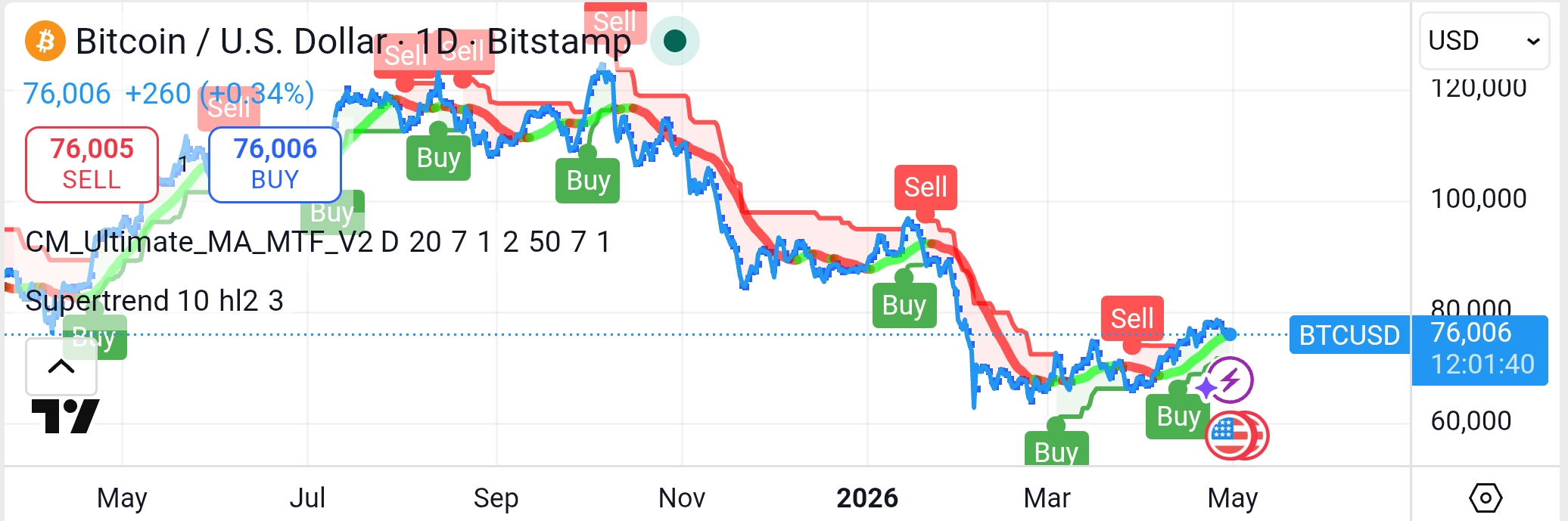
(Chart by TradingView)
What do you think of BTC price in the next one month? Reply in the comments!
Bitcoin is a decentralized peer-to-peer digital currency, created in 2009 by Satoshi Nakamoto, using blockchain and often viewed as scarce “digital gold.” Currently, the price indicator Ultimate Moving Average has increased subtly.
Bitcoin derives value from decentralization, fixed supply, and secure Proof-of-Work validation, enabling direct, trustless transactions on an immutable ledger without intermediaries. Now, the SuperTrend indicator is also showing buy signal.
Bitcoin has grown from an experiment into a widely accepted asset, with ETFs and corporate use boosting its role as a liquid, easily transferable, and highly divisible digital portfolio diversifier.
About Bitcoin ( BTC)
Bitcoin ($BTC$) is a decentralized form of digital money and a peer-to-peer payment system that functions without control from any central bank or single authority. Introduced in 2009 by the anonymous figure Satoshi Nakamoto, it marked the first successful use of distributed ledger technology known as Blockchain. In financial terms, Bitcoin is frequently described as a synthetic commodity or “digital gold” because of its distinctive monetary design and inherent scarcity.
Its fundamental value comes from several innovative features that set it apart from conventional fiat currencies. It runs on a decentralized global network of independent nodes, where transactions are validated through cryptographic processes and recorded on a public, immutable ledger. This structure removes reliance on intermediaries such as banks or clearinghouses, enabling direct settlement between participants. In contrast to fiat currencies that can be expanded by central banks, Bitcoin has a strictly enforced maximum supply of 21 million coins, giving it absolute scarcity that supports its long-term value and role as a hedge against currency depreciation. The network is secured through a Proof of Work consensus mechanism, in which miners expend significant computational resources and energy to solve complex problems, validate transactions, and maintain the system, effectively grounding its security in real-world costs.
Bitcoin’s monetary policy is both transparent and predictable. Roughly every four years, an event called the Bitcoin Halving takes place, cutting the reward for mining new blocks by half. This programmed reduction slows the rate of new supply entering circulation, tightening availability over time and theoretically increasing its stock-to-flow ratio.
Over time, Bitcoin has evolved from a niche technological experiment into a widely recognized institutional asset class. The introduction of spot exchange-traded funds and the inclusion of $BTC$ in corporate treasury strategies highlight its growing acceptance as a portfolio diversifier. Its high liquidity, ease of transfer, and divisibility down to eight decimal places—where the smallest unit is called a Satoshi—make it especially well-suited for the modern digital financial landscape.
What do you think of BTC price in the next one month? Reply in the comments!
Disclaimer: I’m not a financial advisor; this is for education only, not advice. Crypto is highly risky—do your own research or consult a professional, and don’t rely on my data as fully accurate.
Assisted by https://gemini.google.com/.
See also:
- By eliminating downvotes, Blurt ensures users are rewarded based on positive consensus, not through whale punishment. Please join through this link or this link with the invite code "puncakbukit."
- 🌀 SteemTwist — Steem with a Twist
- 🧬 Introducing SteemBiota — Raise, Breed & Evolve Creatures on the Steem Blockchain!
- 🎮 Reversteem — Play Reversi on the Steem Blockchain!
- @steem.amal: Charity At Your Fingertips
- Maximize curation rewards: follow our trail! Maksimalkan reward kurasi: ikuti trail kami! トレイルをフォローし、キユレーション報酬を最大化!
Upvoted! Thank you for supporting witness @jswit.