Addressing Steem's fundamental social reward challenge: One size fits all - fits nobody
Steem rewards have a pricing problem - and we already have the tools to fix it
Describing the challenge
When I first arrived on the Steem blockchain, authors were taking 75% of the payout from every post, and curators were taking just 25%. Before I got here, I understand that they tried a 75% distribution to curators and a 25% distribution to authors. After I'd been here for a while, there was a contentious debate, and the reward split shifted to 50%/50% for curators and authors. In the end, I don't see any practical results from any of these changes. At one time, D.Tube even tried 100% for curators. Did 75% or 50% or 25% attract more authors? More investors? There's no way to know, but I doubt it.
Why?
All of these reward splits suffered from the same (wrong) assumption - the idea that there is a single number that applies, adequately, to all authors and all curators. In reality, there's no such thing as an average person. It's the same problem that the US Air Force faced in aircraft design during the 20th century:
Planes were crashing at high rates during the 1940s, and the Air Force wanted to figure out why. At the time, cockpits were sized to fit the dimensions of an average pilot (as measured in 1926).
Back in 1926, when the army was designing its first-ever cockpit, engineers had measured the physical dimensions of hundreds of male pilots (the possibility of female pilots was never a serious consideration), and used this data to standardize the dimensions of the cockpit. For the next three decades, the size and shape of the seat, the distance to the pedals and stick, the height of the windshield, even the shape of the flight helmets were all built to conform to the average dimensions of a 1926 pilot
In the 1950s, however, the Air Force measured the pilots to see how many people were average across all dimensions used in the cockpit design.
The answer was zero. Out of four thousand.
Out of 4,063 pilots, not a single airman fit within the average range on all 10 dimensions. One pilot might have a longer-than-average arm length, but a shorter-than-average leg length. Another pilot might have a big chest but small hips. Even more astonishing, Daniels discovered that if you picked out just three of the ten dimensions of size — say, neck circumference, thigh circumference and wrist circumference — less than 3.5 per cent of pilots would be average sized on all three dimensions.
The cockpit that was built to be ideally suited for an average pilot was actually well-suited for nobody. The solution? Adjustable seats, foot pedals, helmet straps, and flight suits. According to Brave Leo (citing the book, The End of Average and The Pitfall of Average), after these changes the number of lost aircraft fell from 23.6 per hundred-thousand to 4.3 per hundred-thousand. This represents a reduction of 82%. After this, similar changes spread into other manufacturing, like the automotive industry. The adoption of customized settings, literally, saved lives.
How are Steem rewards like an airplane cockpit?
It has been obvious for years that Steem has a similar problem.
An author who draws thousands or millions of views should probably get something close to 100% of the rewards that their posts generate, but an author who just arrived yesterday with no audience and no track record should probably get somewhere closer to 0.
An author who wants to promote their ideas might want to give up some reward share, in an effort to grow their audience.
Bottom line: 25 or 50 or 75% is the wrong value for most authors, even if it is the right average value (which is unlikely, since I've never seen empirical data to suggest that the average has even been measured).
In my opinion, if we want to know why Steem has a hard time retaining authors, we should start here.
What do we do about it?
All of this has been clear for years - probably since 2016 or 2017.
My first thought to address it was to let the author set their author reward percentage at posting time, so that curators could include that in their voting decisions. The Golos fork of the Steem blockchain even implemented this at one time - letting authors set a range of anywhere from 25% to 75%. However, they got one critical factor wrong. They let the authors change the setting up until payout time. Unfortunately, that system was prone to abuse, and it was abused.
Personally, if Steem could implement a change like that, I'd like to see it range from 0-100 or 5-95, but even 25-75 would be a good start. However, a change like this would require a hard fork, and that's not likely any time soon. So, are we stuck?
No, curators and other participants in the ecosystem have at least three tools at our disposal that can be used to customize the reward flow in ways that would attract and retain authors: (i.) beneficiary rewards; (ii.) post promotion; and (iii.) delegation bots (yes, you read that right - delegation bots).
Beneficiary rewards
We already see this happening at a rudimentary level with #burnsteem25. An author can burn 25% of their rewards in order to raise their visibility. Effectively, this changes the reward mix from 50/50 to 58/42, in favor of curators. If we wanted to simulate 75/25, an author would have to burn about 662/3%.
In order to make this tool more effective, curators just need to be more discerning when looking at beneficiary rewards. The Steem Curation Extension was actually written to make this possible. It highlights a post with null beneficiary rewards. The higher the percentage, the more prominent the highlighting.
The problem? This technique can knock down returns for an author who hasn't, yet, established justification for a 50/50 rewards split, and we can reduce it to any desired threshold (even zero). But, we cannot boost returns for the authors who attract views and make our stake more valuable. Their rewards are still capped at 50%.
Post promotion
This is very similar to beneficiary rewards, and the Steem Curation Extension helps with this, too, by highlighting posts that have been promoted.
Curators can also look for promoted posts in many places. We can check the /promoted feed, or if we only want to search for promoted posts in our specific topic areas, we can check for /promoted/{tag} for either standard tags or community-tags. For example, here's the promoted feed for #burnsteem25.
As with beneficiary rewards, however, post promotion can only reduce an author's percentage. It cannot boost any author above the 50/50 default.
I should also note that @modbot helps to identify promoted posts and posts with null beneficiaries in any subscribed community. It pins those posts to the community's page, in order to provide extra visibility to the authors who use these promotion mechanisms.
So now, we see that it's possible for an author to trade a percentage of their rewards in order to gain audience and visibility, but what about authors who already went through the hard work of building an audience? Are they locked at 50%? Until recently, yes (unless they have an unusually generous audience who supports them with tipping). But now...
Delegation Bots
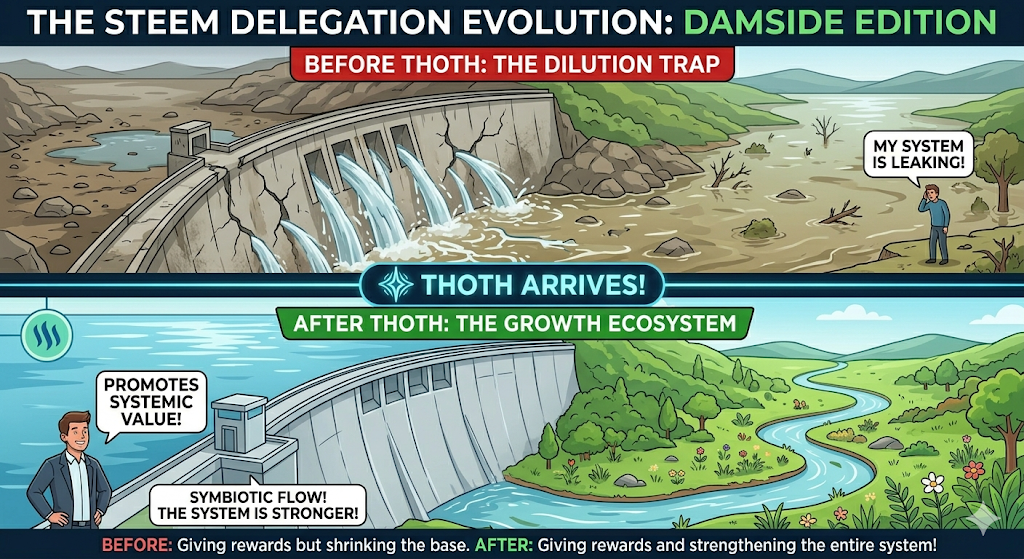
Image by Google Gemini
Thoth demonstrates a new paradigm that any new/innovative delegation bot can begin to follow. It finds attractive (valuable) content that already exists in the blockchain, summarizes it in a suite of posts and replies, and then shares beneficiary rewards with authors and to the delegators who make it possible.
This model is not a redistribution mechanism, it's a secondary rewards layer, straight from the blockchain to the authors who demonstrate lasting value and the delegators who support the initiative.
An unintended, but very useful consequence of this is that authors can continue to receive rewards for posts that they wrote years ago. This long rewards tail is something that authors have requested for as long as I've been here. As time goes on, beneficiary rewards push the post that generated 50% in author rewards up to 51%, 52%, and so on. We finally have a mechanism to lift the ceiling above 50% for the authors who actually attract eyeballs.
In the process, this framework also stands to address several other pain points for ecosystem participants:
- The 7-day payout window changes into a perpetual payout window for authors.
- Delegators are not required to make daily posts in order to get returns.
- SPAM reduction
- The >99.9% of Steem's content that is hidden behind the payout window gets brought back to the surface for readers.
- And so on
For purposes of this post, however, the important point is that we are now able to boost authors past the 50% threshold for the first time since the current reward split was implemented. Curators can assist this process just by reviewing the content that Thoth surfaces and voting for the posts that highlight attractive content.
Conclusion
Steem has a long-standing challenge with author/curator reward splits. The challenge stems from the fact that "one size fits all" doesn't actually fit anybody.
Authors who deliver large audiences should receive a higher share of rewards, and authors who are still getting established should receive a lower share. Instead, the rewards mechanism assumes that everyone is an average author.
The good news is that the problem is fixable through a combination of null beneficiary rewards, post promotion, and new generations of delegation bots that are designed to strengthen the ecosystem, instead of draining it.
The ideal fix would probably involve a hard-fork, so it's not likely to happen soon, but curators and community moderators and developers already have tools available that can compensate. Through the use of beneficiary reward burning, post promotion, and AI delegation bots, ecosystem participants can see to it that reward distributions are tailored to an author's unique contributions to the ecosystem.
It's time to stop cramming Steem's authors into a 1926 aircraft seat and give them the customized settings that will help the value-creators to thrive in the ecosystem.
All we need to do is to learn how to make use of the tools that we already have available.
Your post have been rewarded by the Speak on Steem curator team!
Now become a plus member delegating at least 500 SP
Ways to support us:
Curated by @marvinvelasquez