Conducting a Tabular Literature Review: Key Components and Best Practices
A tabular literature review is a systematic and concise way of comparing and synthesizing information from multiple research papers. It enables researchers to identify trends, gaps, similarities, and differences across studies, thereby providing a strong foundation for further research. Unlike a narrative review, a tabular review presents information in a structured format, making it easier for readers to interpret and compare findings.
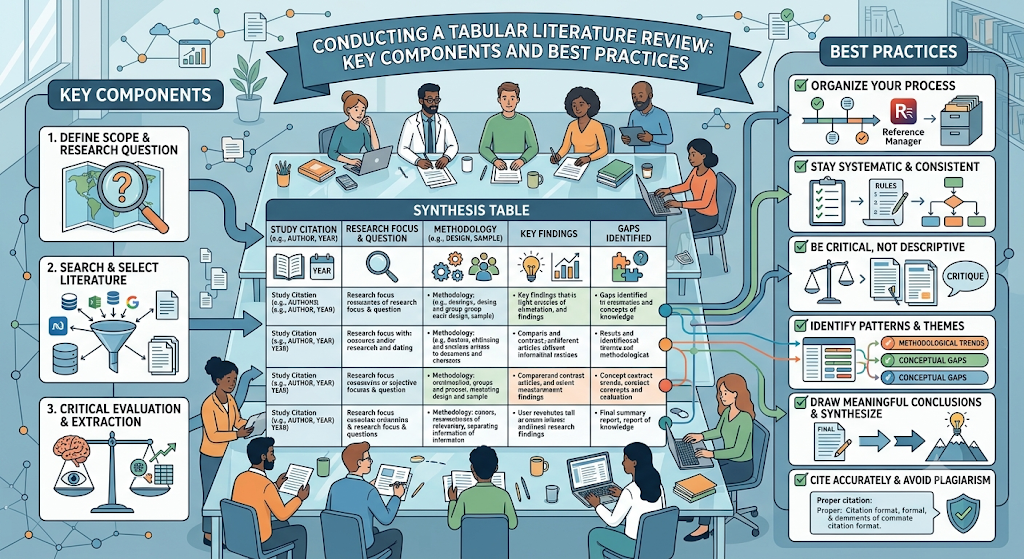
When preparing a tabular literature review, the first step is to select relevant and credible papers from reputable journals, conferences, or academic databases. Each paper should then be analyzed and summarized according to specific criteria. The table should be designed to capture the most important aspects of each study while maintaining consistency across all reviewed papers.
Several key elements should be included in a tabular literature review. First, provide the author(s) and publication year to establish the source and timeline of the research. Second, include the research objective or aim to explain the purpose of the study. Third, describe the methodology or research approach, such as experimental design, survey, case study, systematic review, or machine learning technique. Fourth, summarize the data source or sample size, as this helps assess the validity and scope of the findings.
Another critical component is the key findings or results of each study. This section should highlight the most significant outcomes and contributions of the research. It is also important to mention the limitations identified by the authors, as these reveal potential weaknesses and research gaps. Finally, researchers should include a critical observation or future research direction, which demonstrates analytical thinking and helps identify opportunities for further investigation.
An effective tabular literature review should not merely summarize studies but also facilitate comparison. Researchers should look for recurring themes, common methodologies, conflicting findings, and unexplored areas. The discussion that follows the table should synthesize these observations, highlighting patterns and identifying knowledge gaps that justify the current study.
In conclusion, a well-structured tabular literature review serves as a powerful tool for organizing and evaluating existing knowledge. By systematically presenting authors, objectives, methods, findings, limitations, and research gaps, it enhances clarity and supports evidence-based research development. Such a review not only simplifies complex literature but also provides valuable insights for identifying future research opportunities.
Example Table Headings
| Author & Year | Objective | Methodology | Data/Sample | Key Findings | Limitations | Research Gap/Future Work |
|---|