Methodological Paradigms: Foundations for Research Inquiry
Methodological paradigms are the philosophical frameworks that guide researchers in understanding reality, generating knowledge, and selecting appropriate research methods. They provide the underlying assumptions that influence how research problems are formulated, how data are collected, and how results are interpreted. Understanding methodological paradigms is essential because they shape the entire research process and determine the credibility and relevance of research outcomes.
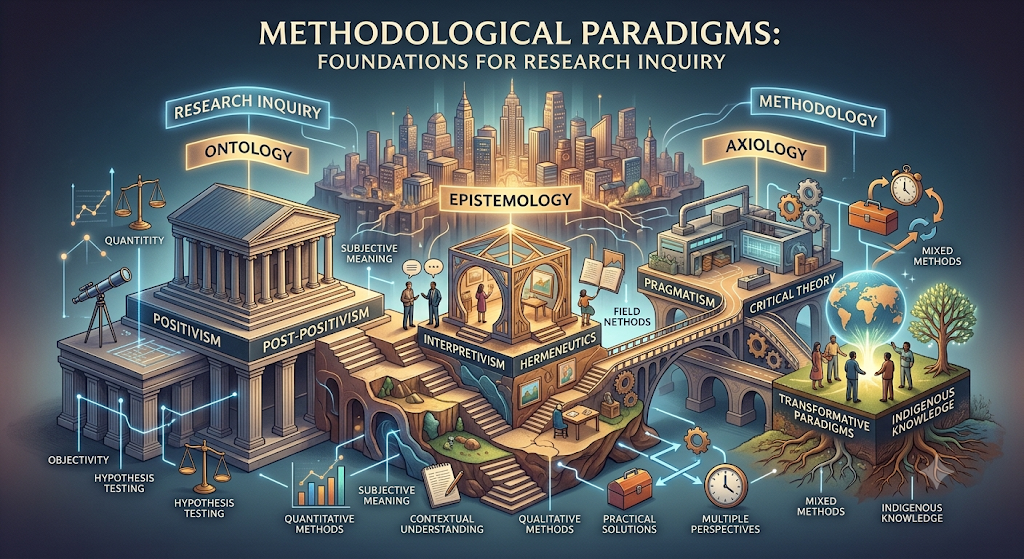
One of the most widely recognized paradigms is positivism, which assumes that reality is objective, measurable, and independent of the researcher. Positivist researchers rely primarily on quantitative methods such as experiments, surveys, and statistical analyses to test hypotheses and establish causal relationships. This paradigm emphasizes objectivity, reliability, and the use of empirical evidence to explain phenomena.
In contrast, interpretivism argues that reality is socially constructed and that individuals may perceive the same situation differently. Researchers operating within this paradigm seek to understand human experiences, meanings, and social interactions. Qualitative methods, including interviews, observations, and case studies, are commonly employed to gain in-depth insights into participants' perspectives. Interpretivism values context and recognizes the active role of the researcher in knowledge creation.
Another important paradigm is critical theory, which focuses on examining power structures, inequalities, and social injustices. Researchers using this approach aim not only to understand social issues but also to promote change and empowerment. Critical research often investigates topics such as discrimination, inequality, and social transformation, emphasizing reflection and action.
Pragmatism has gained increasing popularity, particularly in contemporary research. Rather than being committed to a single philosophical viewpoint, pragmatism emphasizes solving practical problems and answering research questions effectively. It supports the integration of both quantitative and qualitative methods, making it a common foundation for mixed-methods research. Pragmatists believe that the choice of method should depend on the nature of the research problem rather than strict adherence to a specific philosophical position.
In conclusion, methodological paradigms provide the intellectual foundation for research design and practice. Positivism, interpretivism, critical theory, and pragmatism each offer distinct perspectives on reality, knowledge, and inquiry. A clear understanding of these paradigms enables researchers to select appropriate methodologies, justify their research choices, and produce meaningful and reliable findings.