The One-Click DeFi Economy: Why Infrastructure Is Becoming the Future of Onchain Finance
Decentralized Finance was created with a bold vision: make financial services accessible to anyone with an internet connection. Over the past few years, DeFi has delivered remarkable innovation, enabling users to lend, borrow, trade, and earn yield without traditional intermediaries.
Yet despite its success, a major challenge remains.
For many users, participating in DeFi still feels like a full-time job.
The Reality of DeFi Today
Modern DeFi users face an overwhelming number of decisions every day.
They must constantly monitor yield opportunities, compare protocols, move capital between chains, manage risks, track incentive programs, and rebalance positions as market conditions evolve.
A single yield strategy may require interacting with multiple protocols across several blockchains. Users often need to understand liquidity dynamics, reward emissions, token risks, and execution costs before making even a simple allocation decision.
This creates significant friction.
Most people are not entering DeFi because they want to spend hours managing strategies. They are participating because they want better outcomes for their capital.
The problem is simple:
Users want results, not operational complexity.
Why DeFi Has Become So Complex
The complexity of DeFi did not appear by accident.
As the ecosystem expanded, opportunities became increasingly fragmented. Liquidity exists across multiple chains. Yield opportunities shift rapidly. Incentive programs change frequently. Risk profiles evolve continuously.
Capturing the best opportunities often requires active management and constant execution.
In many cases, users are expected to behave like professional portfolio managers. They must analyze markets, allocate capital, monitor performance, and react to changing conditions.
This approach may work for advanced users, but it creates barriers for broader adoption.
When users become the execution layer, scalability becomes difficult.
The future of DeFi requires a different approach.
The Rise of the Infrastructure Layer
The next stage of DeFi evolution is not necessarily about creating more protocols.
It is about creating better infrastructure.
Infrastructure allows complexity to be absorbed by systems rather than individuals. Instead of requiring users to manually manage every aspect of their portfolios, intelligent infrastructure can automate execution, coordinate capital, and optimize allocations.
This shift changes the user experience entirely.
Rather than managing dozens of operational decisions, users can focus on a single objective: deploying capital efficiently.
The infrastructure handles the rest.
This is the foundation of structured DeFi.
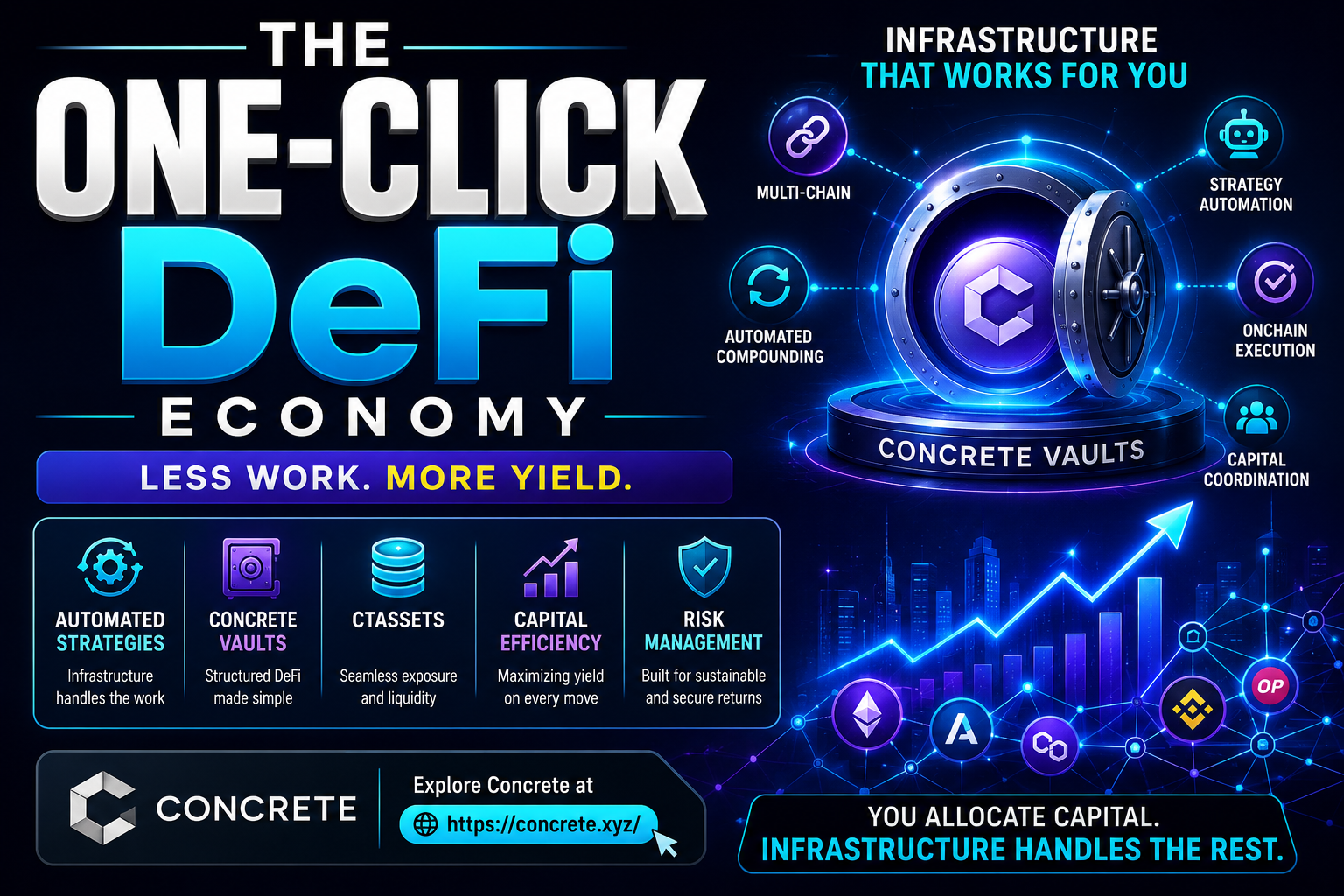
How Concrete Vaults Simplify Onchain Capital Deployment
One example of this infrastructure-driven approach is Concrete Vaults.
Concrete Vaults are designed to simplify onchain capital deployment by automating many of the processes that traditionally require active user management.
Through strategy automation and structured vault systems, capital can be allocated according to predefined frameworks while reducing the need for constant intervention.
Features such as automated compounding help maximize efficiency by reinvesting returns without requiring manual action. Meanwhile, ctAssets provide users with a more streamlined way to access and manage exposure within the ecosystem.
Instead of continuously monitoring positions, moving assets between protocols, or adjusting allocations manually, users can leverage vault infrastructure to access opportunities through a simplified experience.
The result is a more efficient and scalable approach to DeFi participation.
The Benefits of One-Click DeFi
As infrastructure improves, several important advantages emerge.
Greater Capital Efficiency
Automated systems can identify and execute opportunities more effectively than manual workflows, helping capital remain productive across changing market conditions.
Reduced Operational Burden
Users no longer need to spend significant time managing positions, tracking incentives, or monitoring every protocol update.
Consistent Strategy Execution
Emotional decision-making often leads to inconsistent outcomes. Automated execution enables strategies to operate according to predefined rules and objectives.
Improved Risk-Adjusted Yield
Structured systems can balance opportunity and risk more efficiently, creating a stronger framework for sustainable returns.
Institutional DeFi Infrastructure
As the ecosystem matures, institutional participants require reliable systems capable of managing larger amounts of capital. Infrastructure-driven solutions provide the foundation necessary for broader adoption.
The Bigger Shift Ahead
The future of DeFi may not be defined by how many protocols users interact with.
Instead, it may be defined by how little they need to manage themselves.
As infrastructure continues to evolve, users will increasingly expect simple experiences built on sophisticated systems operating behind the scenes.
The key question is no longer whether automation belongs in DeFi.
The real question is whether users want more features—or fewer decisions.
One-click DeFi represents a future where capital allocation becomes simple while infrastructure handles execution, optimization, and coordination.
In that future, users focus on outcomes.
The infrastructure does the work.
Explore Concrete at https://concrete.xyz/
#Concrete #ConcreteVaults #DeFi #DeFiVaults #ctAssets #AutomatedCompounding #StructuredDeFi #OnchainCapitalDeployment #CapitalEfficiency #InstitutionalDeFi #RiskAdjustedYield #OneClickDeFi