Decentralized Infrastructure: How Alltoscan Solves Modern Blockchain Complexity
The transition from a centralized internet to a decentralized infrastructure has introduced significant fragmentation across the digital landscape. As the number of layer-1 blockchains and decentralized finance protocols grows, users are forced to navigate a siloed environment where data and assets are often isolated within specific networks. This complexity creates a barrier for the hundreds of millions of individuals currently participating in the digital asset economy, as they require specialized tools to track transactions, manage diverse portfolios, and interact with smart contracts across disparate ecosystems.
AllToScan come and fix issue to address these foundational bottlenecks by providing a unified intelligence layer for the Web3 environment. By indexing multiple blockchain networks into a single, searchable interface, the platform serves as a central gateway for verifiable on-chain data.
So, Let's Know About AllToScan Ecosystem
AllToScan is a comprehensive blockchain infrastructure platform that integrates multichain analytics, secure asset management, and developer-focused tools into a single ecosystem. Founded by a team of software engineers and blockchain specialists, the project focuses on reducing the technical barriers associated with decentralized technology. At its core, the platform provides a multichain block explorer that allows users to query transactions, wallet addresses, and smart contracts across several major networks, including BNB Chain, Avalanche, Polygon, and Ethereum, through a streamlined and intuitive interface.
Beyond its role as a data provider, the ecosystem includes the WATS Wallet and a suite of decentralized services powered by its native utility token. The project employs a growth flywheel strategy that combines community engagement through gamification with high-performance infrastructure for institutional users. By bridging the gap between casual social interactions and complex on-chain analytics, the platform aims to support the next generation of decentralized applications while maintaining a commitment to open-source innovation and user-controlled security.
AllToScan Utility and Value of a Unified Web3 Interface
The primary challenge in the current blockchain environment is "information asymmetry" combined with "transactional friction." Users often need to visit multiple different explorers to verify a single cross-chain move, and developers must maintain connections to various nodes to keep their applications functional.
AllToScan solves this by consolidating disparate data points into a verifiable, human-readable format. This value proposition extends to institutional researchers who require high-density data for market analysis and individual traders who need real-time confirmations of their asset movements.
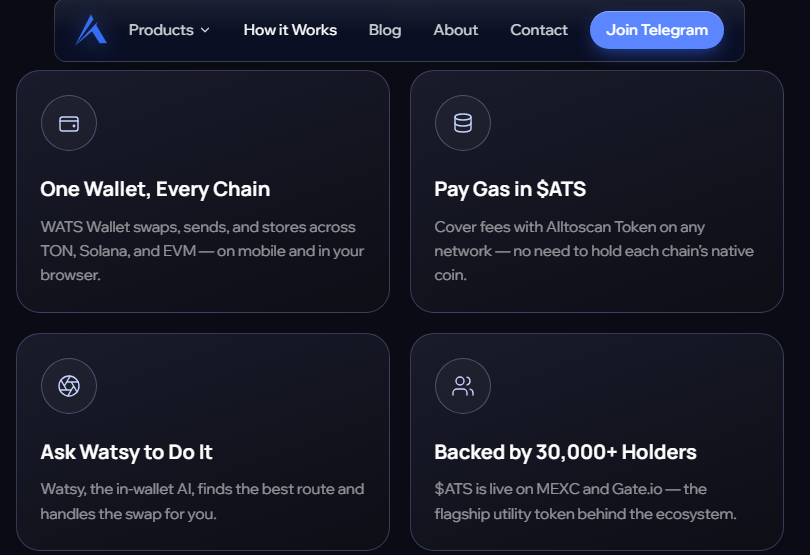
Furthermore, the project addresses the "Gas Fee Dilemma" through its integrated wallet solutions. In a typical multi-chain scenario, a user must hold the native token of every network they interact with just to pay for transaction costs.
Accessing the Ecosystem: Where and How to Participate
For individuals looking to engage with the project, the primary points of entry are through cryptocurrency exchanges and the platform’s native mobile application. The native utility token is currently listed on several prominent centralized exchanges, allowing for global accessibility and liquidity.
Interested participants can find the asset on platforms such as MEXC and Gateio, where the most active trading pair is typically with USDT. The project has also indicated plans for future listings on other Tier 1 exchanges, such as Bitget, to further broaden its reach and market depth.
To utilize the features of the ecosystem, users should begin by downloading the WATS Wallet, which is available on both the App Store for iOS devices and Google Play for Android users. Participation involves creating a non-custodial account, which grants full control over private keys and digital assets. From there, users can connect to the AllToScan explorer to monitor their on-chain activity or interact with the AI-driven assistant within the wallet to execute swaps and manage their portfolios.
Developers looking to build on the platform can access the API PRO services directly through the project's main interface to integrate high-performance data feeds into their own applications.
Exploring the Multichain Landscape with AllToScan
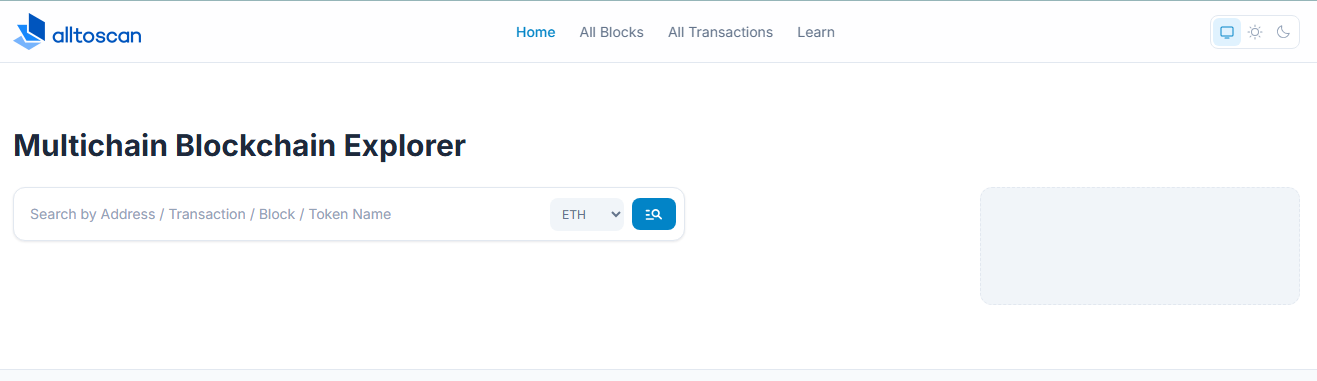
The block explorer serves as the flagship product of the ecosystem, providing a unified search engine for the decentralized world. Rather than operating as a series of disconnected tools, it aggregates data from various layer-1 and layer-2 solutions to provide a holistic view of the market.
The following list describes the core capabilities of the explorer and how it simplifies the user experience:
- Unified Dashboard: Users can search for any transaction hash, wallet address, or token across multiple chains simultaneously without switching tabs or websites.
- Human-Readable Identities: Through partnerships with domain services like Unstoppable Domains and SPACE ID, the explorer allows users to search for names rather than complex 42-character alphanumeric strings.
- Real-Time Indexing: Every confirmed block on supported networks is instantly processed, ensuring that the data displayed is accurate to the latest second of blockchain activity.
- Contract Verification: Developers can use the platform to inspect and verify smart contracts, ensuring transparency for the end-users of decentralized applications.
Bridging the Data Gap for Researchers
For those conducting deep-market research, the platform offers advanced analytics that go beyond simple transaction tracking. It provides insights into token holder distribution, daily gas usage trends, and historical balance changes. These metrics are essential for identifying whale movements or assessing the health of a specific decentralized protocol. By making this data accessible through a clean user interface, the project democratizes information that was previously only available to those capable of running their own full nodes.
Practical Use Cases and $ATS utilities
The token economy of this project is built on the principle of direct utility rather than pure speculation. The ATS utilities are integrated into every layer of the platform, from the consumer-facing wallet to the backend infrastructure used by corporate entities.
The list below highlights how the native token functions as the fuel for the broader ecosystem:
- Gas Fee Substitution: Users of the mobile wallet can pay for transaction costs on various networks using the native token, simplifying the process of moving assets across chains.
- Premium API Access: Developers and enterprises utilize the token to pay for high-rate-limit API calls, which are necessary for powering real-time dashboards and trading bots.
- Staking Incentives: Holders can lock their tokens into the network to help secure the ecosystem and earn rewards, which promotes long-term holding and supply stability.
- Governance Participation: The platform plans to allow token holders to vote on key upgrades and new chain integrations, giving the community a direct say in the roadmap.
Enhancing Developer Efficiency
The API PRO service is a critical component for the Web3 developer community. It provides endpoints for retrieving detailed token information by contract address and historical account balances by block number. By using the native token for these services, developers receive significant discounts compared to standard fiat or stablecoin payments. This creates a circular economy where the growth of third-party applications built on this data directly contributes to the demand and utility of the token.
Future Expansion and the Strategic Roadmap
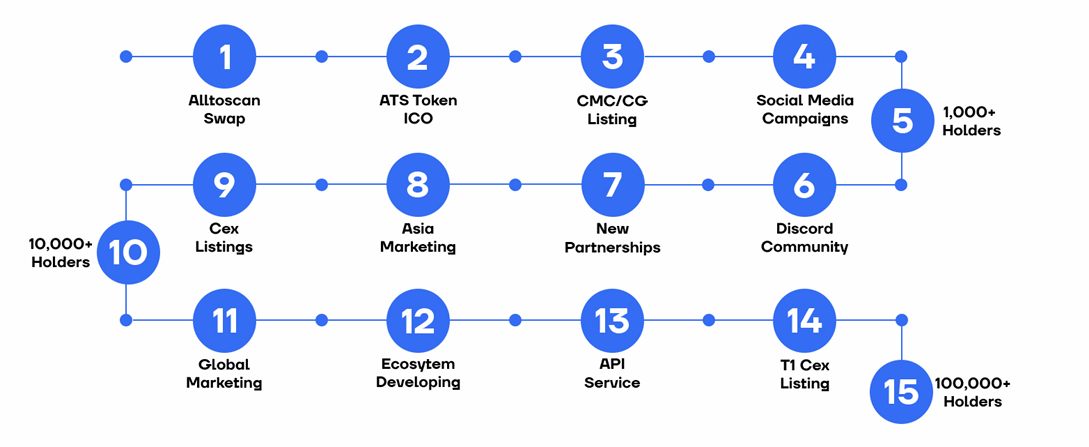
The development team has laid out a comprehensive Roadmap designed to scale the platform from a niche technical tool to a mainstream Web3 gateway. This strategy involves both technical upgrades and aggressive marketing initiatives aimed at capturing a larger share of the global cryptocurrency user base.
The roadmap is structured into several phases, each focusing on a different pillar of growth:
- Phase 1: Infrastructure Foundations: This phase focused on the initial launch of the multichain explorer and the establishment of partnerships with nearly 40 blockchain entities like Polygon and Avalanche.
- Phase 2: Product Diversification: This included the release of the WATS Wallet and the integration of AI tools to assist users in navigating the decentralized finance space.
- Phase 3: Global Market Expansion: The current focus involves targeting the Asian market and increasing the number of holders to over 100,000 through strategic Tier 1 exchange listings.
- Phase 4: Institutional Integration: Future plans involve the launch of an open-source explorer and deeper integrations with mainstream partners like La Liga to bring blockchain data to the sports and entertainment sectors.
Scaling Through Community Gamification
One of the most unique elements of the roadmap is the use of "tap-to-earn" games to onboard new users. By leveraging social platforms like Telegram, the project has successfully engaged over 1.6 million players. These users are then funneled into the ecosystem as they claim their rewards through the native wallet. This innovative acquisition strategy ensures that the platform continues to grow its user base even during periods of market stagnation, providing a consistent stream of new participants for the wallet and token services.
Economic Structure of the ATS Token
The ATS Token is designed with a deflationary model to ensure long-term sustainability and value retention within the ecosystem. With a maximum supply capped at 100,000,000 units, the token economy avoids the pitfalls of infinite inflation that plague many other utility-based projects.
The tokenomics are characterized by the following structural features:
- Fixed Total Supply: The hard cap ensures that no new tokens can be minted, preventing the dilution of existing holders' stakes.
- Deflationary Burn Mechanism: A portion of the tokens used for platform services and transaction fees is permanently removed from circulation, gradually reducing the total supply over time.
- Secured Liquidity: To foster trust, the project has utilized the FlokiFi Locker to secure over $18 million worth of tokens, demonstrating a long-term commitment to the project's health.
- Institutional Backing: The presence of market makers like DWF Labs ensures that the token maintains sufficient liquidity on exchanges, reducing volatility for daily users.
The Role of Deflation in Long-Term Growth
The burn mechanism is not just a marketing tool; it is a fundamental economic policy. By sending a percentage of every service fee to an "eater address" (an unrecoverable blockchain address), the project ensures that as the platform's adoption increases, the scarcity of the token also increases. This creates a direct correlation between the utility of the explorer and wallet and the underlying economic health of the token, aligning the interests of the developers with those of the community.
Decentralized Security and the WATS Ecosystem
The WATS ecosystem is centered around the philosophy of non-custodial security, meaning that users are the sole owners of their digital assets. In a world where centralized platforms often face security breaches or liquidity crises, the ability for a user to maintain their own private keys is paramount. The wallet acts as the bridge between the high-level data provided by the explorer and the actual execution of transactions on the blockchain.
Key security and usability features of the wallet include:
- Biometric Authentication: Integration with modern smartphone security features ensures that only the authorized user can access the wallet interface.
- Watsy AI Assistant: An integrated artificial intelligence tool that helps users find the most efficient routes for token swaps, reducing the risk of human error during complex transactions.
- Multi-Chain Support: The wallet allows for the storage and management of assets across EVM-compatible chains, Solana, and the TON network from a single seat.
- One-Click Transactions: By streamlining the approval process, the wallet makes interacting with decentralized applications as simple as using a traditional banking app.
Simplification Through Artificial Intelligence
The inclusion of Watsy, the AI assistant, represents a significant shift in how users interact with decentralized technology. Instead of manually researching liquidity pools and bridge protocols, a user can simply ask the assistant to "Swap USDT for TON with the lowest fee." The AI then scans the integrated networks, presents the best option, and prepares the transaction for a single-click confirmation. This level of automation is essential for onboarding the next billion users who may not have the time or technical background to master the intricacies of cross-chain finance.
Final Thought
The blockchain industry is moving away from the era of speculative isolation and toward a period of integrated utility. Projects that provide the underlying infrastructure—the explorers, the wallets, and the data APIs—are becoming the most critical components of the digital economy. AllToScan has positioned itself at the intersection of these needs, offering a robust platform that caters to the demands of individual users while providing the high-performance tools required by institutional developers.
By combining a deflationary token model with a multi-chain explorer and an AI-enhanced wallet, the ecosystem addresses the most significant pain points in the current Web3 landscape.
For more information
- Website: https://alltoscan.com/
- X (Twitter): https://x.com/alltoscan
- Telegram: https://t.me/alltoscan
Content curated and presented by:
- Username: Phallax
- Profile Link: https://bitcointalk.org/index.php?action=profile;u=3581934
- Wallet: 0x84F3e2808a716a439cc39a11BBf76aBe709645d2