How Modern Digital Rails Are Eradicating Legacy Processing Leakage
The Fluidity of Capital
Remember when moving money across borders felt like a straightforward equation? You initialized a transaction, paid a clearly stated fee, and the remaining balance arrived safely on the other side.
Traditional banking systems and regional payment processors have constructed an ecosystem where your margins are quietly eroded by a thousand microscopic, invisible cuts.
Between unexpected currency conversion markups, correspondent bank handling charges, regional operational levies, and ever-shifting local tax burdens, the concept of a predictable payment has completely vanished.
As old-world financial institutions tighten their grip with highly complex, layered fee structures, a parallel financial architecture has emerged to challenge the status quo.
Instead, protecting your bottom line requires a deliberate shift toward transparent, programmatic financial stacks designed to eliminate intermediate friction entirely.
The Illusion of Free Transfers and the Anatomy of the "Invisible Cut"
Let’s be honest: whenever a traditional platform or digital wallet advertises "zero-fee international transfers," your internal alarm bells should immediately start ringing. In modern banking, the word "free" is almost always a marketing proxy for an aggressive exchange rate markup hidden behind closed doors. If a payment network processes your cross-border invoice without an upfront flat fee, they are usually widening the interbank spread, embedding a 3% to 5% premium straight into the currency conversion.
To visualize why legacy international capital movement has become an expensive bottleneck, look closely at the multi-tiered routing networks still dominating global commerce today. When you send a standard wire transfer, your funds don’t travel in a straight line; they are passed like a hot potato through an incredibly fragmented chain:
[Your Bank] ➔ [National Central Bank] ➔ [Intermediary Bank A] ➔ [Intermediary Bank B] ➔ [Recipient Bank]
                                                                                                    │
                                                                                 (Accumulated Friction: 3-7%)
This sequence relies on ancient routing protocols where multiple intermediate entities touch your capital before it lands in its final destination. Every single institution along this chain extracts an operational slice, a processing levy, or a fraction of the currency spread. By the time the funds clear, the accumulated friction can easily swallow 3% to 7% of the total transaction volume. For a high-frequency digital enterprise, a creative studio, or an e-commerce operation, that loss doesn't just represent an annoying line item on a spreadsheet—it represents a direct reduction in your marketing budget, your engineering payroll, or your net profit margins.
The Compliance Trap: Why "Hidden Toolkits" No Longer Exist
For years, many global businesses relied on tactical workarounds to mitigate high operational fees and navigate complex regional tax environments. These workarounds often involved setting up layered corporate entities in low-tax jurisdictions, using multi-tiered e-wallet setups, or routing transactions through loosely regulated regional payment aggregators.
The global regulatory framework has evolved to a point where total financial transparency is no longer an option—it is the baseline standard.
Thanks to the rapid implementation of deep compliance mechanisms worldwide, regulatory bodies now possess unprecedented visibility into corporate capital flows. Consider the sheer scale of the automated reporting frameworks currently in effect:
- The Common Reporting Standard (CRS): A global framework that forces financial institutions across more than 100 jurisdictions to automatically exchange detailed financial account information on foreign residents annually.
- FATCA Regulations: Strict reporting mandates that track assets held by foreign entities, leaving virtually no corner of the traditional banking world unmonitored.
- Advanced AI-Driven AML Monitoring: Modern banking networks utilize automated anti-money laundering engines that flag and freeze atypical transaction patterns instantly, turning once-common corporate routing workarounds into immediate operational liabilities.
Attempting to bypass high fees using old-world corporate structuring or obfuscated routing is a recipe for operational disaster. Account freezes, lengthy compliance audits, and retrospective tax penalties will cost your business far more than the processing fees you were trying to avoid.
Architectural Shifts: Modern Tools for Margin Optimization
If you can no longer rely on structural loopholes to protect your capital, how do you keep your margins intact? The answer lies in structural optimization—replacing legacy banking layers with lean, digital-native payment architectures.
Instead of routing funds through an array of middleman networks, modern businesses are shifting toward unified infrastructure that consolidates international payments, alternative assets, and local settlement networks into a single operational interface.
1. Unified Settlement Engines
The most effective way to eliminate intermediate friction is to utilize platforms that bridge the gap between traditional fiat currencies and digital asset ecosystems. By integrating with a highly optimized global processing infrastructure like the one provided by VelPay, businesses can easily accept payments and execute payouts across diverse global regions without maintaining a dozen localized bank accounts.
 When your payment stack combines direct card acquiring, localized banking rails (like SEPA or SWIFT), and virtual asset support inside a singular dashboard, you effectively eliminate the multi-layered fee structures built by legacy middlemen.
2. Digital Assets as a Liquidity Rail
For large corporate payouts, cross-border vendor settlements, or distributed team payroll, traditional wire transfers are simply too slow and unpredictable. Utilizing stable digital currencies anchored to fiat values allows businesses to move capital instantly across global borders for a fraction of a cent, entirely bypassing the correspondent banking network.
To utilize this architecture seamlessly, you need access to a highly reliable cryptocurrency exchange layer that can handle incoming liquidity and instantly convert it into stable operational assets without exposing your treasury to market volatility.
3. Automated FX Hedging and API Integration
For companies operating across multiple regions, manual execution of currency conversions is an operational bottleneck. Modern payment architectures allow you to programmatically lock in competitive exchange rates via open APIs.
By integrating a flexible crypto exchange platform directly into your back-office systems, your software can automatically calculate rates, execute instantaneous asset conversions, and clear payouts 24/7 without requiring manual human intervention or suffering from weekend banking delays.
From Friction to Fluidity: A Tactical Comparison
To truly understand how a modern financial architecture changes your bottom line, let’s look at a practical scenario. Imagine a digital product agency based in Europe that needs to clear a $15,000 monthly payout to a software development team or premium infrastructure vendor located across the globe.
Let's look at how the capital moves under the old way versus the modern optimized approach:
| Operational Variable | Legacy Banking Infrastructure | Optimized Digital Rail Integration |
|---|---|---|
| Primary Routing Method | International SWIFT Wire + 2 Intermediaries | Multi-Asset Settlement Layer & API |
| Processing Timeline | 3 to 5 Business Days (Excluding Weekends) | Near-Instantaneous execution (24/7/365) |
| Visible Transfer Fees | $35 to $75 fixed outbound wire fee | Fractional gas fee or minimal platform fee |
| Hidden Exchange Markup | 2.5% to 4.8% embedded in currency spread | Direct interbank routing or clear digital spread |
| Compliance Overhead | Manual documentation review per transfer | Automated, programmatic transaction logging |
| Total Margin Loss | $450 – $800 | Under $50 |
The difference isn't just a handful of dollars—it's a stark contrast in capital efficiency. Under the old system, hundreds of dollars are drained from a single transaction to maintain an obsolete network of institutional servers and corporate overhead.
By shifting to an infrastructure that supports an instant crypto exchange framework, the transaction shifts from a complex, multi-day bureaucratic process into a straightforward, point-to-point digital settlement. The capital stays where it belongs: in your business ecosystem.
The Irony of Modern Finance: Paying More for Slow Machinery
It is incredibly ironic that in an era where data travels around the globe in milliseconds, an international corporate payment can still take five business days to clear. We live in a world of high-speed automation, yet we are collectively paying premium, institutional fees for financial machinery that was designed during the Cold War.
Think about the absurdity of the traditional weekend banking freeze. Your servers run 24/7, your global advertising campaigns run 24/7, your customer support queues operate across every time zone—yet your corporate capital can be trapped in limbo for 72 hours because an arbitrary banking headquarters in a distant time zone is closed for the weekend.
Even worse, traditional institutions charge you for the privilege of waiting. They present these delays and fees under the guise of "security and institutional stability," while modern cryptography and decentralized protocols have proven that secure, verified transactions can be settled globally in less than sixty seconds for pennies.
Watching your hard-earned business revenue get chipped away by non-negotiable intermediary processing fees feels exactly like watching water leak from a broken pipe. You can see the resource draining away in real time, but the traditional utility provider simply tells you that a leaky pipe is just the unavoidable cost of having running water. It isn't.
Reclaiming Your Capital: A Blueprint for the Modern Digital Enterprise
Optimizing your business's financial operations is no longer about finding a clever gimmick or chasing short-lived regulatory loopholes. The future belongs to businesses that systematically minimize friction by upgrading the core architecture of their payment stack.
If you want to permanently insulate your net margins from invisible fees and erratic currency markups, you must establish a clear, structured blueprint for your capital flows: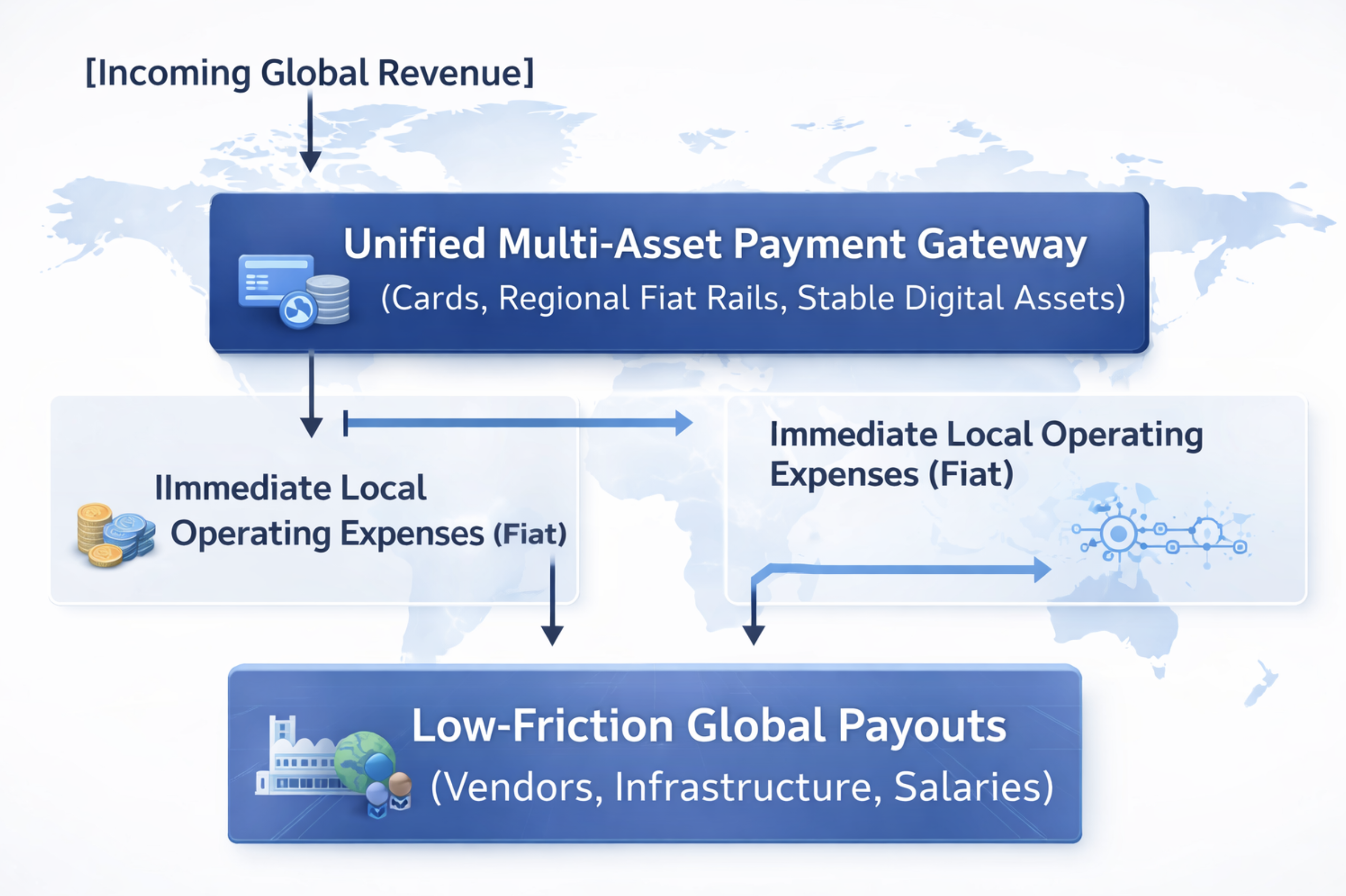
Start by auditing your existing payment infrastructure. Calculate the true, fully loaded cost of your cross-border transactions—don't just look at the flat wire fees, but explicitly calculate the percentage lost to currency spreads and incoming intermediary deductions. Once you identify where the leaks are occurring, begin systematically replacing those legacy links with programmatic alternatives.
Integrate payment gateways that let you move effortlessly between traditional currencies and digital ecosystems. Transition your cross-border vendor arrangements and high-volume corporate payouts to stable digital assets, utilizing high-performance platforms to maintain absolute liquidity and predictable value.
The tools to protect your hard-earned margins are right in front of you. Stop letting old-world institutional friction dictate the speed and profitability of your global business operations. Upgrade your financial stack, take control of your transaction architecture, and ensure that every single dollar you generate goes exactly where it belongs—toward scaling your enterprise.