Bitcoin's Fourth Straight Weekly Gain Has Almost Nothing to Do With Crypto
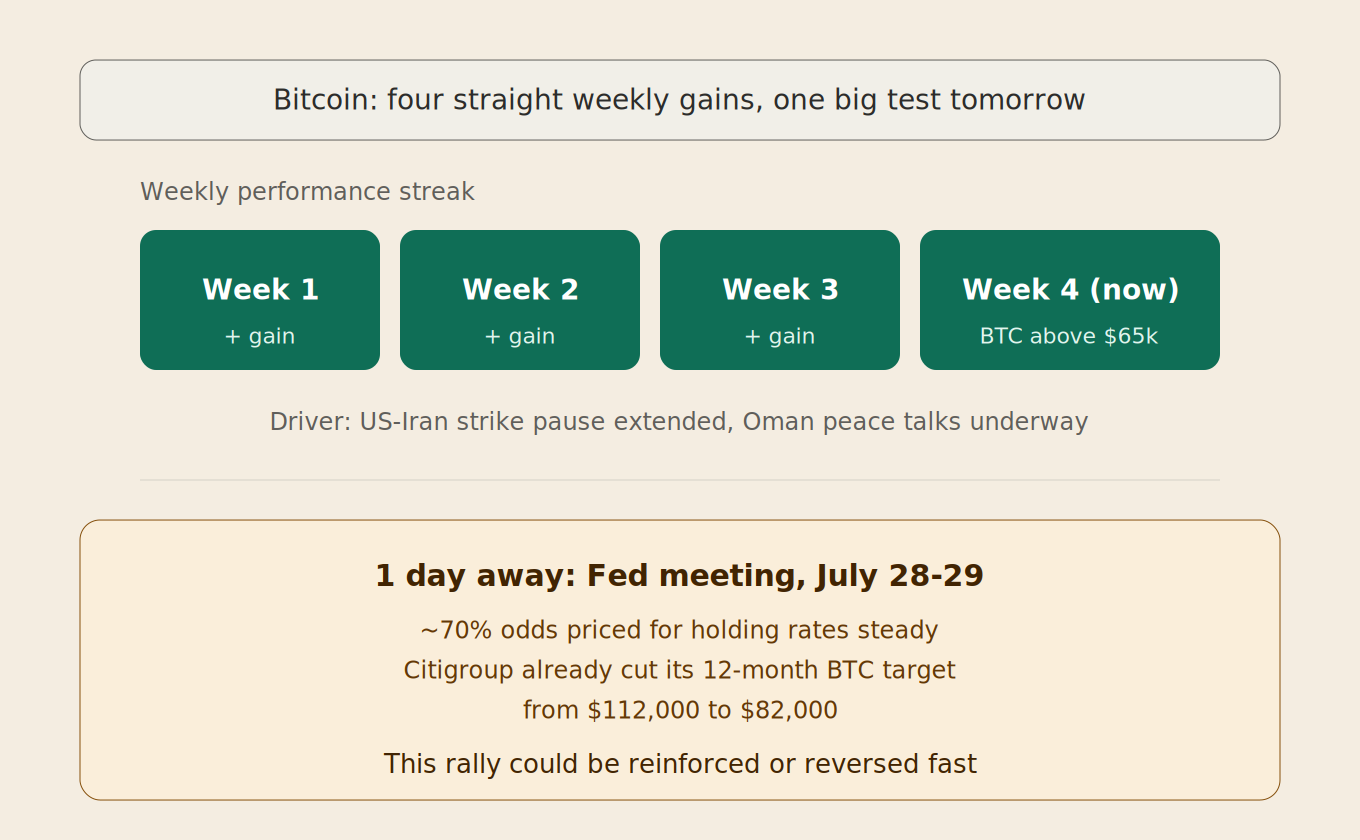
Bitcoin is holding firm above $65,000 this Monday, and this isn't just a one-day bounce — it's now recorded its fourth consecutive weekly gain. Ethereum and Ripple are moving in the same direction, surging over 4% and 1% respectively last week alone, while DeFi tokens like Aave and Ondo have emerged as the strongest performers over the past 24 hours.
The broader crypto market is up 1.7% in the last 24 hours, pushing total market capitalization to $2.3 trillion, with Bitcoin's dominance holding steady at 56.6%.
Question: What's actually driving four straight weeks of gains?
Here's the part worth paying close attention to, because it isn't a crypto-specific catalyst at all: broader cryptocurrency market risk-off sentiment is easing as the US and Iran extend the pause in missile strikes, while Oman hosts peace talks between the two sides.
Think back to what we covered just a week ago — Bitcoin was sitting below $63,000, the Fear and Greed Index was stuck at 22 ("Extreme Fear"), and the entire crypto market was getting dragged down by escalating US-Iran conflict and oil spiking past $80 a barrel. Today, that exact same conflict is the reason crypto is recovering — except now it's the de-escalation doing the work instead of the escalation doing the damage.
This Is the Clearest Lesson All Month
If you've been following along, this is the perfect real-world confirmation of something we've said before: Bitcoin has been trading like a risk asset, not an independent safe haven. A pure "digital gold" asset shouldn't care whether two governments are extending a ceasefire pause. But Bitcoin's fourth straight weekly gain is happening specifically because geopolitical fear is fading — which only makes sense if crypto is moving with broader risk appetite, exactly like tech stocks would.
The Bigger Picture Isn't Fully Resolved
Before this turns into a "crypto is back" story, it's worth being precise about what's actually happened versus what's still uncertain:
A pause in strikes is not a peace deal. Oman is hosting talks, but talks and an extended pause are not the same thing as a resolved conflict. Markets are pricing in reduced risk, not eliminated risk.
Some analysts remain far more cautious on the bigger picture. Notably, Citigroup recently cut its 12-month Bitcoin price target from $112,000 down to $82,000, and now expects essentially no new institutional money flowing into Bitcoin ETFs over the next year — a sign that even during this rebound, not everyone on Wall Street is convinced the momentum will hold.
This comes right before a major Fed decision. As we've been tracking, the Fed's July 28-29 meeting is one day away as of this writing, and markets are still pricing roughly 70% odds of the Fed holding rates steady — meaning this rally could either get reinforced or completely reversed within 48 hours, depending on that single announcement.
Takeaway for Learners
This week is a genuinely rare, clean example of a lesson that usually takes traders years to internalize: the same event can be the reason an asset falls one week and the reason it rises the next — not because the asset changed, but because the market's read on the event changed. Bitcoin didn't become "safer" this week. The world just became slightly less scary, and Bitcoin moved accordingly, like any other risk asset would.
Let's learn together!