Japan Just Rewrote Its Crypto Rules — And It Could Be Bigger Than Any ETF Approval
The Headline Move
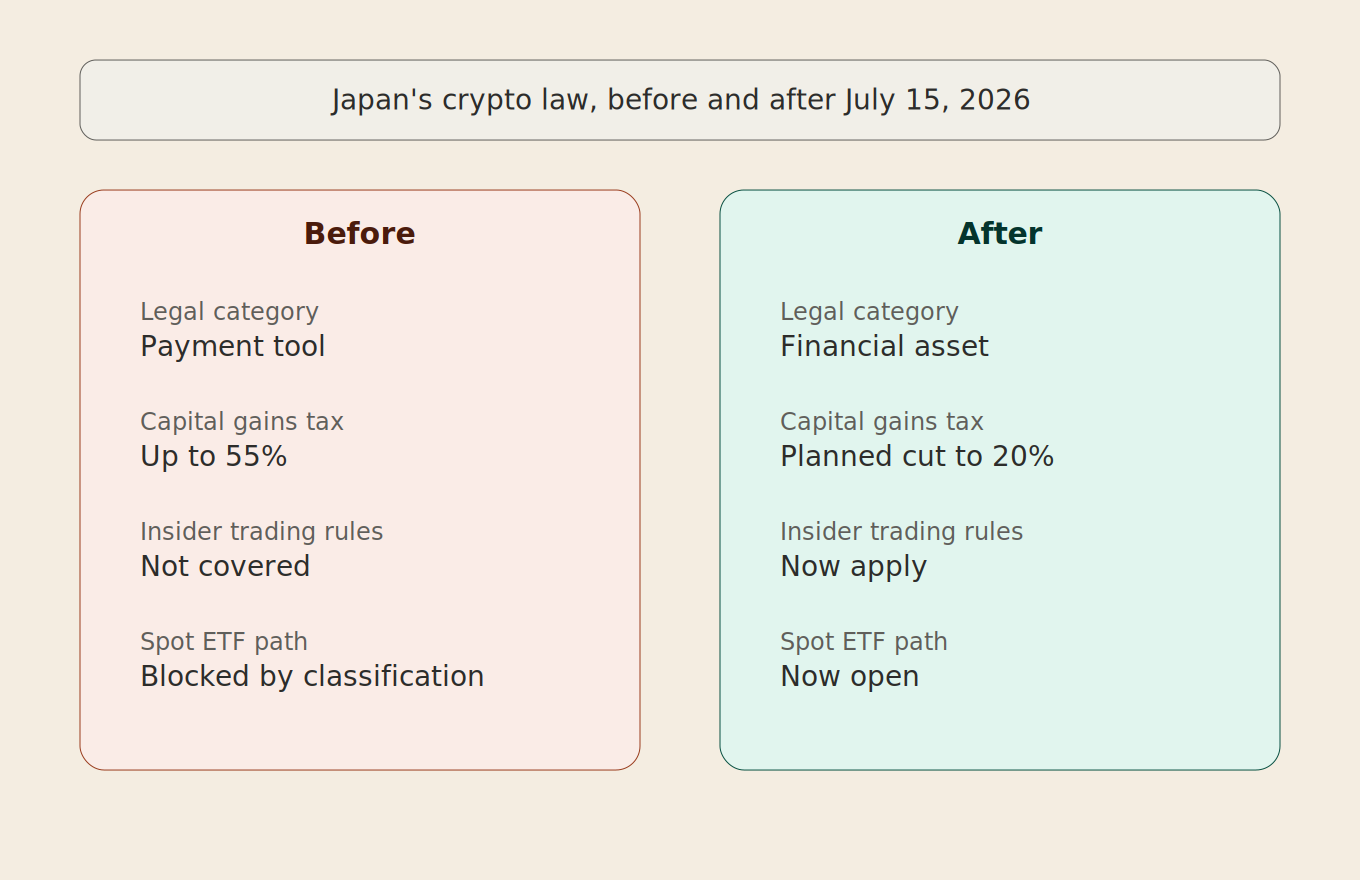
While most crypto headlines this week focused on price swings, the more important story slipped by with far less attention. Japan passed a law on July 15 that reclassifies Bitcoin, Ethereum, and over 105 other tokens as financial assets under the Financial Instruments and Exchange Act. That single sentence quietly changes the entire legal category crypto sits in — from a "payment tool" to a genuine investment asset class.
Why This Matters More Than It Sounds:
Before this law, crypto in Japan was legally treated similarly to a payment method — not that different, on paper, from a prepaid card. Under the new classification, crypto now falls under the same investment framework as stocks and bonds, which brings two major changes:
Insider trading bans now apply to crypto — the same rules that protect stock market investors from trading on non-public information now extend to digital assets. This is a real credibility upgrade, not just a symbolic one.
A massive tax cut is planned — Japan intends to cut crypto capital gains tax from 55% down to 20%. To put that in perspective, a 55% tax rate is one of the harshest in the world for crypto gains; a 20% flat rate suddenly makes Japan competitive with far more crypto-friendly jurisdictions.
The Bigger Domino: Spot ETFs
This reclassification does something else that's easy to miss: this move opens the door for spot Bitcoin ETFs in Japan. When crypto is legally categorized as a payment tool, regulators have a hard time approving fund products built around it. Once it's categorized as a financial asset — the same bucket as gold or equities — approving an ETF becomes a much smaller regulatory leap.
This mirrors exactly what happened in the U.S. before spot Bitcoin ETFs were approved there: the legal groundwork always comes before the product.
How This Fits Into the Bigger Global Picture
This isn't happening in isolation. The same week, crypto wallets are becoming a genuinely practical part of everyday finance rather than just a speculative asset — in the first half of 2026, wallet card spending in emerging markets reached $31 million, with spending in Southeast Asia, South Asia, Africa, and Latin America up 416% year over year.
At the same time, U.S. regulators missed a key July 18 deadline to finalize stablecoin rules under the GENIUS Act, leaving American issuers and exchanges in regulatory limbo — a sharp contrast to Japan moving decisively in the opposite direction.
Question: Why does one country's tax law matter to traders everywhere?
Because regulation is contagious. When a major economy like Japan legitimizes crypto at the legal-framework level, it puts pressure on other regulators globally to keep pace — nobody wants capital and talent quietly relocating to friendlier jurisdictions. Japan lowering its tax burden from 55% to 20% isn't just a domestic policy change, it's a competitive signal to every other regulator watching.
Takeaway for Learners
The biggest mistake new crypto traders make is only watching price charts. The real early signals almost always show up in regulation first — tax law, asset classification, ETF approvals — long before price reflects it. Japan didn't move a market today. It moved a legal foundation that markets will likely build on for years.
Let's learn together!