Custom Packaging vs Stock Packaging: Which One Delivers Better ROI?
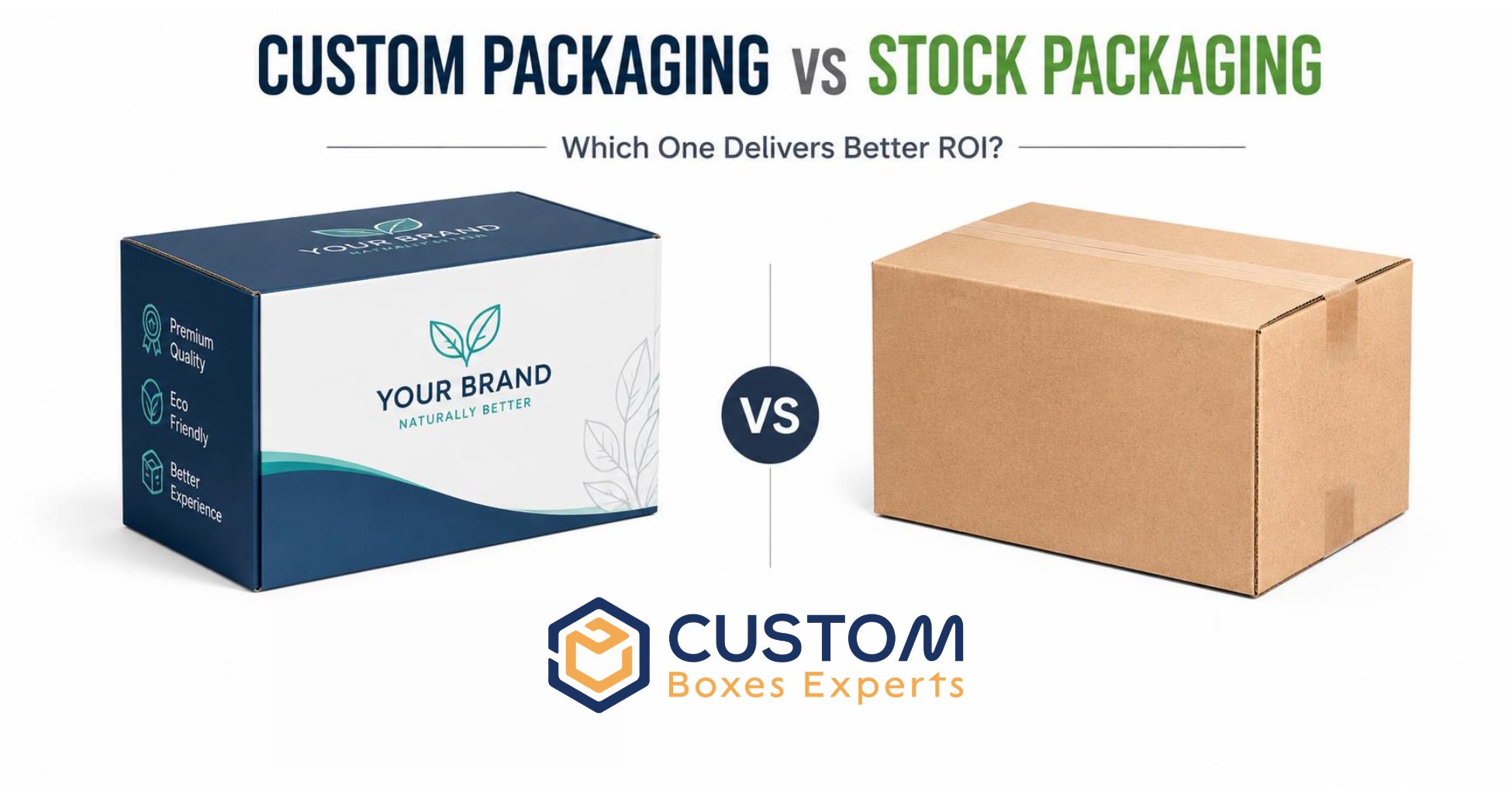
One of the most important choices that a business has to make with respect to its products is between custom packaging and stock packaging
Stock packaging provides instant savings, but custom packaging is considered an investment made by the company. In order to know which of these options yields a higher Return on Investment (ROI), we need to compare the different costs involved in both situations.Understanding the Basics: Stock vs. Custom
Before diving into the financial metrics, it is important to define what each option brings to the table.
Stock Packaging: These are standardized, pre-manufactured, and generic packages (like standard brown Kraft boxes and white mailers). They can easily be sourced, need no set-up charges, and can even be purchased in bulk.
Custom Packaging: It entails customized sizes, special materials to be used, and branding. Custom boxes can have your logo or inserts and can be designed according to your needs. This form of packaging is solely based on your product and brand.
Financial Analysis: Upfront Costs vs. Long-Term Value
On surface evaluation, stock packaging appears to be the clear winner when it comes to ROI based on cost. But a closer inspection tells us a different story.
- Production and Purchasing Costs
Stock boxes have a lower barrier to entry. There are no tooling fees, printing plate charges, or design costs. If you are a startup testing a product, stock packaging keeps your initial overhead remarkably low.
However, having custom product packaging boxes will require some initial investment in the form of designing and manufacturing the product boxes. But when the customized printed product boxes are purchased in bulk, then the unit price becomes very low. In the case of a well-established business, the difference is minimal.
- Shipping and Dimensional Weight Fees
This is where stock packaging often loses its financial advantage. Because the stock boxes come in standard sizes, they will not be able to fit the size of your product.
You must make sure that your product is protected by using bubble wrap,packaging inserts, packing peanuts, or filler paper to fill up any excess space inside the box.
Dimensional weight (DIM) is used by major shipping companies when pricing their services according to how much space your box occupies in the delivery van rather than how much it actually weighs.
Stock boxes often force you to pay to ship trapped air.
Custom boxes packaging is engineered to the exact dimensions of your product, reducing shipping volume and eliminating excess filler material costs.
The Marketing and Brand Equity Multiplier
ROI isn't just about cutting expenses; it is also about driving revenue. Your packaging is the first physical touchpoint a customer has with your brand.
The Unboxing Experience
In today’s digitally advanced era, unboxing has become a potent marketing tool. Customers tend to post eye-catching packaging on social media sites such as Instagram and TikTok.
A basic stock box hardly motivates anyone to whip out their mobile phone and make a video of it. However, high-quality personalized boxes give customers something memorable to capture, turning regular consumers into brand ambassadors. It is user-generated content that helps you market your products for free, which reduces CAC.
Perceived Value and Premium Pricing
The appearance of your package directly influences how much a customer thinks your product is worth. A high-quality product arriving in a generic, flimsy stock box instantly loses some of its perceived value.
When you utilize high-quality box packaging custom designs, you elevate the product inside. This allows brands to command premium prices, directly boosting profit margins and increasing overall ROI.
Operational Efficiency and Product Protection
Damaged items are an absolute killer for business ROI. When a product breaks during transit, you lose the item, pay for return shipping, pay to ship a replacement, and risk losing a customer forever.
The custom boxes provide better protection for the products since they cater to the particular weight and fragility of your goods. In addition, custom boxes make the packing process easy and fast since warehouse workers can pack your items quickly.
The Verdict: Which Delivers Better ROI?
The answer ultimately depends on the current stage and scale of your business.
Choose Stock Packaging When: You are at the stage of a proof of concept, working with very small order sizes, or operating a company whose products are mere commodities and have no value beyond that. For such cases, spending less money on setup works out better in the short term.
Choose Custom Packaging When: You wish to grow, develop your brand identity, make optimal use of space for shipping, and enhance customer retention. Financial benefits derived through social media buzz, lower shipping costs, lesser damage to products, and repeat customers will definitely outweigh the setup costs in the long run.
For growing businesses, custom packaging is rarely just an expense; it is a high-performing sales and operations tool that consistently delivers a superior return on investment.