Delhi Six-Lane Tunnel: A New Era of Connectivity for Delhi-NCR
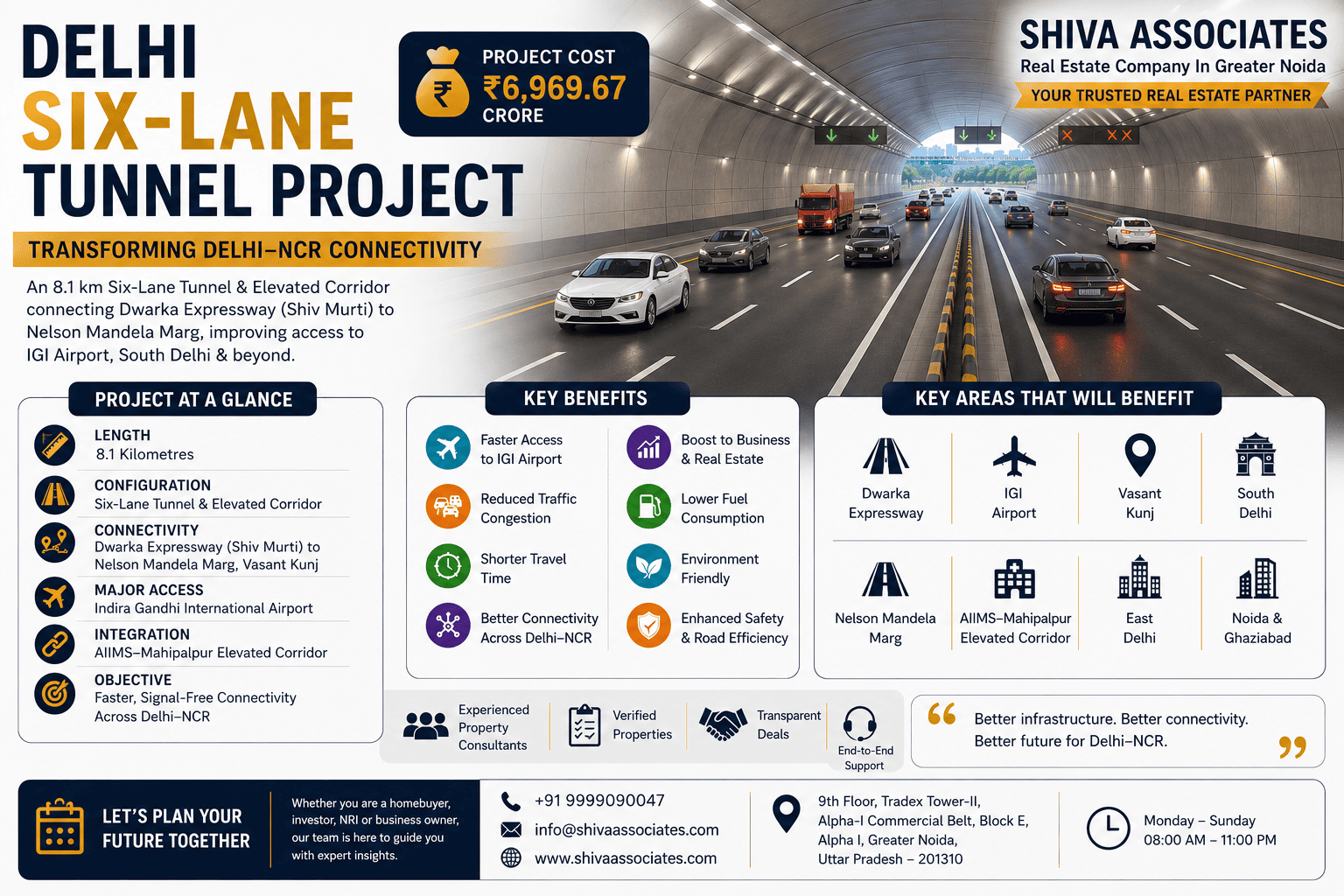
Can better infrastructure change the way millions of people travel every day? The Delhi Six-Lane Tunnel Project could be one of the answers.
Every major city reaches a point where simply widening existing roads is no longer enough. As populations grow and economic activity increases, transportation systems must evolve to meet rising demand.
Delhi-NCR is currently experiencing that transformation.
Over the past decade, the region has seen remarkable infrastructure development. New metro lines have expanded public transport, expressways have shortened travel times, and ambitious projects like the Noida International Airport are redefining regional connectivity. Yet traffic congestion continues to be one of the biggest daily challenges for residents.
One of the latest proposals aimed at solving this problem is the Delhi Six-Lane Tunnel Project—an ambitious initiative that could significantly improve mobility across the National Capital Region.
In this article, we'll explore what the project is, why it matters, and how it could shape the future of transportation in Delhi-NCR.
Why Does Delhi Need Another Major Road Project?
Anyone who regularly travels through Delhi understands how quickly traffic can build up, especially during peak hours.
Routes leading to Indira Gandhi International Airport, South Delhi, Dwarka, Gurgaon, and neighbouring NCR cities often experience heavy congestion.
Long traffic queues don't just waste time—they also increase fuel consumption, delay logistics, and make daily commuting more stressful.
As Delhi continues to grow, improving transportation infrastructure becomes essential rather than optional.
The Delhi Six-Lane Tunnel Project has been planned to address some of these challenges by providing an alternative travel corridor.
What Is the Delhi Six-Lane Tunnel Project?
The project includes an 8.1-kilometre six-lane tunnel and elevated corridor connecting the Dwarka Expressway near Shiv Murti to Nelson Mandela Marg in Vasant Kunj.
The estimated project cost is approximately ₹6,969.67 crore.
Instead of forcing all vehicles onto existing roads, the tunnel creates another high-capacity corridor capable of carrying significant traffic volumes while reducing pressure on surrounding routes.
Although construction of such projects takes time, the long-term objective is simple:
Faster journeys
Better connectivity
Reduced congestion
Improved road safety
More Than Just a Tunnel
At first glance, it may appear to be another road construction project.
In reality, infrastructure like this often has a much broader impact.
Transportation improvements influence:
Business activity
Tourism
Logistics
Employment
Urban expansion
Daily quality of life
Cities around the world have demonstrated that well-designed transportation networks become the backbone of economic development.
Delhi-NCR is following the same path.
Expected Benefits
Faster Daily Commutes
Time is one of our most valuable resources.
If commuters can reduce even 15–20 minutes from their daily travel, the cumulative benefit across millions of people becomes enormous.
The proposed tunnel aims to create a smoother and faster route by reducing delays caused by traffic signals and busy intersections.
Easier Airport Access
The project is expected to strengthen connectivity with Indira Gandhi International Airport.
This is important for:
Business travellers
Tourists
Airport employees
Airlines
Cargo movement
Reliable airport access benefits the entire regional economy.
Better Traffic Distribution
Traffic congestion often occurs because too many vehicles rely on the same roads.
Creating additional transportation corridors distributes traffic more evenly across the network.
This benefits both tunnel users and commuters travelling on nearby surface roads.
Improved Road Safety
Modern tunnels are built with sophisticated engineering systems that enhance safety.
These commonly include:
Intelligent traffic management
CCTV surveillance
Emergency exits
Fire protection systems
Ventilation systems
LED lighting
Digital traffic information
Such features improve both operational efficiency and driver confidence.
Infrastructure Is Changing Delhi-NCR
The Delhi Six-Lane Tunnel is just one part of a much larger transformation.
Several significant projects are reshaping the region, including:
Noida International Airport
Regional Rapid Transit System (RRTS)
Delhi Metro Expansion
Dwarka Expressway
Delhi–Mumbai Expressway
Yamuna Expressway
Eastern Peripheral Expressway
Together, these projects aim to create an integrated transportation network connecting major cities across the National Capital Region.
How Infrastructure Influences Cities
Infrastructure doesn't simply reduce travel time.
It changes how cities function.
Better transportation supports:
Economic growth
Commercial activity
Education
Healthcare
Tourism
Logistics
Regional connectivity
Businesses become easier to reach.
Employees spend less time commuting.
Visitors can move around more efficiently.
All these improvements contribute to a better urban experience.
The Connection Between Infrastructure and Real Estate
One interesting aspect of transportation projects is how they influence surrounding areas.
Improved accessibility often makes locations more attractive for residential and commercial development.
People generally prefer places that offer:
Good road connectivity
Easy airport access
Nearby metro stations
Shorter commute times
Better public infrastructure
While many factors affect property values, transportation remains one of the most important considerations for homebuyers and investors.
Looking Ahead
Large infrastructure projects require years of planning, engineering, and investment.
Although the Delhi Six-Lane Tunnel Project is still a proposal, it represents the direction in which Delhi-NCR is moving—a future built on stronger connectivity and smarter transportation.
As more infrastructure projects become operational, commuting across the region is expected to become faster, safer, and more convenient.
For millions of residents, this means spending less time in traffic and more time where it matters most.
Final Thoughts
The Delhi Six-Lane Tunnel Project is much more than an underground road.
It represents another milestone in Delhi-NCR's continuing journey toward becoming a better-connected metropolitan region.
Combined with projects like the Noida International Airport, RRTS, and Delhi Metro Expansion, the tunnel reflects a long-term vision of improving mobility and supporting sustainable urban growth.
Whether you're a daily commuter, business owner, traveller, or someone interested in infrastructure, this project is certainly worth following in the coming years.
I'd Love to Hear Your Thoughts
Do you think underground road tunnels are an effective solution for reducing traffic in rapidly growing cities?
Have you experienced similar infrastructure projects in your city?
Share your thoughts in the comments—I'd love to hear your perspective.
Learn More
For a more detailed analysis of the Delhi Six-Lane Tunnel Project, including the route, project highlights, estimated investment, and its impact on Delhi-NCR, visit:
Delhi Six-Lane Tunnel: A New Era for Delhi-NCR
https://www.shivaassociates.com/post/delhi-six-lane-tunnel-a-new-era-for-delhi-ncr
You may also like:
Greater Noida Real Estate Guide 2026
https://www.shivaassociates.com/post/greater-noida-real-estate-guide-buy-invest-live
About the Author
Shiva Associates is a trusted real estate company in Greater Noida, helping homebuyers, investors, and NRIs with residential, commercial, industrial, and investment properties across Greater Noida and the Yamuna Expressway.
Website: https://www.shivaassociates.com
Email: info@shivaassociates.com
Phone: +91 9999090047

- Quotation : ✅LINK✅
✅ ➊ You can write comments or thoughts about the above photo here. ➋ Edit the content between the check emojis, and delete the check emojis at the beginning and end. ➌ The check emoji is marked for the purpose of letting users know which part needs to be corrected.✅
- ✅Item 01✅
- ✅Item 02✅
- ✅Item 03✅