Why Understanding the Question Is Half the Solution
Why Understanding the Question Is Half the Solution
Many students begin solving a mathematics problem as soon as they see numbers on the page. Unfortunately, this often leads to unnecessary mistakes.
One of the most important problem-solving skills is taking a moment to understand the question before attempting a solution.
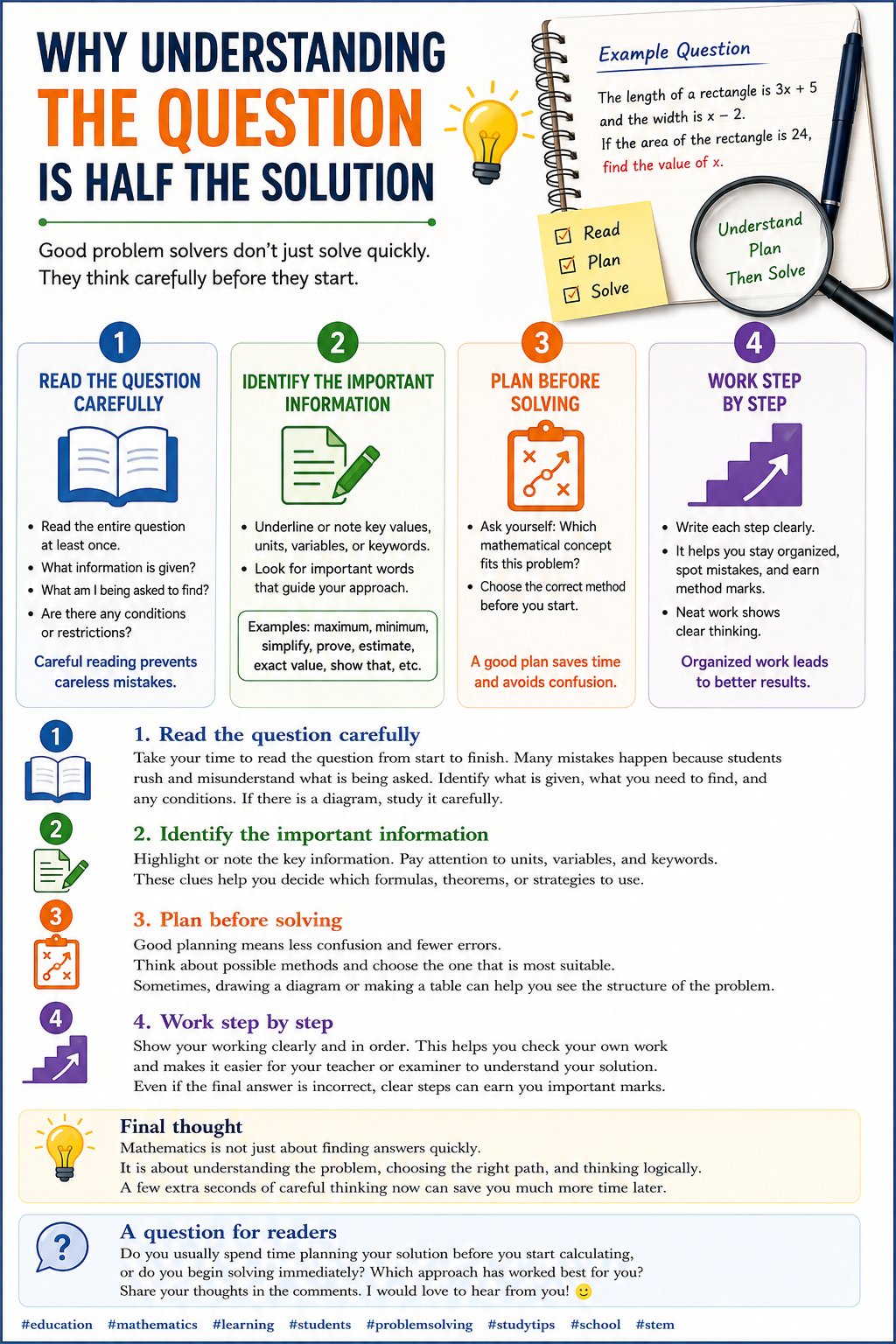
Step 1: Read the question carefully
Read the entire question at least once without picking up your calculator or writing anything down.
Ask yourself:
- What information has been given?
- What am I being asked to find?
- Are there any conditions or restrictions?
A careful reading often prevents careless mistakes.
Step 2: Identify the important information
Underline or note the key values, units, variables, or keywords.
For example, words such as:
- maximum,
- minimum,
- simplify,
- prove,
- estimate,
- exact value,
all suggest different mathematical approaches.
Step 3: Plan before solving
Instead of immediately applying the first formula that comes to mind, pause and ask:
“Which mathematical concept fits this problem?”
Choosing the correct method is often more important than performing the calculations quickly.
Step 4: Work step by step
Write each step clearly.
Organized solutions make it easier to:
- spot mistakes,
- explain your reasoning,
- and earn method marks in examinations.
Remember, neat work is not only easier for your teacher or examiner to follow—it also helps you follow your own thinking.
Final thought
Many students believe that mathematics is about finding answers quickly.
In reality, successful problem solvers spend time understanding the question before they begin solving it.
A few extra seconds of careful thinking can save several minutes of correcting mistakes later.
A question for readers
Do you usually spend time planning your solution before you start calculating, or do you begin solving immediately? Which approach has worked best for you?
Thank you for reading.