# AI in Education Isn't Replacing Teachers—It's Changing What Teaching Looks Like
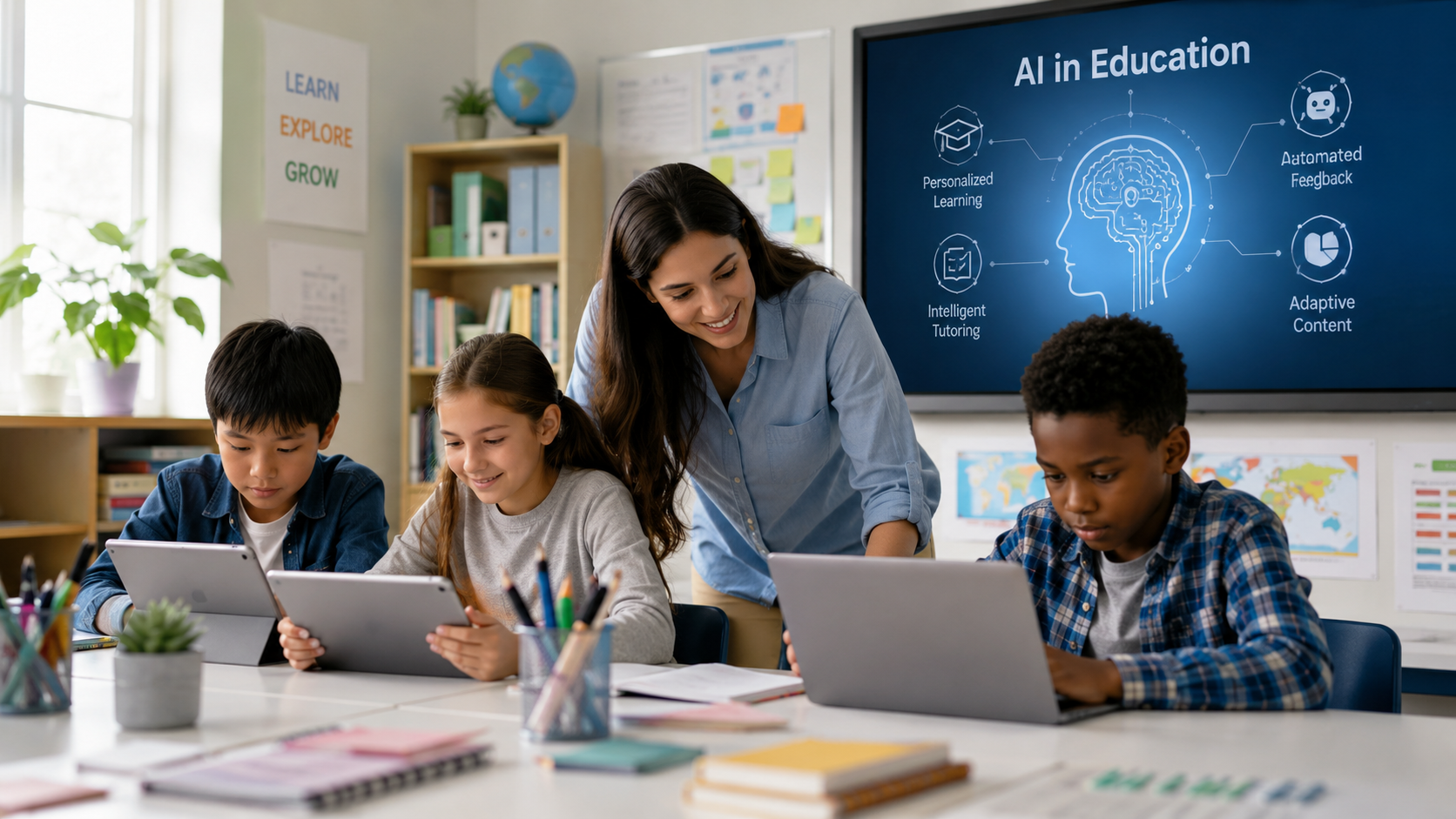
Modern classrooms are using AI to support personalized learning without replacing teachers.
A few years ago, the idea of artificial intelligence in classrooms sounded like science fiction. Today, it's quietly becoming part of everyday learning. Students use AI to understand difficult concepts, teachers rely on it to save time on repetitive tasks, and parents are discovering new ways to support learning at home.
This rapid shift has sparked plenty of debate. Some people worry that AI will make students lazy. Others believe it will replace teachers altogether. The reality is far less dramatic—and far more interesting.
AI isn't changing education by taking over classrooms. It's changing education by making learning more adaptable, more personalized, and, in many cases, more accessible.
Learning Has Never Been One-Size-Fits-All
Every classroom tells the same story.
Some students finish an assignment in ten minutes. Others need thirty. One child learns best by reading, another by watching, and someone else only understands after trying it themselves.
Traditional classrooms have always faced this challenge. A teacher can only divide their attention so many ways during a lesson.
AI doesn't solve every problem, but it can help bridge some of these gaps. Instead of presenting identical material to every learner, AI-powered tools can adjust explanations, generate different practice questions, or recommend additional resources based on a student's progress.
That doesn't mean every student follows a completely different curriculum. It simply means learning can become a little more flexible.
Teachers Gain Time, Not Less Importance
One of the biggest misconceptions about AI is that it exists to replace educators.
Anyone who has spent time in a classroom knows how unrealistic that idea is.
Teaching involves far more than delivering information. Teachers motivate students, notice emotional changes, encourage curiosity, resolve conflicts, and build relationships that technology simply cannot replicate.
Where AI often proves useful is behind the scenes.
Instead of spending hours creating worksheets, organizing lesson materials, or writing multiple versions of the same quiz, teachers can automate some of those repetitive tasks. The time saved can then be invested where it matters most—working directly with students.
In many ways, AI works best as an assistant rather than a replacement.
Personalized Learning Becomes More Practical
For years, educators have talked about personalized learning. The concept sounds wonderful, but implementing it for twenty or thirty students at once has always been difficult.
AI makes personalization more realistic.
Students who master a concept quickly can move on to more challenging work without waiting for the rest of the class.
Students who need additional practice can receive extra examples before frustration builds.
This doesn't eliminate the need for teachers to make instructional decisions. Instead, it gives them better information and more flexibility.
Learning begins to feel less like everyone moving at exactly the same speed and more like everyone moving toward the same destination in their own time.
Students Still Need Critical Thinking
One concern surrounding AI is that students might rely on it too heavily.
It's a valid concern.
If learners simply copy AI-generated answers without understanding them, very little learning actually takes place.
This is why digital literacy has become just as important as traditional literacy.
Students need to learn how to ask thoughtful questions, evaluate AI-generated information, verify facts, and recognize when technology makes mistakes.
Using AI responsibly is becoming a skill in itself.
The goal isn't to avoid AI altogether.
The goal is to learn how to use it wisely.
Education Is Becoming More Accessible
One of the most promising aspects of AI is its ability to support learners with different needs.
Students who struggle with reading may benefit from text-to-speech tools.
Language learners can receive simplified explanations.
Children who need additional practice can generate more exercises without waiting for new materials.
Parents teaching at home can also access resources that were once available only through expensive educational programs.
As these technologies improve, quality educational support becomes easier to access regardless of location.
AI Encourages Experimentation
Teachers have always been creative problem-solvers.
AI simply adds another tool to the toolbox.
Some educators use it to brainstorm lesson ideas.
Others create differentiated activities for mixed-ability classrooms.
Some generate discussion prompts that encourage deeper thinking rather than memorization.
The interesting part is that no two teachers use AI in exactly the same way.
Technology becomes most valuable when it adapts to individual teaching styles instead of forcing everyone into the same workflow.
The Human Side Still Matters Most
No matter how advanced educational technology becomes, students continue to remember the people who believed in them.
They remember the teacher who encouraged them after a poor test.
The parent who patiently explained a difficult concept.
The mentor who inspired confidence.
AI cannot replace empathy.
It cannot recognize the pride in a student's face after solving a difficult problem.
It cannot build trust the way human relationships do.
Education has always been about people first.
Technology simply supports that mission.
Looking Ahead
The future of education will probably include more AI, not less.
Classrooms may become more personalized.
Teachers may spend less time on repetitive administrative work.
Students may have access to learning experiences that adjust to their individual needs.
But none of these changes remove the importance of human guidance.
Instead, they allow teachers to focus more on mentoring, coaching, and inspiring learners while technology handles some of the routine work in the background.
Even newer educational platforms, including tools like Brainator that generate learning materials with AI assistance, reflect this broader trend toward making educational resources more adaptable rather than replacing the role of educators.
Perhaps the most important question isn't whether AI belongs in education.
It's how we can use it thoughtfully—so that technology helps every learner grow while keeping curiosity, creativity, and human connection at the center of the classroom.