Salt is Good …
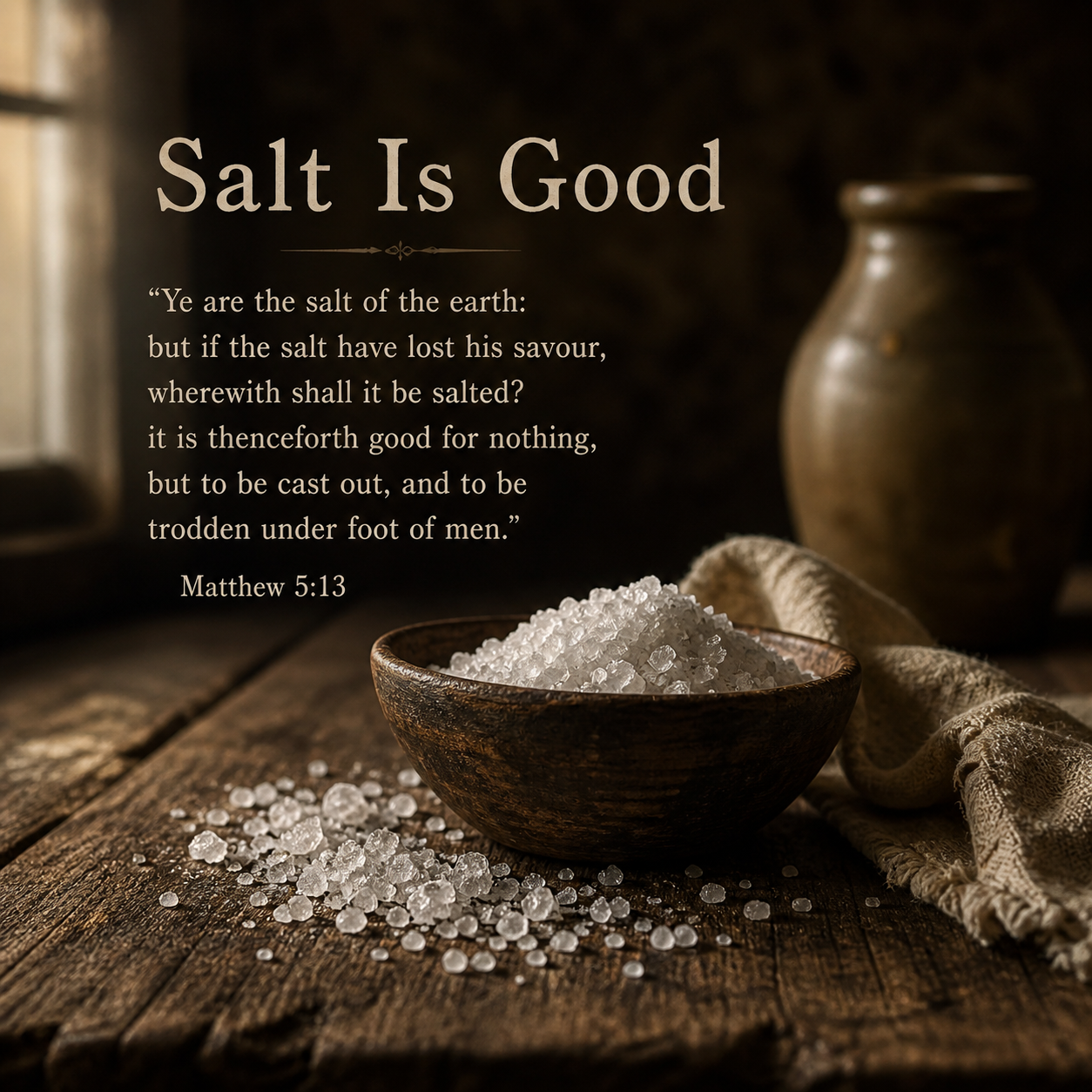
“Salt Is Good”
I remember sitting in a doctor’s office with my mother years ago. Her blood pressure was dangerously high—well over 170—and her nose would not stop bleeding. The doctor looked at her and said plainly, “You’ve got to cut out the salt. And for heaven’s sake, quit smoking—or get another doctor.”
Now my mother had her own way of seeing things. She loved those canned soups—Campbell’s, Progresso—and she used to say, “If it doesn’t sting your mouth, it’s not salty enough.”
She quit smoking that day.
The salt… well, that took time.
But as I sat there listening, a thought crossed my mind: the Bible says, “Salt is good…” (Luke 14:34). And I knew right then—that was not what Jesus was talking about.
Salt in the Scripture is a remarkable thing. It isn’t a delicate powder it is a grit. It is a jagged, honest mineral that preserves, seasons, and gives flavor where there is none. God even commanded in the Old Testament that every sacrifice be offered with salt—“with all thine offerings thou shalt offer salt” (Leviticus 2:13). It was called the salt of the covenant. It was a sign of something enduring, faithful, and incorruptible. Salt, you see, speaks of purity, preservation, and a refusal to decay.
Then the Lord Jesus looks at His disciples and says: “Ye are the salt of the earth…” (Matthew 5:13). Not the sugar. Not the honey. He didn't call us to be the "syrup" of the world, coating things in a sticky, artificial sweetness. He called us to be salt. A sharp, distinct presence in a world that is otherwise bland and rotting.
But then comes the warning: “…if the salt have lost his savour, wherewith shall it be salted? it is thenceforth good for nothing…”
Now that’s a strange statement. In the ancient world, salt wasn't always refined. It was often dug out of the earth—grey, rocky, and mixed with lime. If the actual salt mineral leached out, all that was left was a dusty, useless grit. It was still called salt, but its useful strength was gone, it had become so mixed, so diluted, and so contaminated by the earth around it that its presence could no longer be detected.
For example ,salt left open to the rain may still leave a white crust behind, but the strength has run out of it. It has the look of salt without the bite of salt.
It was still there—but it had no effect. No flavor. No preservation. No distinction.
And then the Lord says something even more sobering: “…but to be cast out, and to be trodden under foot of men.” Think of the irony. Salt is meant for the table, the place of fellowship, or the altar, the place of sacrifice. But once it loses its "sting," it is moved from the holy to the profane. It is thrown onto the pathways to be trampled and discarded.
And here’s the striking part—even when salt is no longer good for seasoning, it still has power. It can sterilize the ground. It can kill what it touches and make the earth barren.
That’ll preach. Because a life that has lost its distinctiveness for God does not become neutral. It doesn't just become "nice." It becomes ineffective at best… and harmful at worst. A church that tries too hard to blend in often ends up poisoning the very ground it was meant to preserve.
Think of Lot’s wife. She was turned to a pillar of salt—a monument not of preservation, but of looking back. A heart divided. She became a statue of "almost," a life that lost its forward direction because she was still rooted in the very world that was being judged.
And yet, salt is still called good. Not because of what it is by itself—but because of what it does when it is pure.
The question isn’t: “Are we salt?” If you belong to Christ—you are.
The question is:
Are we still distinct? Or have we leached into the soil around us? Are we still effective? Or have we traded our "sting" for a seat at the world's table?
Can our presence be tasted? Or have we become part of the fog?
In a world that is growing darker, more corrupt, and more confused, God has not called His people to disappear. He has called them to preserve, to season, and to stand.
“Salt is good…” May it be said of us—not only that we are salt by name, but that we still have our savour.