How Small Aquaculture Farms Can Produce Floating Feed More Efficiently
Aquaculture does not always begin with a large commercial farm. Many fish farming businesses start with a relatively small number of ponds or tanks and gradually expand as market demand increases. During the early stages, purchasing finished feed may seem like the simplest option. However, as feed consumption increases, producing feed on the farm can become an attractive way to gain greater control over formulation, pellet size, and production schedules.
Floating fish feed is particularly suitable for farms that want to monitor feeding activity. Because the pellets remain visible on the water surface, farmers can observe how actively fish are feeding and adjust the quantity accordingly.
For small producers, the main challenge is finding equipment that matches actual production requirements without creating unnecessary investment. A compact small floating fish feed extruder
small floating fish feed extruder can provide a practical starting point when the farm needs to produce floating pellets on a limited scale.
The most suitable system depends on the fish species, feed formula, desired pellet size, daily feed consumption, available raw materials, and future expansion plans.
Why Do Small Fish Farms Consider Producing Their Own Feed?
Feed is one of the largest recurring expenses in aquaculture.
When a farm purchases all feed from outside suppliers, it has limited control over formulation and pricing.
Producing feed internally can provide several potential advantages.
Farmers may be able to:
- Use locally available ingredients
- Adjust formulas according to fish growth stages
- Produce different pellet sizes
- Control production schedules
- Reduce dependence on outside suppliers
- Experiment with new feed formulas
However, producing feed internally also requires investment in machinery, raw materials, electricity, labor, maintenance, and storage.
Therefore, the decision should be based on actual feed consumption rather than simply the desire to own a machine.
What Is Floating Fish Feed?
Floating fish feed is designed to remain on the water surface for a certain period.
This characteristic provides a major advantage for farmers because the feeding process is easier to observe.
Farmers can see whether fish are actively consuming the feed.
If the fish stop feeding, the operator can stop adding pellets.
This can help reduce unnecessary feed waste.
Floating feed is commonly used for species such as tilapia, carp, catfish, and various other farmed fish.
The exact formulation and pellet size should be adjusted according to the nutritional and physical requirements of each species.
What Raw Materials Can Small Farms Use?
A floating fish feed formula can contain different combinations of raw materials.
Common ingredients include:
- Corn
- Wheat
- Soybean meal
- Fish meal
- Rice bran
- Wheat bran
- Rapeseed meal
- Protein concentrates
- Fish oil
- Vitamin premixes
- Mineral premixes
The exact formula depends on the target fish.
Some farms may have access to locally produced agricultural materials.
Using local ingredients can potentially reduce transportation costs and improve supply flexibility.
However, raw material quality must remain consistent.
Ingredients with excessive moisture, contamination, or inconsistent particle size can make extrusion more difficult.
Why Is Raw Material Preparation Important?
Extrusion works best when the raw materials have been properly prepared.
Large particles should generally be reduced in size before mixing.
A hammer mill can be used to grind grains and other suitable ingredients.
Particle size influences mixing uniformity and extrusion performance.
If particles are too large, they may not be processed evenly.
If materials are excessively fine, grinding energy consumption can increase.
The correct particle size should be determined according to the formula and target pellet diameter.
How Does Mixing Affect Feed Quality?
After grinding, the ingredients need to be mixed.
A mixer distributes different materials throughout the batch.
This is particularly important when small quantities of vitamins, minerals, or additives are included.
A uniform mixture helps ensure that the nutritional composition of individual pellets remains consistent.
The mixer should also have sufficient capacity to supply the extruder continuously.
If the mixing process is too slow, the extrusion machine may need to stop and wait.
This can reduce the actual production efficiency of the entire system.
How Does Extrusion Produce Floating Pellets?
Extrusion uses mechanical energy, heat, moisture, and pressure to process feed ingredients.
The prepared mixture enters the extrusion chamber and is moved forward by the screw.
As the material moves through the machine, pressure and temperature increase.
Starch and other components undergo structural changes.
When the processed material exits the die, the pressure suddenly decreases.
Water vapor expands and creates a porous internal structure.
This reduces the density of the pellet and allows it to float.
The degree of expansion depends on the formula and extrusion conditions.
What Determines Floating Performance?
Several factors influence whether a pellet floats effectively.
These include:
- Starch content
- Moisture level
- Temperature
- Pressure
- Screw configuration
- Die design
- Formula composition
- Pellet density
Higher expansion generally creates lower-density pellets.
However, excessive expansion is not always desirable.
Pellets also need sufficient structural strength and water stability.
The objective is to create feed with a suitable balance between floating ability, hardness, density, and nutritional characteristics.
What Is the Role of the Extruder?
The extruder is the core forming machine in a floating fish feed production system.
For small farms, equipment selection should focus on actual daily feed demand.
A machine with excessive capacity may increase the initial investment without providing a meaningful benefit.
A machine with insufficient capacity can become a production bottleneck.
Therefore, buyers should estimate daily and monthly feed consumption before selecting an extruder.
Can a Dry Extruder Be Used for Floating Feed?
Yes, depending on the formulation and required product characteristics.
For producers interested in producing dense aquatic feed, sinking fish feed pellet machine price
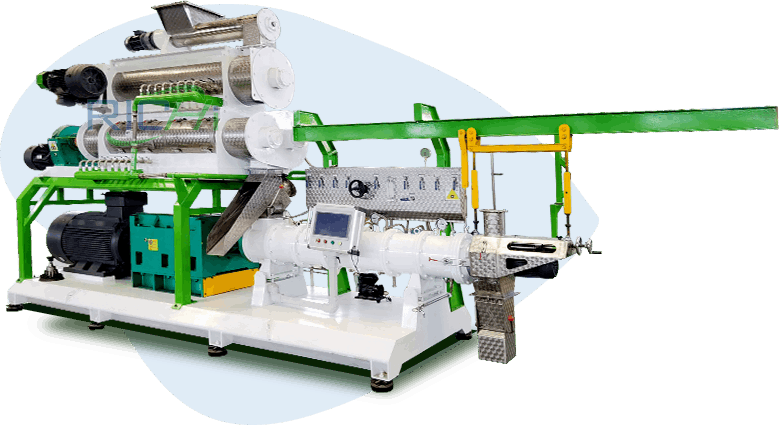
sinking fish feed pellet machine price is another important consideration, particularly when comparing conventional pelletizing systems for sinking feed applications.
Dry extrusion can reduce the complexity of the production system because it may not require the same steam-conditioning arrangement used in some wet extrusion processes.
However, the suitability of dry extrusion depends on the actual formula.
Manufacturers should evaluate raw material properties, desired expansion, moisture, pellet size, and production capacity before choosing the equipment.
What Pellet Sizes Can Be Produced?
Fish require different pellet sizes at different growth stages.
Fry and juvenile fish generally consume smaller particles.
Larger fish require larger pellets.
The die determines the basic diameter of the extruded product.
By changing dies, the same extruder can often produce different pellet sizes.
The cutting system controls pellet length.
A small farm producing feed for several growth stages should consider whether the selected machine can conveniently accommodate different dies.
How Does Drying Affect Floating Feed?
Freshly extruded pellets normally contain more moisture than is suitable for long-term storage.
A drying system reduces moisture to the desired level.
Drying must be carefully controlled.
Excessive drying can increase energy consumption and potentially affect product characteristics.
Insufficient drying can reduce storage stability.
The dryer should therefore be matched to the extruder capacity.
For small farms, a compact drying system may be sufficient.
There is usually no need to install an industrial-scale dryer if the farm only produces a limited amount of feed.
Why Is Cooling Necessary?
After drying, the pellets remain warm.
Cooling reduces their temperature before screening and packaging.
This is important because hot pellets should not normally be packaged immediately under conditions where condensation could become a problem.
A suitable cooling process helps stabilize the finished feed.
Small farms may use compact cooling equipment, while larger commercial facilities generally require continuous cooling systems with higher capacity.
What Is the Purpose of Screening?
Screening removes fines and oversized pellets.
A uniform final product is easier to package and distribute.
It also provides a more consistent feeding experience.
Fines can sometimes be recycled into the production process.
This reduces material waste.
For small-scale operations, the screening system can be relatively simple.
The required equipment should be selected according to the production volume and target pellet size.
Is Oil Coating Necessary?
Not every floating fish feed formula requires oil coating.
However, oil may be added to increase energy density or provide specific nutritional benefits.
Some manufacturers apply oil after drying.
A coating system can distribute the oil evenly across the pellet surface.
The amount of oil should be controlled carefully.
Excessive surface oil can influence pellet handling and storage.
Whether a small farm needs an automatic coating machine depends on its formula and production requirements.
How Can Small Farms Control Equipment Investment?
Investment control is one of the most important considerations for small producers.
A basic floating feed system may include:
- Raw material grinder
- Mixer
- Extruder
- Cutter
- Dryer
- Cooler
- Screen
- Packaging equipment
However, not every farm needs a fully automated configuration.
Packaging can initially be performed manually.
Raw materials can be stored in smaller quantities.
Automatic batching can be added later.
This allows the farm to focus investment on the equipment that directly affects feed production.
Is a Pellet Mill an Alternative to an Extruder?
A conventional pellet mill can produce compressed feed pellets, but it works differently from an extruder.
A pellet mill relies primarily on mechanical compression through a die.
Extrusion uses additional heat, moisture, and pressure and can create expanded products with lower density.
For floating feed, extrusion is generally more suitable when the product requires controlled expansion and low density.
Nevertheless, pellet press technology may be suitable for other feed applications where dense compressed pellets are preferred.
The choice should therefore be based on the required final product rather than simply comparing machine prices.
How Important Is Formula Design?
The formula has a major influence on extrusion performance.
Starch-containing ingredients can contribute to expansion.
Protein and fiber levels also affect processing characteristics.
A formula that performs well in one extruder may behave differently in another machine.
This is why manufacturers should provide detailed ingredient information when requesting equipment recommendations.
A suitable machine should be selected based on the actual formula rather than a generic feed category.
How Does Production Capacity Affect the Choice?
Capacity should be calculated from real feed consumption.
Suppose a farm consumes 300 kg of feed per day.
Purchasing a machine designed to produce several tons per hour may not provide an economic advantage.
The machine would operate for only a very short period each day while still requiring a relatively large investment.
A compact machine may be more appropriate.
On the other hand, if the farm plans to supply feed to neighboring farms, higher capacity may eventually become necessary.
Future business development should therefore be considered.
Can Small Farms Automate Their Production?
Yes, but automation should be introduced gradually.
A small farm can begin with manually operated equipment.
As production grows, the farm can add:
- Automatic feeders
- Batch weighing
- Automatic conveyors
- Centralized control
- Automatic packaging
This modular approach provides flexibility.
It also reduces the risk of investing heavily in equipment before the market has been established.
What Maintenance Is Required?
Even compact extrusion equipment requires regular maintenance.
Operators should inspect:
- Screws
- Dies
- Cutting knives
- Bearings
- Gearboxes
- Motors
- Feeders
- Heating components
Wear parts should be checked regularly.
Cleaning is especially important when changing formulas.
Residual material from one feed formula can contaminate another product if the equipment is not cleaned properly.
Keeping commonly used spare parts available can also reduce downtime.
What About Electricity Requirements?
Energy consumption depends on the machine size and operating conditions.
Grinding, extrusion, drying, conveying, and cooling all consume energy.
Drying can be particularly significant if the material enters the process with high moisture.
Small farms should therefore consider local electricity prices and available heat sources.
The cheapest machine to purchase is not always the cheapest machine to operate.
Energy efficiency should be considered over the expected service life of the equipment.
How Should Buyers Compare Suppliers?
Buyers should ask suppliers to provide detailed technical information.
Important questions include:
- What is the actual capacity?
- What raw materials can be processed?
- What pellet sizes can be produced?
- What motor power is required?
- What auxiliary equipment is included?
- What is the expected moisture after drying?
- What spare parts are required?
- Is installation support available?
Buyers should also clarify whether the quoted capacity is based on actual testing.
This can prevent unrealistic expectations after installation.
Why Is Testing Valuable?
Raw materials differ significantly.
Two soybean meals may have different characteristics.
Different wheat varieties can also behave differently during extrusion.
Testing helps determine suitable operating conditions.
It can evaluate:
- Expansion
- Floating time
- Pellet density
- Moisture
- Water stability
- Pellet hardness
- Output
For new feed formulas, testing can be particularly useful before investing in a complete production system.
How Can a Small Farm Prepare for Future Growth?
A farm may begin with a compact production system and gradually expand.
The factory layout should therefore allow room for additional equipment.
Electrical capacity can also be considered in advance.
Storage areas can be designed so that additional raw materials and finished products can be accommodated later.
For example, a farm might initially use manual packaging and later install automatic weighing and bagging.
This approach allows capital investment to follow business growth.
Why Is Equipment Integration Important?
Even a small production line should be designed as a complete system.
The grinder should supply enough material to the mixer.
The mixer should keep pace with the extruder.
The extruder should match the dryer.
The dryer should match the cooler.
The screening and packaging sections should be capable of handling the finished output.
If one machine is significantly smaller than the others, it can become a bottleneck.
Good equipment matching therefore improves the efficiency of the entire system.
What Should a New Buyer Prepare?
Before contacting an equipment supplier, a buyer should prepare several basic details.
These include:
- Fish species
- Number of fish or ponds
- Daily feed consumption
- Feed formula
- Raw materials
- Target pellet size
- Floating requirements
- Desired production capacity
- Available factory space
- Electricity conditions
The more accurate the information, the more practical the equipment recommendation can be.
Buyers can also go to website resources covering aquatic feed machinery to compare different processing technologies and understand how complete feed production systems are configured.
Conclusion
Small aquaculture farms do not necessarily need large industrial feed factories.
A properly selected extrusion system can provide an efficient way to produce floating feed according to the farm's own requirements.
The most important factors are not simply machine size or purchase price.
Raw material characteristics, feed formula, pellet size, floating performance, daily consumption, drying requirements, energy costs, and future expansion should all be considered.
A compact and modular production system can be particularly useful for new or growing farms.
The producer can begin with essential processing equipment and gradually add automation and packaging systems as production increases.
Before purchasing machinery, it is advisable to define the desired feed product and calculate realistic production requirements.
With the right equipment configuration, small aquaculture businesses can gain greater control over feed production, reduce dependence on external suppliers, and develop a more flexible feeding strategy for different fish growth stages.