Why the Dollar Keeps Winning, Even When the Crisis Driving It Up Is Bad News for Everyone
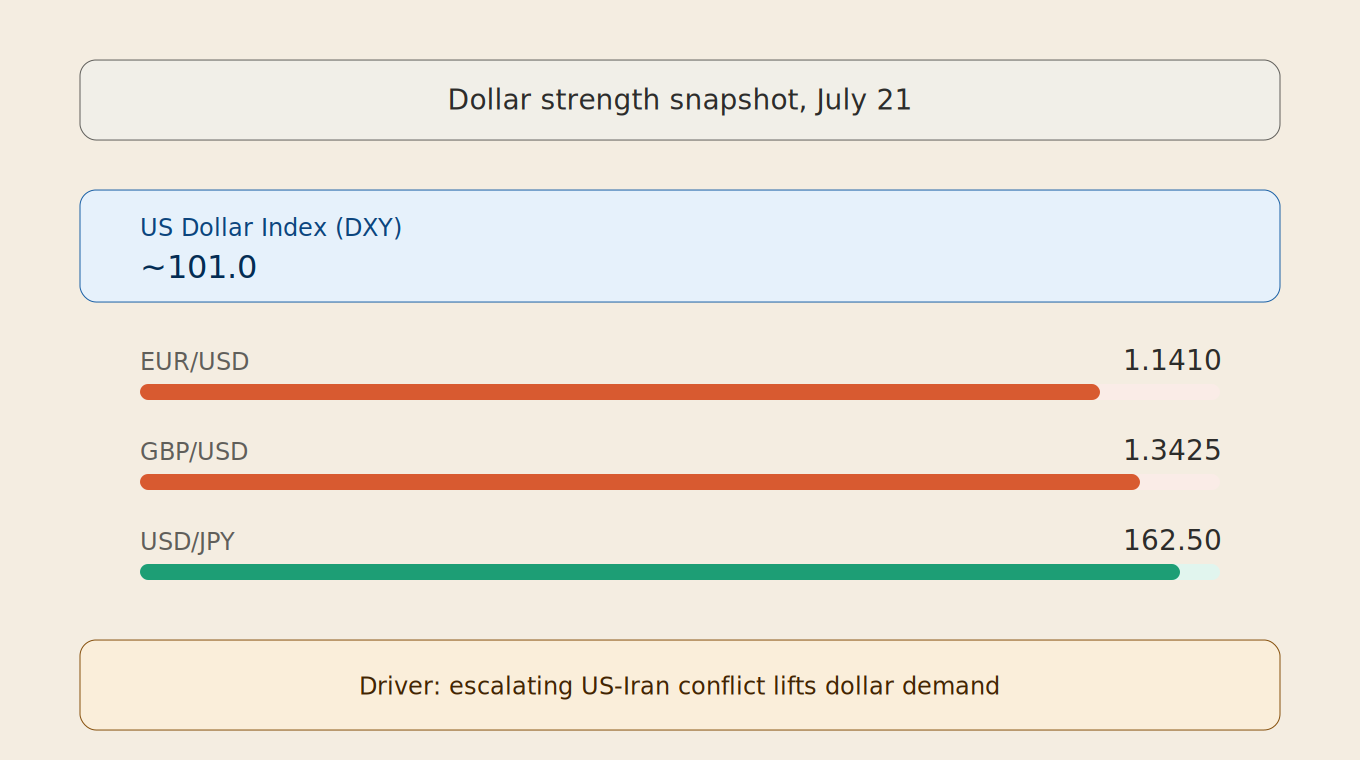
Forex markets are in the middle of a real-time lesson on how safe-haven flows actually work. As of Tuesday, July 21, the U.S. Dollar Index is holding firm near the 101 level, and nearly every major currency pair is bending the same direction: toward dollar strength.
EUR/USD eased to around 1.1410 in early Asian trading, with the euro slipping toward the key 1.1400 support zone.
GBP/USD dipped modestly toward 1.3420–1.3430, testing multi-day lows.
USD/JPY edged higher toward 162.50, keeping the yen under pressure despite Japan's Finance Ministry repeating it stands ready to intervene if needed.
What's Actually Driving This
The trigger is the escalating conflict between the U.S. and Iran. The U.S. has now carried out a 10th round of strikes on Iranian targets, hitting military command centers, air defense systems, and missile launch sites. Iran retaliated by striking Bahrain and Kuwait and attacking tankers in the Strait of Hormuz, while Yemen's Houthi rebels declared a maritime blockade of Saudi Arabia.
Question: If the U.S. is directly involved in the conflict, why does the dollar keep strengthening instead of weakening?
This is the part every new forex trader gets backwards. The instinct is to assume a country involved in an active conflict should see its currency weaken. But the dollar's role in the global system flips that logic:
The dollar is the world's default safe haven, not just America's currency. When geopolitical risk rises anywhere, global capital tends to flow into U.S. Treasuries and dollar-denominated assets, regardless of whether the U.S. is a party to the conflict. Fear drives capital toward perceived safety, and that safety is still priced in dollars.
Rising oil prices cut both ways, but the market is pricing the inflation side harder. The closure risk around the Strait of Hormuz has pushed crude to fresh highs, which normally would hurt the dollar through inflation concerns. But right now, that same inflation fear is reinforcing expectations that the Fed will need to stay hawkish — and higher-for-longer U.S. rates make the dollar more attractive to hold, not less.
Other currencies have their own separate problems layered on top. The yen is weak partly because of the same rate differential story — Japanese rates remain far below U.S. rates, so capital keeps flowing out of yen into higher-yielding dollar assets, conflict or no conflict.
The Global Ripple Effect
This isn't isolated to G7 currencies either. South Korea's president recently flagged concern about USD/KRW hovering in the 1,500–1,600 range, criticizing how leveraged products have amplified stock market volatility — a sign that dollar strength is now pressuring emerging-market currencies too, not just the euro and pound.
Question: Is there any limit to this dollar strength?
Yes — and it's worth watching. Cooling U.S. inflation data has been cited as a factor that could limit how much further the Fed tightens, which would cap the dollar's gains. Some analysts, including Natixis, have even projected the Dollar Index retreating toward the 98 level by year-end if the current rally loses momentum. In other words, the dollar's strength right now is a function of today's fear and rate expectations — not a permanent state.
Takeaway for Learners
The single most important lesson in forex trading is this: currencies don't move based on which country "looks stronger" in a conflict — they move based on where global capital feels safest and where interest rates are most attractive. Right now, both of those signals point to the dollar, even though the U.S. is an active party in the very conflict driving the fear. Learn to separate "who is involved" from "where does capital flee to," and a huge amount of forex price action stops looking confusing.
Let's learn together!