The first trans-Neptunian object other than Pluto confirmed to have an atmosphere.
in Popular STEMyesterday

The first trans-Neptunian object other than Pluto confirmed to have an atmosphere.


Souce


In popular science, we usually say that beyond Neptune there are comets and cometary objects; a comet itself is an activity, an action—it’s what happens to an icy object when it approaches a star, when it begins to heat up and undergoes cometary reactions or processes. but if we were to travel beyond Neptune and approach those objects, we wouldn’t be able to tell them apart from a normal asteroid. That said, if we were to land on one, we’d realize it’s made of icy elements—water—but also lots of gases, carbon, and everything else.


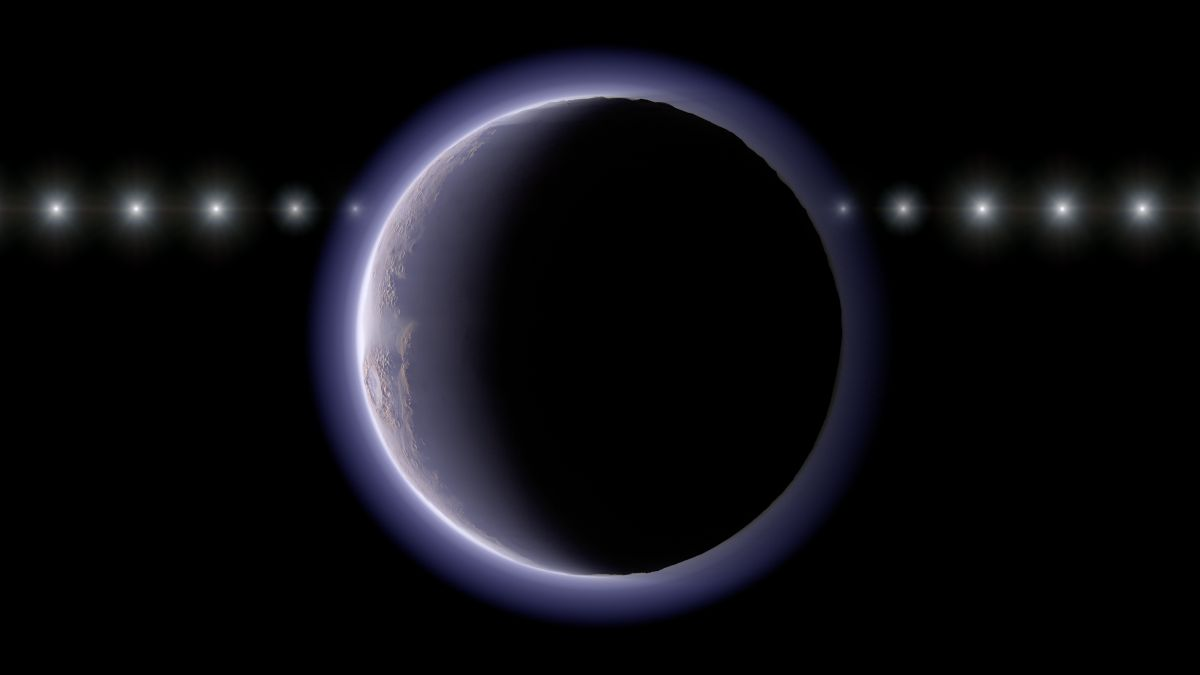
And there is one that would fall into the Plutino category: Plutino 2002 XV93. From its name, you can tell it has been known since 2002. It is very small, about 500 km in diameter. It turns out that on May 4th or 5th, I think on May 5th—sorry—it was published in Nature Astronomy that professional astronomers, along with an amateur astronomer who collaborated on this research, had detected that this Plutino had an atmosphere—in fact, it is the first trans-Neptunian object other than Pluto confirmed to have an atmosphere.


It is called a Plutino because its orbit is at a similar distance to Pluto’s and it has orbital characteristics similar to Pluto’s; there are several of these objects classified as Plutinos. The question is how they detected that such a small object, only 500 km in diameter, has an atmosphere. In January 2004, these researchers, along with an amateur astronomer, observed a stellar occultation, The object passed in front of a distant star, and instead of the star’s light suddenly being blocked by the object’s disk, they observed a gradual dimming both before and after the object passed in front of the star.


This suggests that the light was refracted as it passed through a thin layer of gas; it is estimated that this object’s atmosphere is very thin, and it would not be breathable not only because it lacks oxygen, but also because it is extremely thin—somewhere between 5 and 10 million times thinner than Earth’s atmosphere. even so, it could give rise to faint nebulae, and yet it is very puzzling because it is such a small object. There are giant moons like Jupiter’s giant moons, Ganymede or Callisto; the question is where that atmosphere comes from. Right now it is a mystery—but a mystery because it baffles scientists.


With so little gravity, the gases should either freeze—because it is very far away and in a very cold part of the solar system—or escape rapidly into space; in fact, they calculated that this object should have lost its atmosphere in less than 1,000 years, so there must be a process that replenishes the atmosphere of this small Plutino; it is believed that it might have cryovolcanoes, but so far away and with cryovolcanic activity, it’s complicated. A cryovolcano is a volcano that expels ice and gas from its interior, but it needs heat in some form—internal heat, not external. Something has to heat what’s inside that small object, which is only 500 km in diameter, in order to expel what’s inside—in the form of ice and gas—from its interior, if you’ll pardon the redundancy.


In the case of Pluto, which is much larger than this Plutino and also has Charon, which exerts certain gravitational forces that can trap some heat within Pluto, but in this case it remains a mystery; we don’t know—it’s an unknown. What could be causing this atmosphere? This also suggests that other larger objects might also have their own atmospheres; all these small worlds will ultimately turn out to be very interesting and very dynamic.


The images without reference were created with AI
Thank you for visiting my blog. If you like posts about #science, #planet, #politics, #rights #crypto, #traveling and discovering secrets and beauties of the #universe, feel free to Follow me as these are the topics I write about the most. Have a wonderful day and stay on this great platform :) :)


! The truth will set us free and science is the one that is closest to the truth!


Sort:  

Congratulations!

Your post has been selected and upvoted by the SteemPro Team 🚀

Explore more on SteemPro:
🌐 https://www.steempro.com
🎮 Play SteemHeights: https://www.steempro.com/games/steem-heights
💬 Join our Discord: https://discord.gg/Bsf98vMg6U

💪 Supporting the growth of the Steem ecosystem together.

🟩 Vote for witness faisalamin:
https://steemitwallet.com/~witnesses
https://www.steempro.com/witnesses#faisalamin

steempro-cover-black.png
This is an automated message.