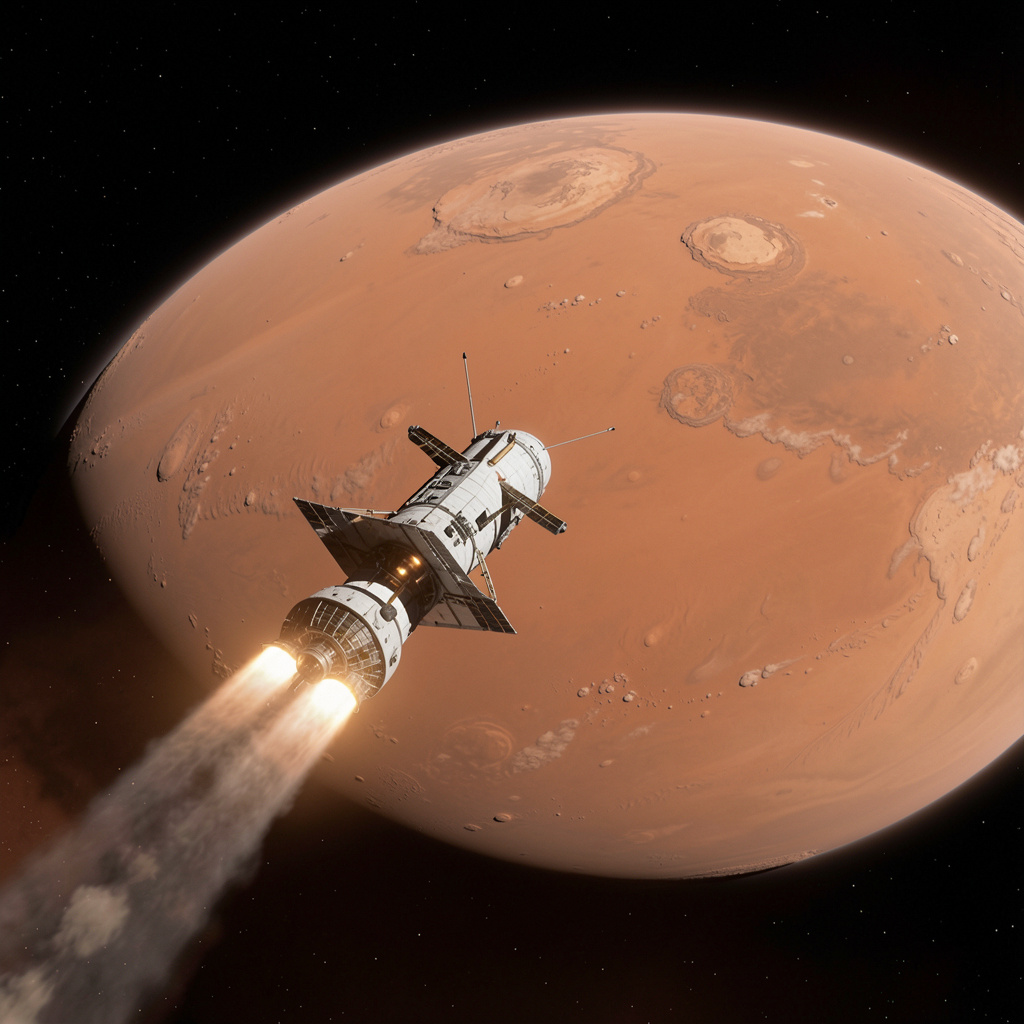
The shortest trip to Mars.

in Popular STEMyesterday

The shortest trip to Mars.


The Brazilian cosmologist Marcelo de Oliveira Souza, sorry, from the State University of the North of Rio de Janeiro, was looking for asteroids close to the Earth to evaluate impact risks and studying that topic. In 2015 he was looking for those asteroids and noticed one particular one, 2001 CA21, whose orbital estimates were imprecise, showing a strange trajectory that crossed the orbits of the Earth and Mars with an orbital plane inclined by about 5 degrees.


Oliveira Souza began to object, he realized that this wrong geometry was not that it was wrong in itself, it was not that the data of that geometry of that orbit had been miscalculated, but that the geometry of that particular asteroid contained useful clues to discover a faster trajectory between Earth and Mars, that is, he was looking for possible asteroids that could impact the Earth and discovered a channel, a route to reach Mars more quickly.


And it really is a great route because currently a mission to Mars takes between 7 to 10 months one way with the current technology that we have, because then I will show you a new engine that NASA is developing, with current technology it takes 7 to 10 months only to go to Mars, then you have to stay there and the missions to Mars are expected to last about 3 years, not only because of the issue of the alignment window with that with Mars and the Earth, which occurs every 26 months, but because, it takes 7 or 10 months without arriving, you have to do the corresponding research things on Mars and then you have to return.


So a complete round trip, so far it is expected to last almost 3 years, but if you get into the trajectory, in the geometry that this cosmologist has deduced thanks to studying this curious asteroid, well with this trajectory you could do a mission depending on the year in the launch window of 2031 it could be only 153 total days, not 3 years of mission, but 153 total days. The departure in 33 days, the stay on Mars, to do the corresponding things, 30 days and the return 90 days.


In 2020, in theory, there was a window and an even better trajectory that allowed the trip in just 34 days one way, although it required speeds that at that time and now we also do not have the current technology to achieve them, impulses are needed like the one NASA's New Horizon probe had, but when it had already developed the impulse with its ion engine to reach 16.26 km per second, so to achieve these trajectories the mass of the ship, the moment, is important. That is, the right year to leave and also the propulsion you have, but in short the trip could be shortened instead of 3 years to 153 days and save a brutal amount of fuel.


The calculations are that they do nothing currently, in the 3-year mission, what both NASA and the European Space Agency were studying is that the astronauts did nothing, that they were at rest and that they were lying down, in fact, it was a couple of years ago they asked for volunteers for experiments of lying down for weeks or several months, but your back would have to be ruined, it is horrible, your job would be to lie down and then logically undergo health measurements, etc.


Why would the astronauts have to lie down and do nothing? Well, to begin with because they would consume less oxygen, less food, eh because there would be nothing to do and among the things that would need to be done to at least keep the mind entertained, well, there are video games.


Study Source


The images without reference were created with AI
Thank you for visiting my blog. If you like posts about #science, #planet, #politics, #rights #crypto, #traveling and discovering secrets and beauties of the #universe, feel free to Follow me as these are the topics I write about the most. Have a wonderful day and stay on this great platform :) :)


! The truth will set us free and science is the one that is closest to the truth!


Posted using SteemX